Comparison of volumetric responses to different corticosteroid administration methods in IgG4-related ophthalmic disease
Min Kyu Yang, Seong Jung Ha, Ho-Seok Sa

TL;DR
This study compares how different corticosteroid treatments affect the size of eye-related glands in a specific immune disease, finding that intravenous treatment is more effective than oral treatment.
Contribution
The study provides new evidence that intravenous corticosteroids offer better long-term results than oral ones for treating IgG4-related ophthalmic disease.
Findings
Intravenous methylprednisolone showed higher 2-year radiological relapse-free survival (80%) compared to oral prednisolone (37.5%).
Local triamcinolone injection had the highest relapse-free survival (100%) and comparable volume reduction to intravenous treatment.
Oral prednisolone resulted in significantly higher gland volume ratios post-treatment compared to intravenous and local treatments.
Abstract
To analyze the clinical and volumetric responses to different corticosteroid administration methods for IgG4-related ophthalmic disease (IgG4-ROD). The medical records of patients with bilateral lacrimal gland (LG) enlargement diagnosed with IgG4-ROD through unilateral LG biopsy between January 2011 and January 2022 were retrospectively reviewed. Clinical signs and the non-biopsied LG volume across three administration routes were compared: oral prednisolone (Pd), intravenous (IV) methylprednisolone (methylPd), and local triamcinolone (TA) injection. Radiological relapse was defined as the first instance of failure to satisfy the radiological response criteria, i.e., a post-treatment volume of <1.0 cm3 or a post-treatment to pre-treatment volume ratio of <35%. Among the 28 patients, eight, ten, and ten received oral Pd, IV methylPd, and local TA injection, respectively. No significant…
Genes, proteins, chemicals, diseases, species, mutations and cell lines named across the full text — each resolved to its canonical identifier and authoritative record.
Click any figure to enlarge with its caption.
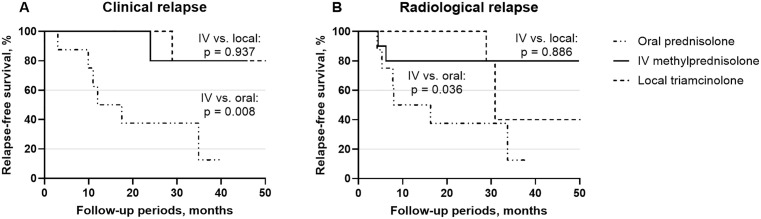 Figure 1
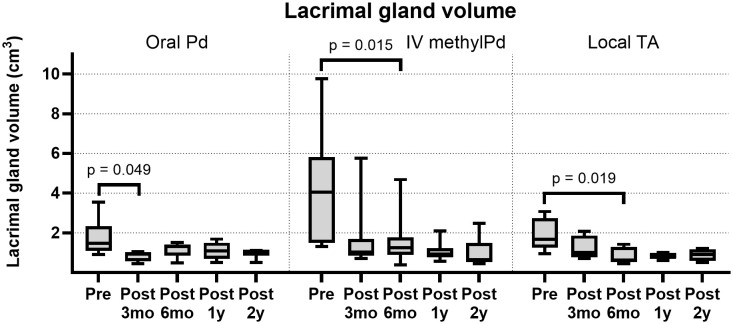 Figure 2
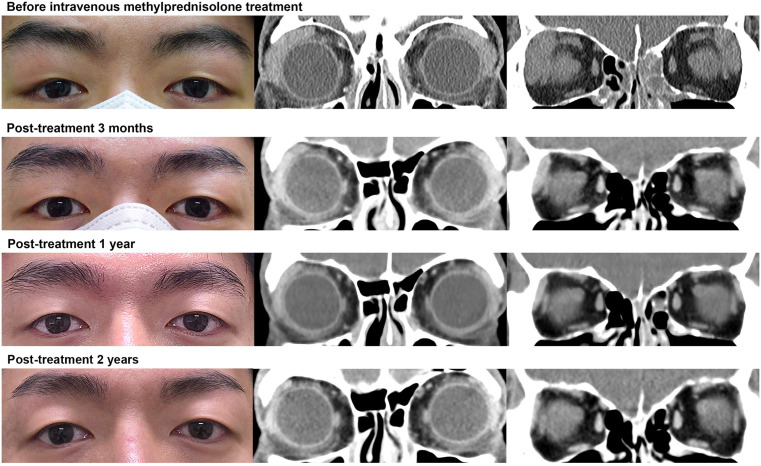 Figure 3
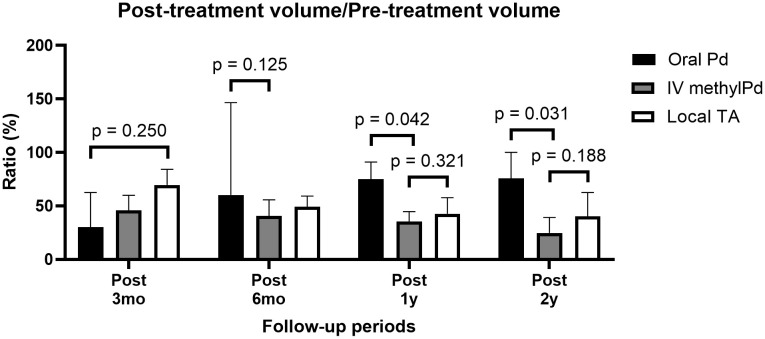 Figure 4
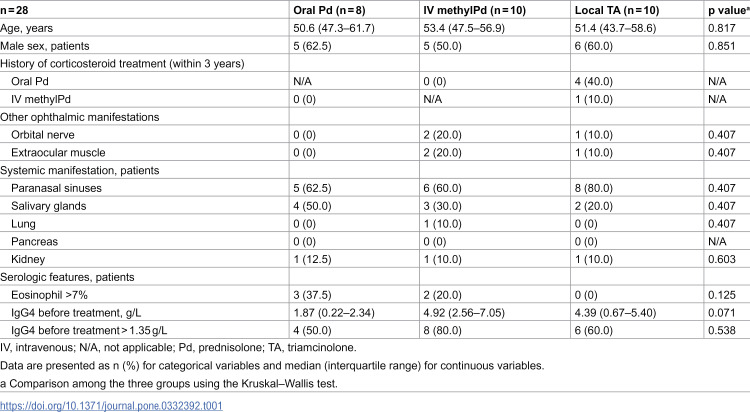 Figure 5
Peer Reviews
No public reviews on file for this paper yet. If you reviewed it on a platform where reviews are public (OpenReview, ICLR, NeurIPS, ICML), you can paste yours below so the community can read it here.
Videos
No videos yet. Explain this paper in a talk, walkthrough, or lecture? Add one.
Taxonomy
TopicsIgG4-Related and Inflammatory Diseases · Nasolacrimal Duct Obstruction Treatments · Ocular Surface and Contact Lens