Adaptable Immunofluorescence Protocol for Muscle Fiber Typing in FFPE Human and Mouse Skeletal Muscle and Intact Mouse Hindlimbs
Connor Thomas, Lainey M. Hibbard, Kenneth E. White, Steven S. Welc

TL;DR
This paper introduces a new immunofluorescence protocol for analyzing muscle fiber types in preserved human and mouse muscle samples, offering a safer and more practical alternative to traditional methods.
Contribution
The study presents a novel adaptable immunofluorescence protocol for muscle fiber typing using FFPE tissue and intact hindlimbs.
Findings
FFPE muscle samples allow for high-throughput fiber type analysis with preserved morphology and spatial architecture.
The protocol simplifies sample handling, storage, and transport compared to traditional frozen tissue methods.
The method is compatible with downstream applications and emerging techniques that prefer FFPE samples.
Abstract
Skeletal muscle fiber type composition affects muscle function, metabolism, and disease vulnerability. In addition, muscle fiber type analysis informs disease diagnosis and underlying pathophysiology. Multiple methodologies can be used to assess muscle fiber type; however, immunofluorescence (IF) for myosin heavy chain (MyHC) isoforms is the most widely used modern approach due to its relative ease, time‐effectiveness, single‐cell resolution, and capacity to preserve spatial positioning within the native tissue architecture. Here, we present a protocol for IF for MyHC labeling on formalin‐fixed paraffin‐embedded (FFPE) mouse and human muscle sections. We then describe a modified procedure for fiber type analysis of the intact mouse lower hindlimb, enabling high‐throughput muscle composition and morphological analysis across distinct muscles on a single tissue section. Traditionally, IF…
Genes, proteins, chemicals, diseases, species, mutations and cell lines named across the full text — each resolved to its canonical identifier and authoritative record.
Click any figure to enlarge with its caption.
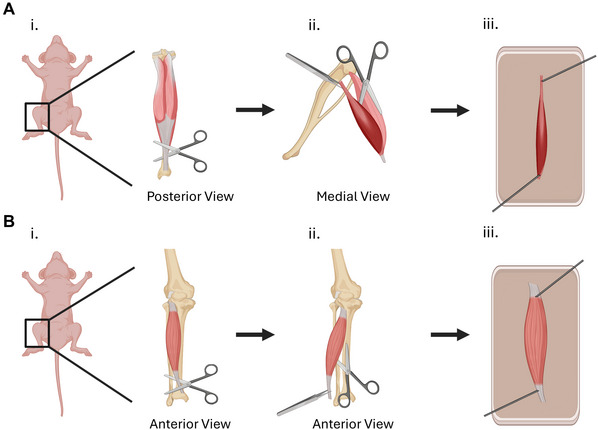 Figure 1
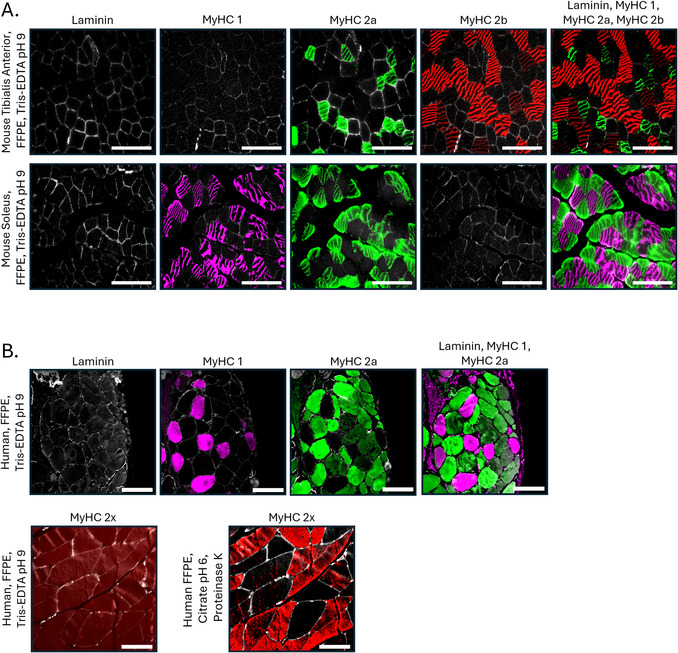 Figure 2
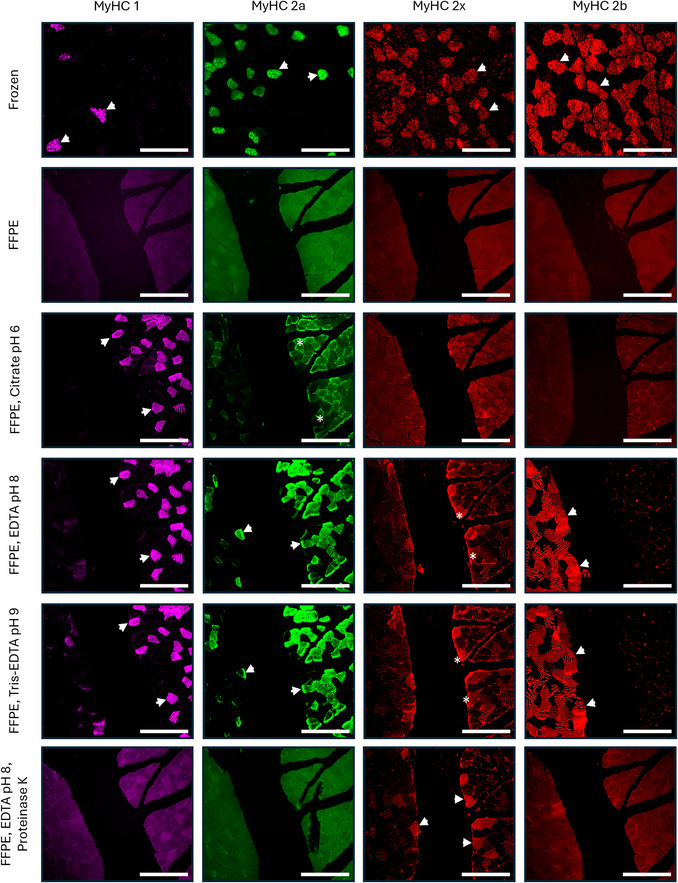 Figure 3
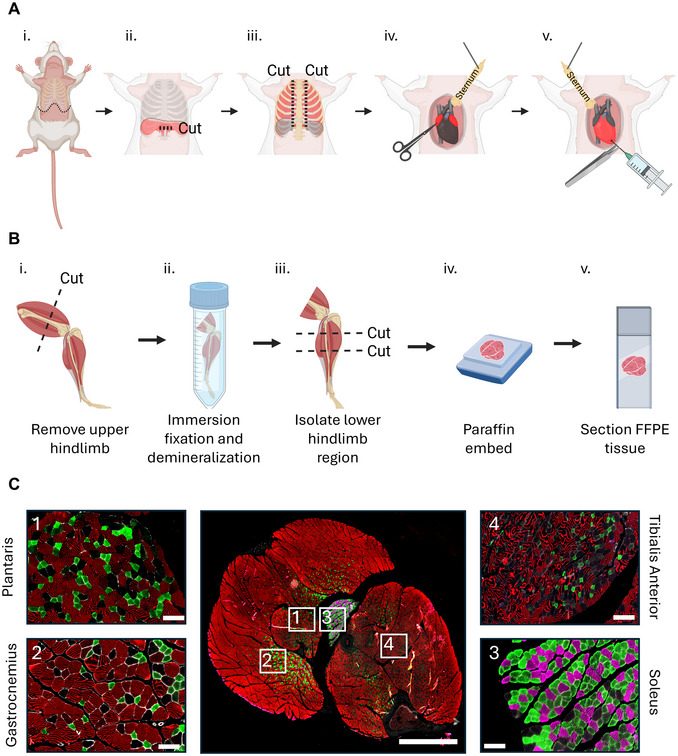 Figure 4
Peer Reviews
No public reviews on file for this paper yet. If you reviewed it on a platform where reviews are public (OpenReview, ICLR, NeurIPS, ICML), you can paste yours below so the community can read it here.
Videos
No videos yet. Explain this paper in a talk, walkthrough, or lecture? Add one.
Taxonomy
TopicsMuscle Physiology and Disorders · Cardiomyopathy and Myosin Studies · Molecular Biology Techniques and Applications