Hydrogen‐Deuterium Exchange Defines Ligand‐Induced Conformational Changes to the Class III Biotin Protein Ligase from Saccharomyces cerevisiae
Louise M. Sternicki, Tara L. Pukala, Kamila J. Pacholarz, Perdita Barran, Grant W. Booker, Steven W. Polyak, Kate L. Wegener

TL;DR
This study uses hydrogen-deuterium exchange mass spectrometry to validate the structure of a yeast biotin protein ligase and shows how ligand binding affects its shape.
Contribution
The study provides the first structural insights into a eukaryotic class III BPL and reveals ligand-induced conformational changes.
Findings
HDX MS validated the AlphaFold-predicted structure of ScBPL.
Ligand binding caused localized structural changes in the active site and N-terminal domain.
The N-terminal extension of ScBPL contains a structured domain homologous to glutamine amidotransferase.
Abstract
Biotin protein ligase (BPL) catalyzes the covalent attachment of biotin onto biotin‐dependent enzymes, where it functions as an essential cofactor. Eukaryotic BPLs are distinct due to the presence of a large N‐terminal extension to the conserved catalytic domain and C‐terminal cap. No high‐resolution structures of a eukaryotic BPL have been solved; however, previous functional studies revealed the N‐terminal extension interacts with the biotinylation substrate. Mass spectrometry (MS) and complementary techniques were utilized to investigate the structure of the yeast Saccharomyces cerevisiae BPL (ScBPL). Lower resolution techniques suggested holo‐ScBPL had a more compact structure and sampled fewer conformational states. In addition, solution‐phase and a charge state dependent gas‐phase stabilization was observed. Hydrogen‐deuterium exchange (HDX) MS provided experimental validation of…
Genes, proteins, chemicals, diseases, species, mutations and cell lines named across the full text — each resolved to its canonical identifier and authoritative record.
Click any figure to enlarge with its caption.
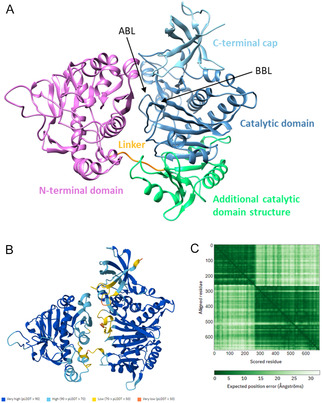 Figure 1
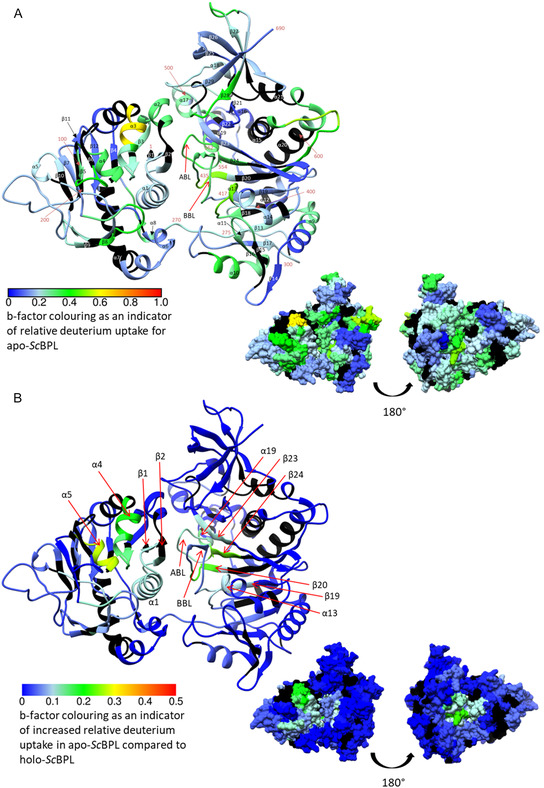 Figure 2
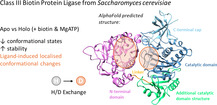 Figure 3
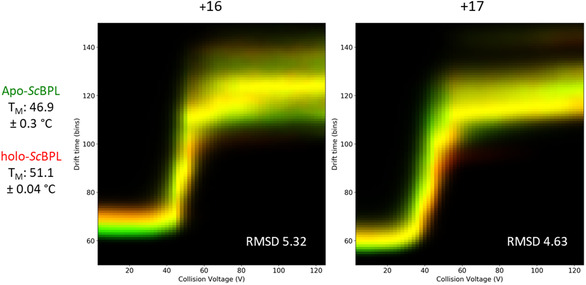 Figure 4
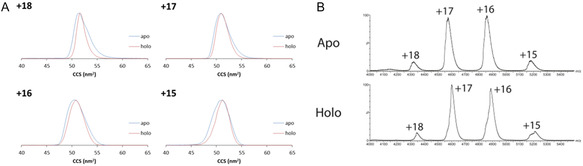 Figure 5
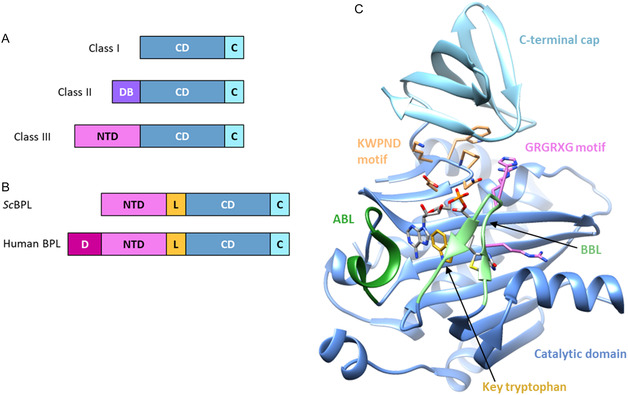 Figure 6
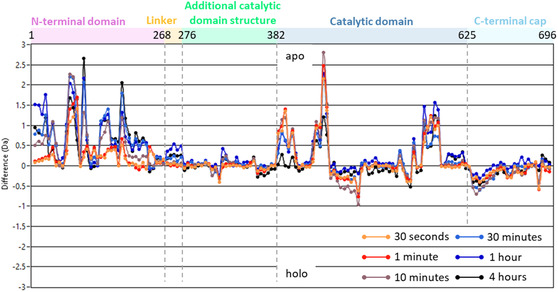 Figure 7
Peer Reviews
No public reviews on file for this paper yet. If you reviewed it on a platform where reviews are public (OpenReview, ICLR, NeurIPS, ICML), you can paste yours below so the community can read it here.
Videos
No videos yet. Explain this paper in a talk, walkthrough, or lecture? Add one.
Taxonomy
TopicsBiotin and Related Studies · Click Chemistry and Applications · Cellular transport and secretion