Analysis of the Effects of Sugar Modifications on RNA Chemical Ligation Reactions
Yu Hirano, Naoshi Kojima, Harei Sakurai, Emi Saito, Hirokazu Nankai, Yasuo Komatsu

TL;DR
This study explores how sugar modifications at the RNA ligation site affect the efficiency of RNA synthesis, revealing that specific substitutions improve reaction performance.
Contribution
The study identifies optimal 2′-substituent combinations for RNA ligation, enhancing synthesis efficiency and functionality.
Findings
2′-fluoro-5′-amino nucleotides show higher reactivity compared to ribo- or deoxy-variants.
2′-O-methyl modification with 3′-phosphate nucleotides achieves the highest ligation efficiency.
2′-fluoro-5′-amino nucleotides maintain reactivity under acidic conditions.
Abstract
Chemical ligation of RNA fragments is an effective method for synthesizing long RNAs. It is particularly useful for incorporating site‐specific modifications into long RNAs; however, its low reaction efficiency remains a major challenge. Herein, 5′‐amino‐2′‐substituted uridine or cytidine nucleotides are synthesized, which are attached to the 5′ end of a synthetic RNA and conjugated with a phosphate group at the 3′ end of an alternative RNA fragment, to perform a head‐to‐tail‐type RNA ligation. It is examined how the 2′ position of nucleotides with 5′‐amino or 3′‐phosphate groups in the ligated site affects the ligation reaction. The 2′‐fluoro‐5′‐amino‐nucleotide shows enhanced reactivity compared with the 2′‐ribo‐ or 2′‐deoxy‐5′‐amino‐nucleotide. In contrast, the 2′‐O‐methyl modification demonstrates optimal efficacy with the 3'‐phosphate nucleotide. Interestingly, the…
Genes, proteins, chemicals, diseases, species, mutations and cell lines named across the full text — each resolved to its canonical identifier and authoritative record.
Click any figure to enlarge with its caption.
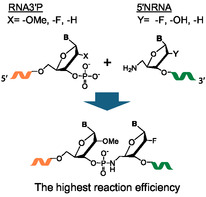 Figure 1
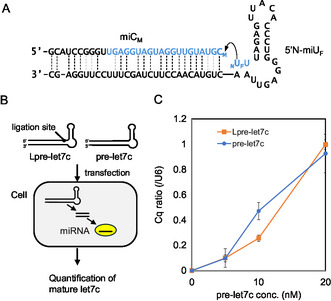 Figure 2
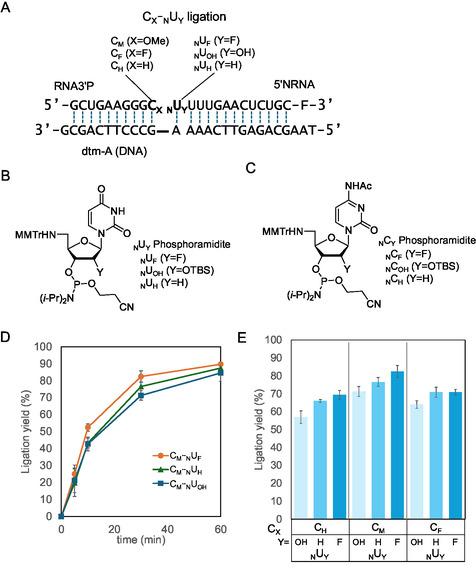 Figure 3
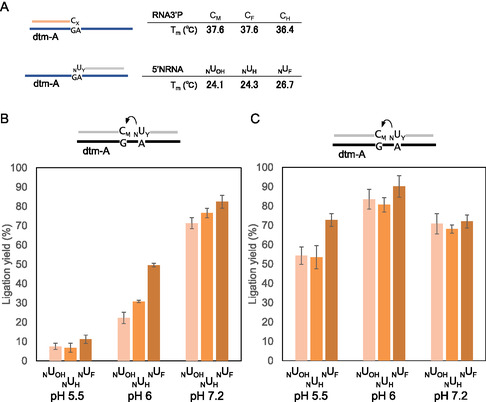 Figure 4
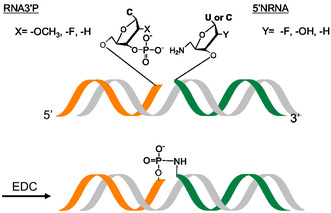 Figure 5
Peer Reviews
No public reviews on file for this paper yet. If you reviewed it on a platform where reviews are public (OpenReview, ICLR, NeurIPS, ICML), you can paste yours below so the community can read it here.
Videos
No videos yet. Explain this paper in a talk, walkthrough, or lecture? Add one.
Taxonomy
TopicsRNA modifications and cancer · DNA and Nucleic Acid Chemistry · RNA and protein synthesis mechanisms