Cupin‐Type Dimethylsulfoniopropionate Lyase from Pelagibacter ubique (DddK Pu ) Catalyzes Aza‐Michael Addition of Primary and Secondary Amines to Acrylic Acid
Diletta Arceri, Angela Mourelle, Teodor Parella, Jordi Bujons, Carlos J. Moreno, Pere Clapés

TL;DR
A protein from a marine bacterium efficiently catalyzes a key chemical reaction to make amino acids used in drug production.
Contribution
A novel biocatalytic method using DddK Pu for aza-Michael addition to synthesize β-amino acids with high selectivity.
Findings
DddK Pu catalyzed aza-Michael addition with 90%–100% conversion and 40%–86% yields for secondary amines.
The W26G variant achieved 50%–100% conversion and 43%–81% yields for primary amines.
The enzyme showed chemoselectivity for specific amine substrates.
Abstract
The formation of carbon─nitrogen (C─N) bonds is a cornerstone of organic synthesis, underpinning the production of amines, imines, and nitriles found in numerous active ingredients. Among the methods for C─N bond formation, the aza‐Michael addition stands out as a powerful and versatile approach. Herein, we present a biocatalytic strategy for the efficient aza‐Michael addition of primary and secondary amines to acrylic acid, i.e., aza‐Michaelase activity, leveraging the promiscuity of dimethylsulfoniopropionate (DMSP) lyase from Pelagibacter ubique HTCC1062 (DddK Pu ). In vivo DddK Pu catalyzes the β‐elimination of DMSP to sodium acrylate and dimethylsulfide (i.e., a retro sulfa‐Michael reaction). Here, we screened DddK Pu against a diverse library of 30 primary and 44 secondary amines. The wild‐type enzyme achieved 90%–100% conversion and 40%–86% isolated yields of…
Genes, proteins, chemicals, diseases, species, mutations and cell lines named across the full text — each resolved to its canonical identifier and authoritative record.
Click any figure to enlarge with its caption.
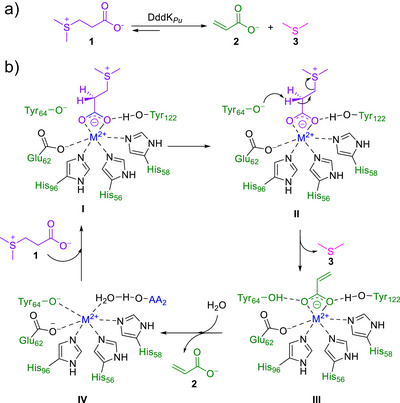 Figure 1
 Figure 2
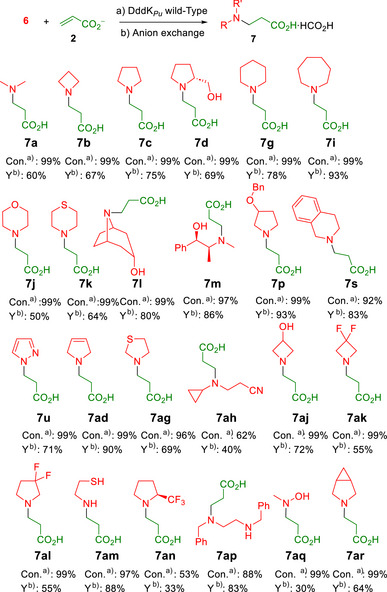 Figure 3
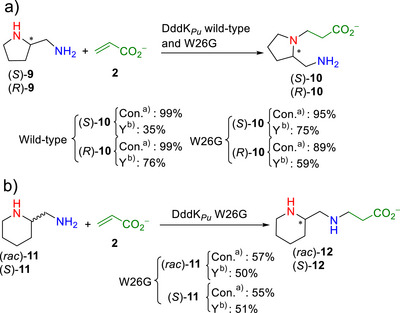 Figure 4
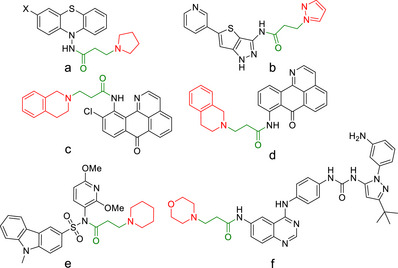 Figure 5
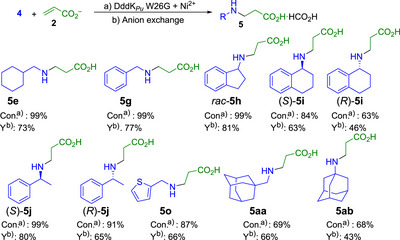 Figure 6
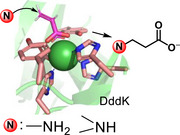 Figure 7
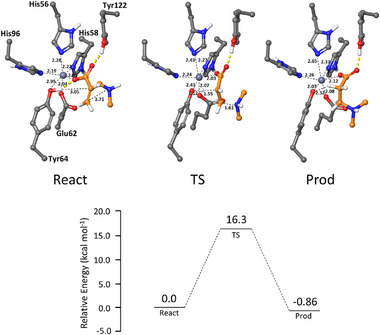 Figure 8
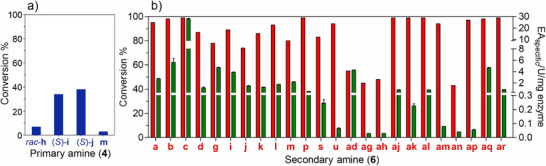 Figure 9
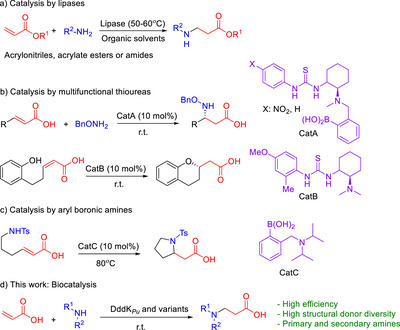 Figure 10
 Figure 11
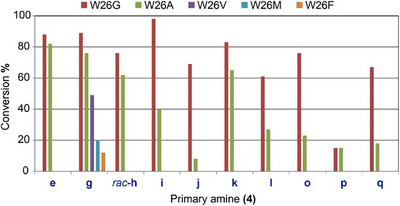 Figure 12
 Figure 13
 Figure 14
 Figure 15
Peer Reviews
No public reviews on file for this paper yet. If you reviewed it on a platform where reviews are public (OpenReview, ICLR, NeurIPS, ICML), you can paste yours below so the community can read it here.
Videos
No videos yet. Explain this paper in a talk, walkthrough, or lecture? Add one.
Taxonomy
TopicsClick Chemistry and Applications · Carbohydrate Chemistry and Synthesis · Sulfur-Based Synthesis Techniques