Computational Study of Ignored Pericyclic Reactions: Rearrangements of 1,2‐Bis(Diazo)Alkanes to 1,2,3,4‐Tetrazines and Subsequent Fragmentations
Hans‐Ulrich Reissig, Ernst‐Ulrich Würthwein

TL;DR
This paper uses computer simulations to explore a new chemical reaction pathway that can form complex nitrogen-rich rings and predict how to isolate them.
Contribution
The study reveals a previously overlooked electrocyclic reaction pathway for forming 1,2,3,4-tetrazines and identifies conditions for their isolation.
Findings
DFT calculations show that 1,2-bis(diazo)alkanes can form 1,2,3,4-tetrazines via an 8π-electrocyclization.
Substitution patterns strongly influence the feasibility and stability of the reaction products.
Carbene or nitrene intermediates may lead to fragmentation into alkynes or nitriles.
Abstract
An electrocyclic ring closure of bis‐1,3‐dipoles can afford six‐membered heterocycles. This 8π‐electron process was systematically analyzed by DFT calculations with 1,2‐bis(diazo)alkane derivatives as possible precursor compounds and 1,2,3,4‐tetrazines as products. The C2‐symmetry of the transition state of the parent system points to a conrotatory ring closing event. The subsequent (6–2–2) cycloreversions of these elusive nitrogen‐rich heterocycles to alkynes or nitriles and dinitrogen were also computationally investigated. The results show that the reactions are strongly dependent on the substitution pattern, but all are kinetically easily feasible delivering products of differing stability. The calculations can therefore provide important information for experimental endeavors to generate or even isolate so far unknown 1,2,3,4‐tetrazines. The feasibility of carbene or…
Genes, proteins, chemicals, diseases, species, mutations and cell lines named across the full text — each resolved to its canonical identifier and authoritative record.
Click any figure to enlarge with its caption.
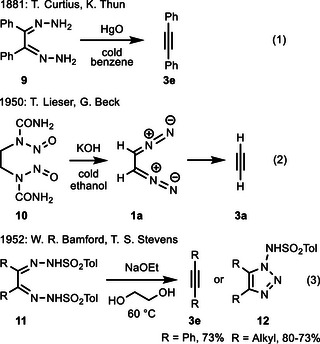 Figure 1
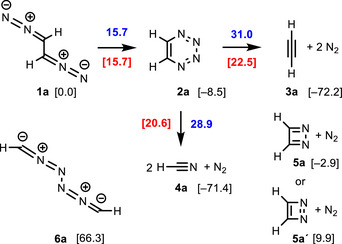 Figure 2
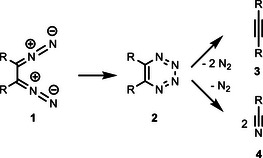 Figure 3
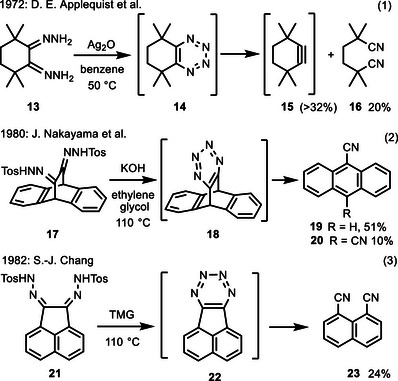 Figure 4
 Figure 5
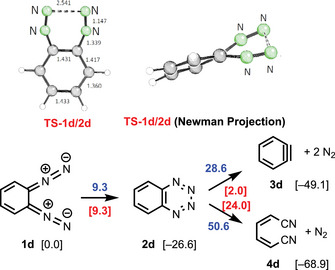 Figure 6
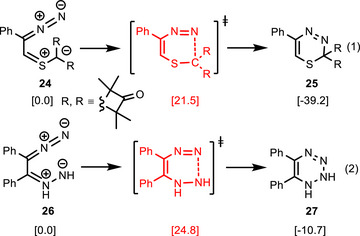 Figure 7
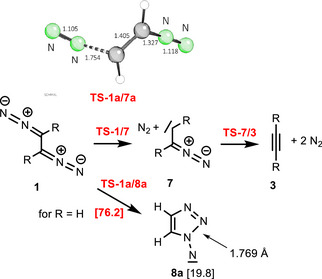 Figure 8
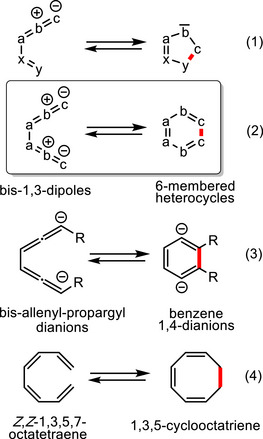 Figure 9
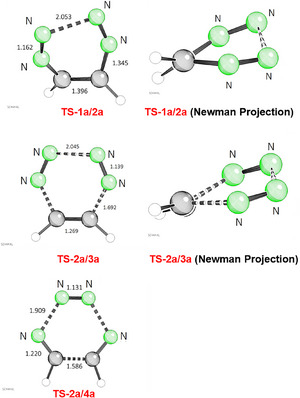 Figure 10
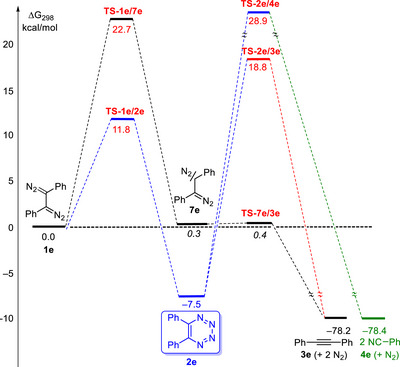 Figure 11
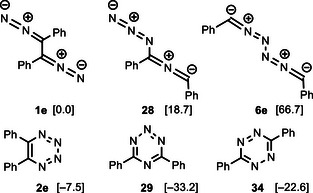 Figure 12
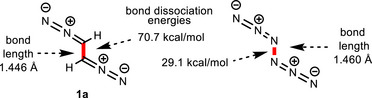 Figure 13
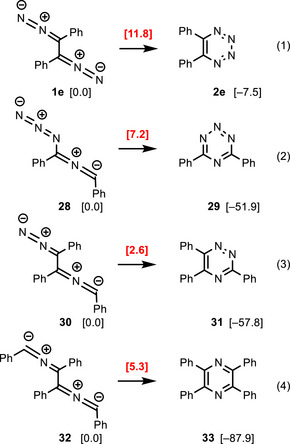 Figure 14
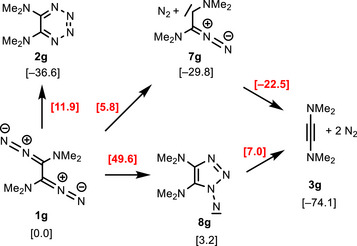 Figure 15
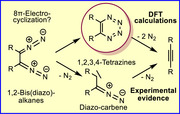 Figure 16
Peer Reviews
No public reviews on file for this paper yet. If you reviewed it on a platform where reviews are public (OpenReview, ICLR, NeurIPS, ICML), you can paste yours below so the community can read it here.
Videos
No videos yet. Explain this paper in a talk, walkthrough, or lecture? Add one.
Taxonomy
TopicsCyclopropane Reaction Mechanisms · Click Chemistry and Applications · Synthesis and Biological Evaluation