Organocatalytic Microfluidic Double‐Layer Capacitors
Shen‐Yi Guo, Miguel Paraja, Augustina Jozeliūnaitė, Manuel Gallardo‐Villagrán, Qing‐Xia Zhang, Alenka Marsalek, Naomi Sakai, Stefan Matile

TL;DR
This paper introduces a new method for electric-field catalysis using bioinspired structures in microfluidic systems, enabling scalable organic synthesis.
Contribution
The novel contribution is the development of bioinspired supramolecular electrodes that enable scalable electric-field catalysis.
Findings
Supramolecular electrodes based on polyarginine and pyrenebutyrate show high activity for electric-field catalysis.
Electric-field catalysis triples the yield of a well-optimized organocatalytic reaction.
The method overcomes scalability issues of traditional electric-field catalysis.
Abstract
Ideas to use external electric fields to enable, accelerate and direct the movement of electrons during chemical reactions are not new. Theory and experiments under special conditions predict that electric‐field catalysis (EFC) from externally applied fields could change the way we make molecules. The challenge is the incompatibility with organic synthesis under scalable bulk conditions. Access to applied electric fields (AEFs) > 1 V nm−1, predicted as necessary for direct transition‐state stabilization, is not possible even with electromicrofluidic systems, where the distance between the plate electrodes is minimized. Therefore, we decided to shift our attention from the applied fields to their consequences. We consider electrical double layers (EDLs) that form within a few nanometers from the plate electrodes as engineerable supramolecular electrodes. Applying lessons from…
Genes, proteins, chemicals, diseases, species, mutations and cell lines named across the full text — each resolved to its canonical identifier and authoritative record.
Click any figure to enlarge with its caption.
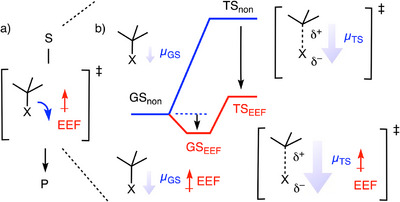 Figure 1
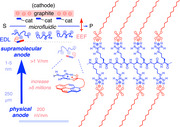 Figure 2
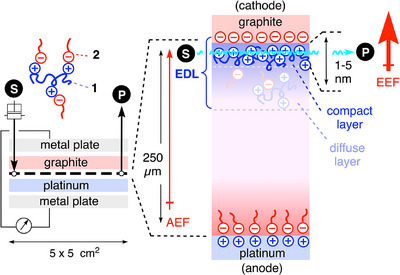 Figure 3
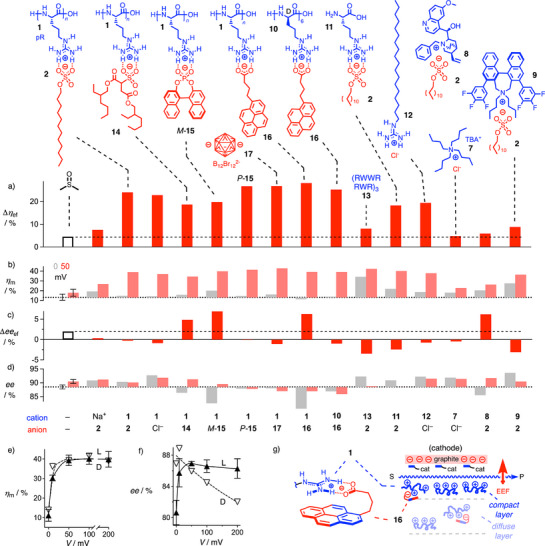 Figure 4
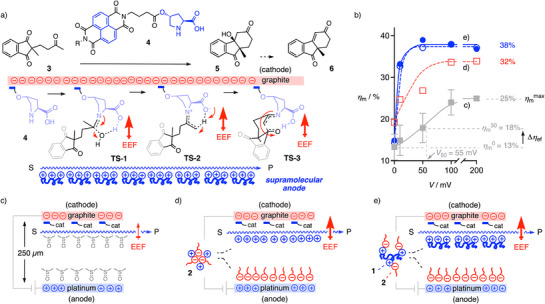 Figure 5
Peer Reviews
No public reviews on file for this paper yet. If you reviewed it on a platform where reviews are public (OpenReview, ICLR, NeurIPS, ICML), you can paste yours below so the community can read it here.
Videos
No videos yet. Explain this paper in a talk, walkthrough, or lecture? Add one.
Taxonomy
TopicsMolecular Junctions and Nanostructures · Advanced biosensing and bioanalysis techniques · Electrowetting and Microfluidic Technologies