Physiochemical screening of road avenue plants in better landscape management of highly polluted urbanized city (Lahore), Pakistan
Bushra Munam, Sohaib Muhammad, Muhammad Tayyab, Hafiza Komal Hanif, Mahrukh Majeed, Hassan Nawaz, Muhammad Jawad Tariq Khan, Summiya Faisal, Muhammad Hasnain, Sarah Maryam Malik, Muhammad Bilal, Muhammad Zahid

TL;DR
This study examines how roadside plants in Lahore, Pakistan, respond to high air pollution, identifying species that can survive and help manage urban landscapes.
Contribution
The study identifies specific plant species that are resilient to pollution and suitable for urban landscaping in highly polluted cities.
Findings
Eucalyptus globulus and other Ficus species showed higher chlorophyll and carotenoid levels in polluted areas.
Alstonia scholaris and Polyalthia longifolia experienced significant reductions in chlorophyll.
Certain plants like Eucalyptus globulus and Morus alba can tolerate pollution stress, making them suitable for urban planting.
Abstract
Lahore has been consistently ranked as the world’s most polluted city. Because of combative ideas to construct highways, underpasses and flyovers, Lahore had lost a remarkable percentage of its tree cover over the past 15 years. The present study focuses on the outcomes of rapidly increasing air pollution on roadside vegetation. In current study, species such as Alstonia scholaris L., Bougainvillea spectabilis Willd., Dalbergia sissoo Roxb. Eucalyptus globulus Labill., Ficus virens Aiton, Ficus benjamina L., Ficus religiosa Linn., Morus alba L., Murraya paniculata L., Putranjiva roxburghii Wall., Polyalthia longifolia Sonn., Rubia tinctorum L. found on the seven busiest roads of Lahore were selected (on the basis of traffic densities) for biomonitoring. These plants were selected due to their prevalence and commonly occurrence on these selected roads. Variation on biochemical…
Genes, proteins, chemicals, diseases, species, mutations and cell lines named across the full text — each resolved to its canonical identifier and authoritative record.
Click any figure to enlarge with its caption.
 Figure 1
 Figure 2
 Figure 3
 Figure 4
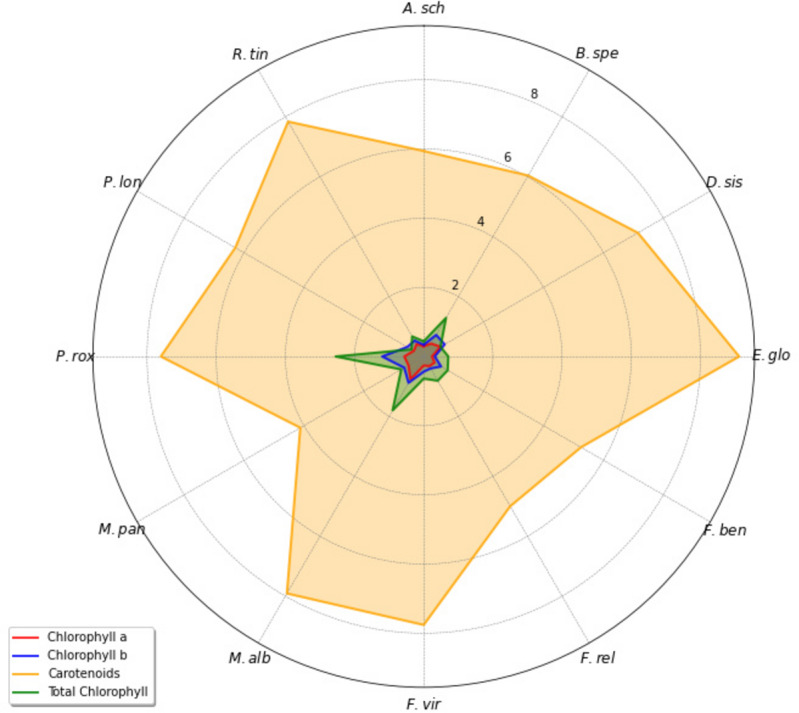 Figure 5
 Figure 6
 Figure 7
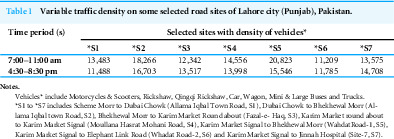 Figure 8
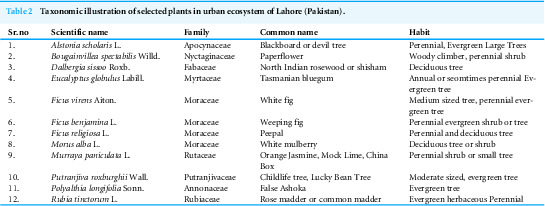 Figure 9
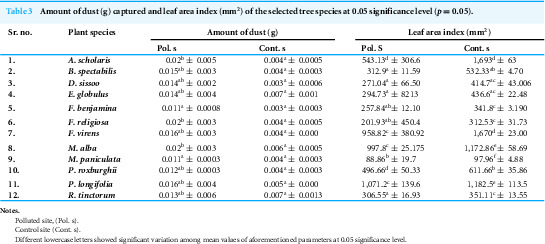 Figure 10
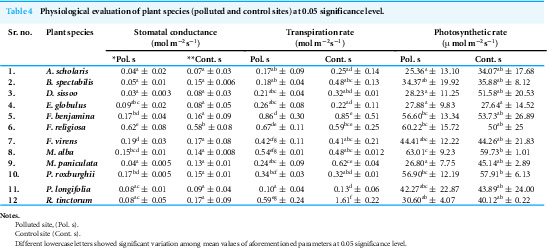 Figure 11
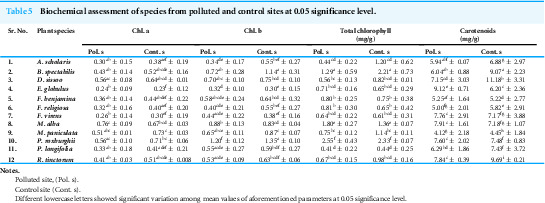 Figure 12
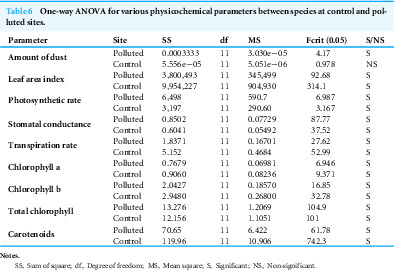 Figure 13
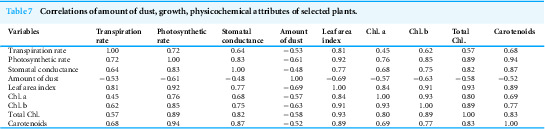 Figure 14
Peer Reviews
No public reviews on file for this paper yet. If you reviewed it on a platform where reviews are public (OpenReview, ICLR, NeurIPS, ICML), you can paste yours below so the community can read it here.
Videos
No videos yet. Explain this paper in a talk, walkthrough, or lecture? Add one.
Taxonomy
TopicsPlant responses to elevated CO2 · Urban Green Space and Health · Urban Heat Island Mitigation