Risk stratification for stricture formation after endoscopic submucosal dissection for esophageal dysplasia
Kareem Khalaf, Youstina Hanna, Tomoyuki Nishimura, Huaqi Li, Natalia Causada Calo, Gary R May, Christopher W Teshima, Jeffrey D Mosko

TL;DR
This study identifies factors that increase the risk of esophageal narrowing after a procedure called endoscopic submucosal dissection for treating esophageal dysplasia.
Contribution
The study provides a risk stratification model for stricture formation based on lesion and procedural characteristics.
Findings
Stricture rates increased with the extent of circumferential defect involvement, reaching 57.7% for defects ≥90%.
Local triamcinolone acetide injection showed varied stricture prevention depending on defect size.
Prophylactic steroid regimens had different effectiveness, with combination therapy showing the lowest stricture rate.
Abstract
We aimed to evaluate the demographic, clinical, procedural, and histopathologic factors associated with stricture development following esophageal endoscopic submucosal dissection (ESD). We conducted a retrospective cohort study of patients undergoing ESD for esophageal lesions from 2019 to 2024 at St. Michael’s Hospital, in Toronto, Canada. The primary outcome was stricture formation, defined as a symptomatic luminal narrowing at the ESD site confirmed on follow-up endoscopy, requiring intervention. Strictures requiring dilation developed in 24% of patients, 85% of which were impassable with a standard gastroscope (9.9 mm diameter). Stricture rates increased with defect circumferential involvement: <50% (7.7%), 50%–74% (11.5%), 75%–89% (23.1%), and ≥90% (57.7%). Intraprocedural local triamcinolone acetate (LTA) injection was administered in 40 of 108 patients (37%), with a mean defect…
Genes, proteins, chemicals, diseases, species, mutations and cell lines named across the full text — each resolved to its canonical identifier and authoritative record.
Click any figure to enlarge with its caption.
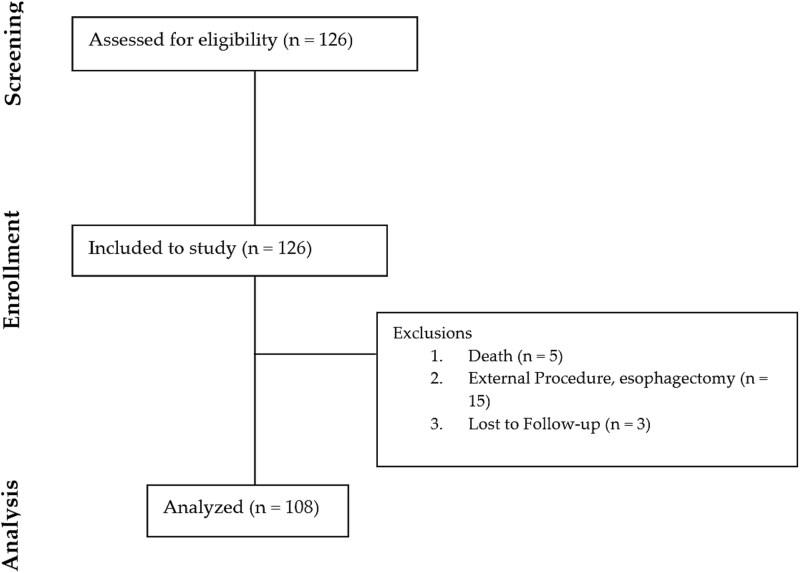 Figure 1
Peer Reviews
No public reviews on file for this paper yet. If you reviewed it on a platform where reviews are public (OpenReview, ICLR, NeurIPS, ICML), you can paste yours below so the community can read it here.
Videos
No videos yet. Explain this paper in a talk, walkthrough, or lecture? Add one.
Taxonomy
TopicsEsophageal Cancer Research and Treatment · Esophageal and GI Pathology · Gastric Cancer Management and Outcomes