Virologic characteristics of SARS-CoV-2 infection across evolving Omicron subvariants
Julie Boucau, Owen T. Glover, Caitlin Marino, Gregory E. Edelstein, Manish C. Choudhary, Yijia Li, Brooke M. Leeman, Zahra Reynolds, Karry Su, Dessie Tien, Chase B. Mandell, Eliza Passell, Andrew Alexandrescu, Emory Abar, Mamadou Barry, Dibya Ghimire, Tammy D. Vyas

TL;DR
This study found that despite evolving Omicron subvariants of SARS-CoV-2, viral shedding and infection dynamics remain largely unchanged.
Contribution
The study provides empirical evidence that Omicron subvariants do not significantly alter viral shedding or infectiousness duration.
Findings
Viral RNA levels and shedding duration were similar across Omicron subvariants.
A significant proportion of individuals shed replication-competent virus after symptom resolution.
Symptoms are not reliable indicators of infectiousness for ending isolation.
Abstract
SARS-CoV-2 has evolved subvariants since the emergence of the Omicron variant in 2021. Whether these changes impact viral shedding and transmissibility is not known. POSITIVES is a prospective longitudinal cohort of individuals with mild SARS-CoV-2 infection. Ambulatory, immunocompetent participants who did not receive antivirals self-administered 6 anterior nasal swabs over 15 days. Samples were analyzed by qPCR to quantify viral RNA, semiquantitative viral culture to detect shedding of replication-competent virus, and whole-genome sequencing to classify subvariants. Our predictor of interest was Omicron subvariants: BA.1x, BA.2x, BA.4/5x, XBB.x, and JN.x. Outcomes included RNA levels and duration of shedding replication-competent virus. We additionally explored whether symptoms are a valid marker for ending isolation. The median peak nasal SARS-CoV-2 RNA (6.0–6.3 log10 RNA…
Genes, proteins, chemicals, diseases, species, mutations and cell lines named across the full text — each resolved to its canonical identifier and authoritative record.
Click any figure to enlarge with its caption.
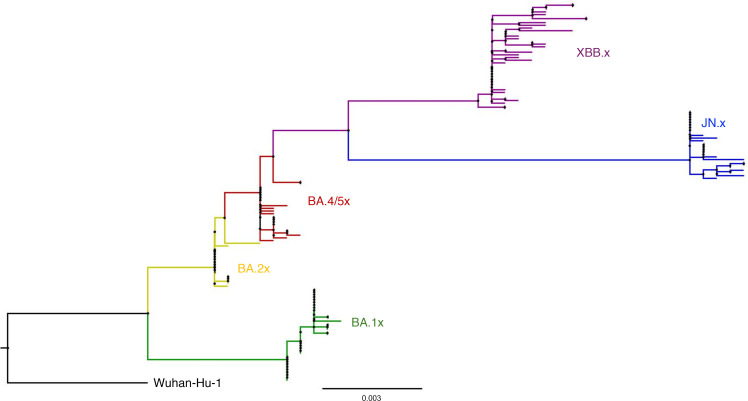 Figure 1
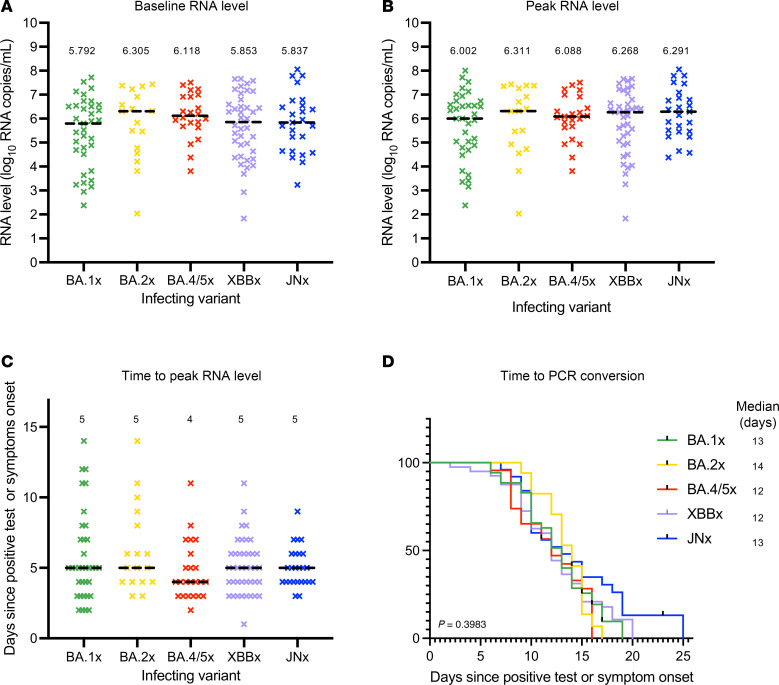 Figure 2
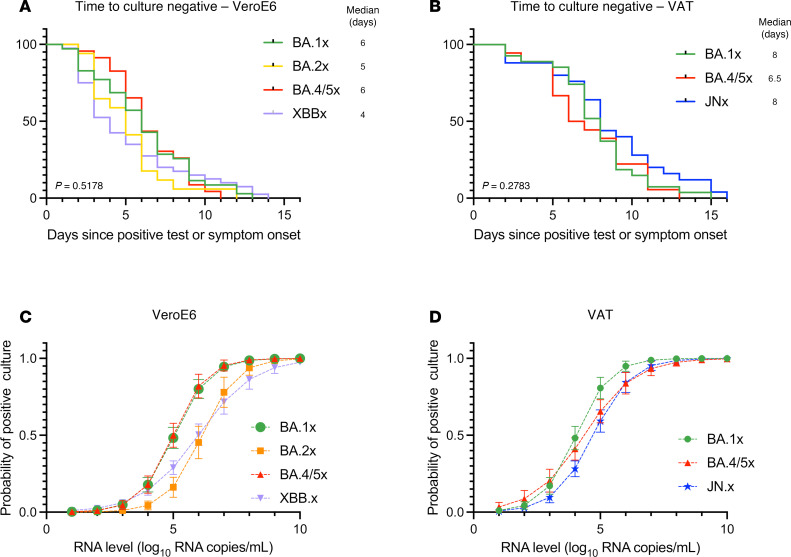 Figure 3
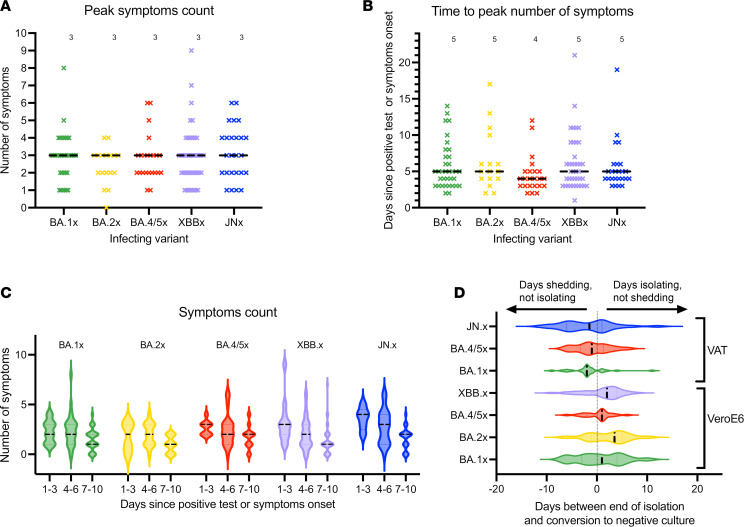 Figure 4
 Figure 5
Peer Reviews
No public reviews on file for this paper yet. If you reviewed it on a platform where reviews are public (OpenReview, ICLR, NeurIPS, ICML), you can paste yours below so the community can read it here.
Videos
No videos yet. Explain this paper in a talk, walkthrough, or lecture? Add one.
Taxonomy
TopicsRespiratory viral infections research · SARS-CoV-2 and COVID-19 Research · SARS-CoV-2 detection and testing