Time-at-bedside and competency acquisition: a secondary analysis of GM-ITE domain scores in Japanese resident physicians
Kohta Katayama, Toshihiko Takada, Yuji Nishizaki, Kazuya Nagasaki, Taro Shimizu, Yu Yamamoto, Takashi Watari, Yasuharu Tokuda, Vineet Chopra, Yoshiyuki Ohira

TL;DR
This study finds that spending more time at the patient's bedside is linked to better skills in physical exams, procedures, and disease knowledge among Japanese resident physicians.
Contribution
The study provides evidence that time-at-bedside is associated with specific competency gains in clinical procedures and disease knowledge.
Findings
More time-at-bedside was weakly associated with medical interview and professionalism scores.
Physical examination and clinical procedures scores increased with more time-at-bedside in a dose-response pattern.
Disease knowledge scores also showed a dose-response increase with more time-at-bedside.
Abstract
Direct bedside learning is recognized as essential for clinical skill development, yet its domain-specific effects on competency acquisition have not been fully elucidated. We examined how self‐reported time‐at‐bedside was associated with performance across four GM‐ITE competency domains. We performed a nationwide multicenter, cross-sectional study of Japanese first- and second-year postgraduate resident physicians who took the General Medicine In-Training Examination (GM-ITE) in late 2022. Time-at-bedside was defined as the average self-reported time per day a resident spent providing direct care at the patients’ bedside and was stratified into six categories: C1 (10–20 min/day), C2 (30–50 min/day), C3 (60–80 min/day), C4 (90–110 min/day), C5 (120–140 min/day), and C6 (≥ 150 min/day). Data on time-at-bedside were collected through an electronic survey conducted immediately after the…
Genes, proteins, chemicals, diseases, species, mutations and cell lines named across the full text — each resolved to its canonical identifier and authoritative record.
Click any figure to enlarge with its caption.
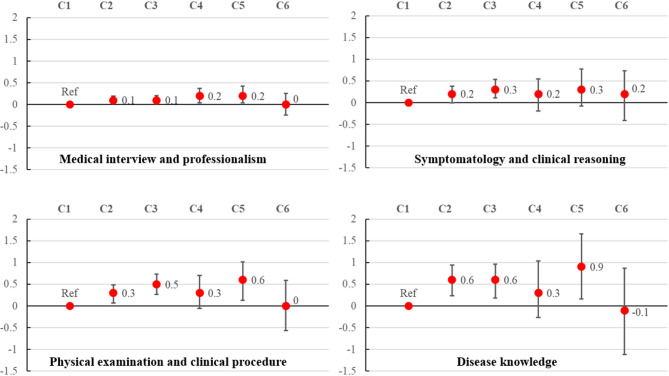 Figure 1
Peer Reviews
No public reviews on file for this paper yet. If you reviewed it on a platform where reviews are public (OpenReview, ICLR, NeurIPS, ICML), you can paste yours below so the community can read it here.
Videos
No videos yet. Explain this paper in a talk, walkthrough, or lecture? Add one.
Taxonomy
TopicsInnovations in Medical Education · Hospital Admissions and Outcomes · Simulation-Based Education in Healthcare