Computational study of conformational interconversion of an amyloid β double layer system
Yasuhiro Oishi, Motoharu Kitatani, Kichitaro Nakajima, Hirotsugu Ogi, Koichi Kusakabe

TL;DR
This study uses computational methods to explore how amyloid β peptides change shape, which is linked to Alzheimer's disease.
Contribution
The paper presents new insights into the energy barriers and structural factors influencing conformational changes in Aβ peptide layers.
Findings
Twisted conformations of Aβ peptides were identified as local energy minima.
Flat-to-twisted transitions are endothermic due to broken hydrogen bonds and loss of van der Waals interactions.
Some twisted conformations revert to flat structures more easily due to steric hindrance near the torsional axis.
Abstract
The formation of amyloid fibrils comprising amyloid β (Aβ) peptides is associated with the pathology of Alzheimer's disease. In this study, we theoretically investigated conformational changes of a flat double-layer structure of two Aβ20−34 peptides using the density functional theory calculation. Several twisted conformations were identified as local energy minima in which a part of the peptide chain bends upward while the rest remains bound to the lower Aβ20−34 monomer. Flat-to-twisted conformational transition exhibited endothermic behavior, with endothermic energy increasing as more backbone hydrogen bonds were broken. In addition, the loss of van der Waals interaction from the hydrophobic sidechain contributed to endothermicity. The nudged elastic band method was applied to analyze the potential energy surface connecting the flat and twisted conformations. Comparison of the…
Genes, proteins, chemicals, diseases, species, mutations and cell lines named across the full text — each resolved to its canonical identifier and authoritative record.
Click any figure to enlarge with its caption.
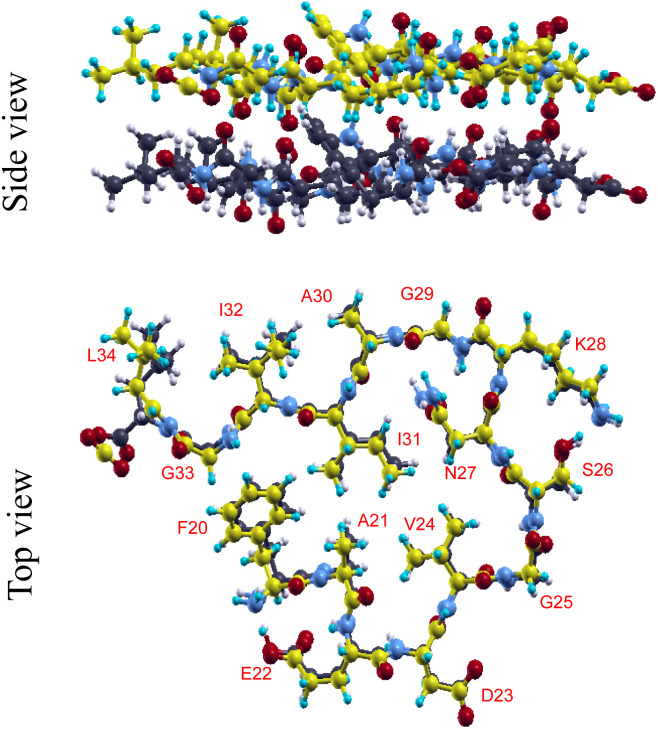 Figure 1
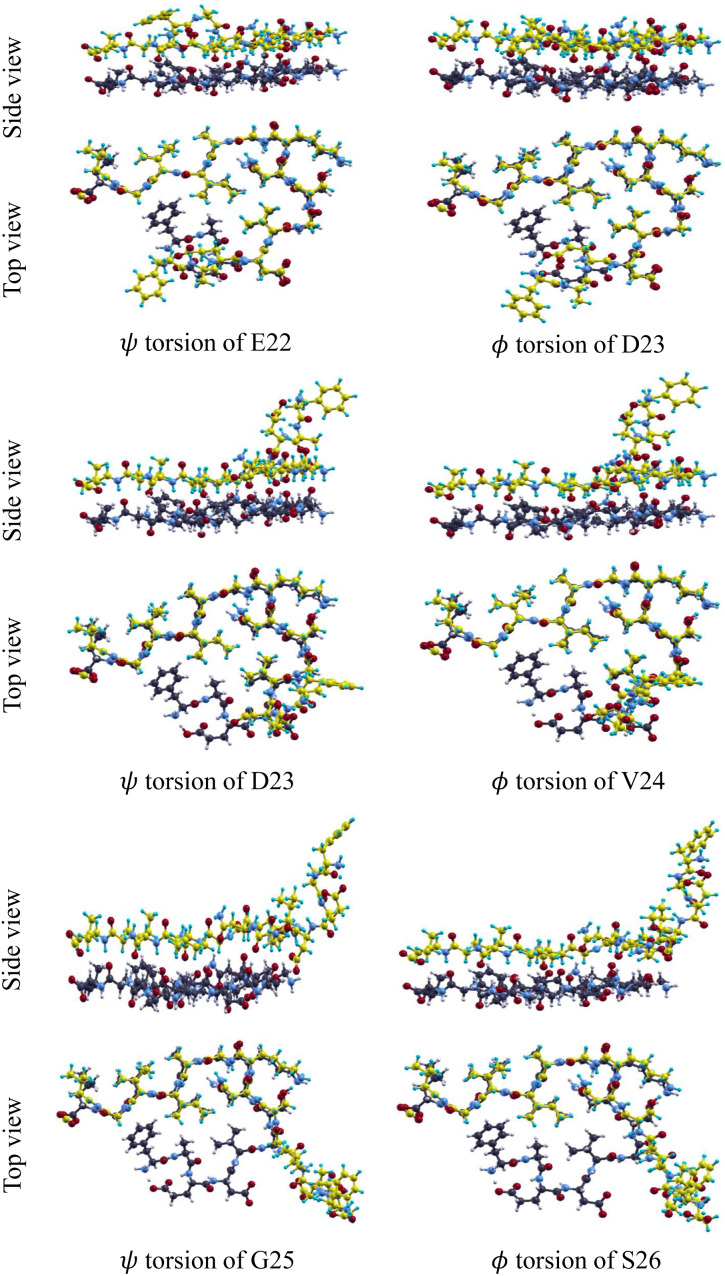 Figure 2
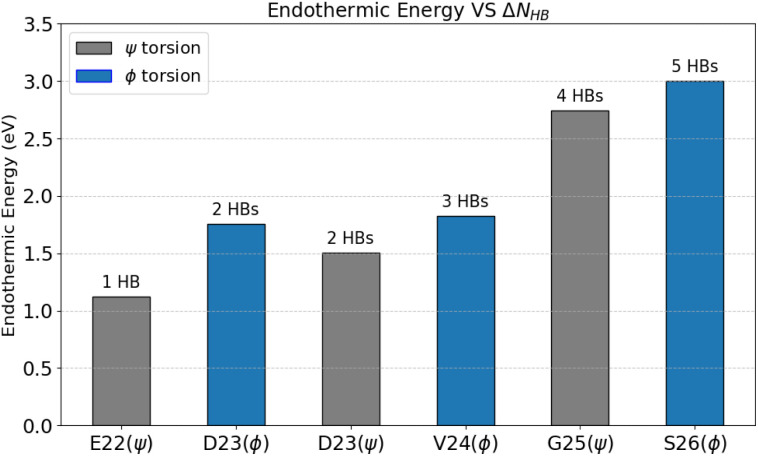 Figure 3
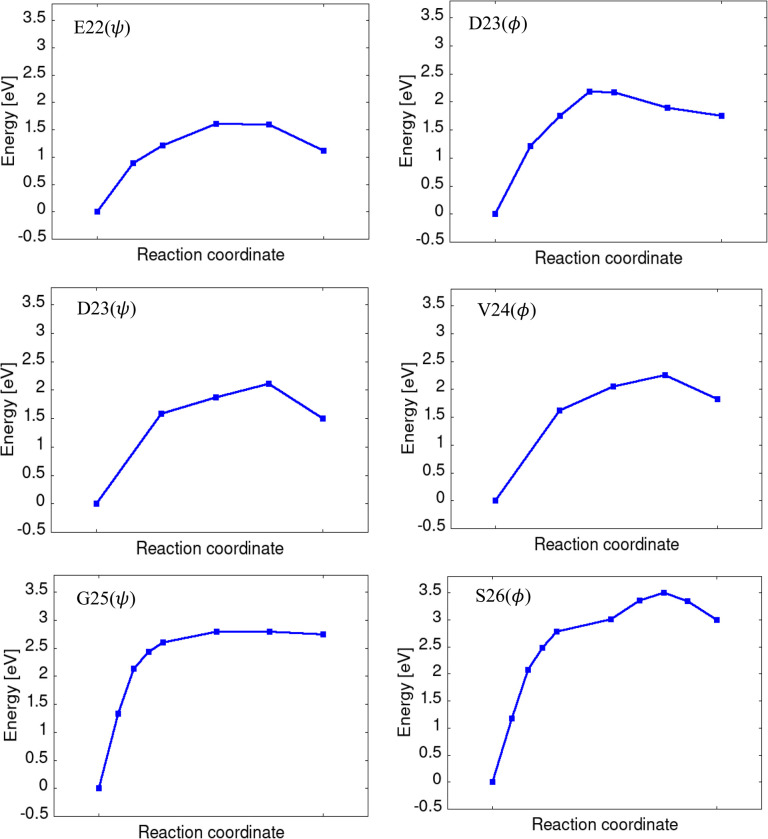 Figure 4
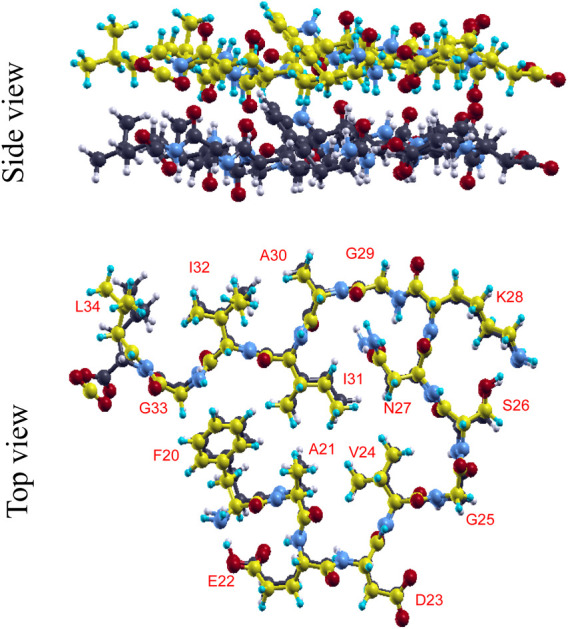 Figure 5
Peer Reviews
No public reviews on file for this paper yet. If you reviewed it on a platform where reviews are public (OpenReview, ICLR, NeurIPS, ICML), you can paste yours below so the community can read it here.
Videos
No videos yet. Explain this paper in a talk, walkthrough, or lecture? Add one.
Taxonomy
TopicsSupramolecular Self-Assembly in Materials · Alzheimer's disease research and treatments · Lipid Membrane Structure and Behavior