Ligand-free reductive amination via Pd-coated mechanocatalysis
Maximilian Wohlgemuth, Sarah Schmidt, Lars Beißel, Lars Borchardt

TL;DR
A new method for reductive amination uses mechanical milling with palladium to produce amines efficiently without needing a ligand.
Contribution
A sequential two-frequency milling protocol enables ligand-free reductive amination with high amine yields.
Findings
A sequential two-frequency milling protocol separates imine formation and hydrogenation.
Hydrophobic additives enhance reaction efficiency by excluding water.
The method achieves up to 88% amine yields and works with various substrates.
Abstract
Reductive amination under direct mechanocatalysis was enabled by a sequential two-frequency milling protocol, separating imine formation and hydrogenation. Strongly hydrophobic liquid additives accelerated the reaction by enhancing water exclusion. This approach allowed amine yields of up to 88% and was applicable to various aldehydes, ketones, and primary or secondary amines. Reductive amination under direct mechanocatalysis was enabled by a sequential two-frequency milling protocol, separating imine formation and hydrogenation.
Genes, proteins, chemicals, diseases, species, mutations and cell lines named across the full text — each resolved to its canonical identifier and authoritative record.
Click any figure to enlarge with its caption.
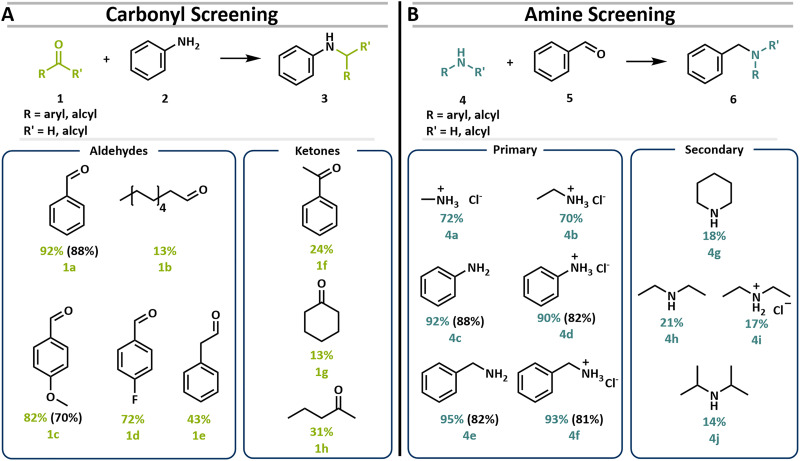 Figure 1
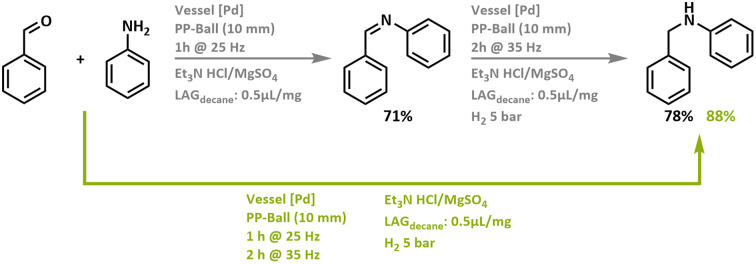 Figure 2
 Figure 3
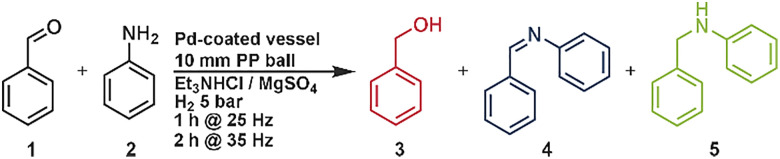 Figure 4
Peer Reviews
No public reviews on file for this paper yet. If you reviewed it on a platform where reviews are public (OpenReview, ICLR, NeurIPS, ICML), you can paste yours below so the community can read it here.
Videos
No videos yet. Explain this paper in a talk, walkthrough, or lecture? Add one.
Taxonomy
TopicsChemical Synthesis and Analysis · Asymmetric Hydrogenation and Catalysis · Catalytic Cross-Coupling Reactions