Renal response and prognosis of newly diagnosed patients with multiple myeloma with renal impairment applying VRD and autologous hematopoietic stem cell transplantation
星玥 吴, 越 黄, 红苗 沈, 红英 尤, 治 严, 妍 谢, 卫芹 姚, 霜 颜, 婧 王, 英颖 翟, 晓兰 施, 京晶 商, 松 金, 灵芝 颜, 德沛 吴, 琤琤 傅

TL;DR
This study examines the effectiveness of VRD treatment and stem cell transplantation in multiple myeloma patients with kidney issues, finding it effective even in those needing dialysis.
Contribution
The study identifies the feasibility and outcomes of VRD and auto-HSCT in NDMM patients with varying degrees of renal impairment.
Findings
VRD and auto-HSCT showed high overall response rates in patients with renal impairment.
Patients with kidney response (RORR) had better survival outcomes.
1q21+ and light chain type are independent risk factors for poor kidney response.
Abstract
探讨在肾功能受损的多发性骨髓瘤(MM)患者中使用VRD方案联合自体造血干细胞移植(auto-HSCT)的可行性,分析不同肾功能损伤水平的疗效与肾脏反应,探索早期肾脏反应的预后意义及其影响因素。 苏州大学附属第一医院进行的回顾性研究对2018年8月至2022年10月收治的316例初诊多发性骨髓瘤(NDMM)患者按照肾功能分组,分析其临床特征、治疗反应、预后等。计量资料组间比较用t检验或秩和检验,计数资料组间比较用卡方检验,生存分析采用Kaplan-Meier法和Log-rank检验,肾脏反应的多因素分析采用Logistic回归。 根据基线估算肾小球滤过率(eGFR)将患者分为正常[≥90 ml·min−1·(1.73 m2)−1,160例]、轻度受损[≥60 ml·min−1·(1.73 m2)−1且<90 ml·min−1·(1.73 m2)−1,55例]、中度受损[≥30 ml·min−1·(1.73 m2)−1且<60 ml·min−1·(1.73 m2)−1,39例]和重度受损[<30 ml·min−1·(1.73 m2)−1,62例]。中或重度受损组患者国际分期系统(ISS)和修订的国际分期系统(R-ISS)分期较晚,血红蛋白水平较低,处于虚弱状态比例更高,轻链和IgD类型的比例更高(均P<0.05)。患者的中位年龄和移植率在不同组别间存在差异,与轻度和中度受损组相比,重度受损组患者更年轻(P=0.001),移植率更高(P=0.041)。患者总体客观缓解率(ORR)为93.7%、≥非常好的部分缓解(VGPR)率为82.9%,诱导治疗疗效在各组间差异无统计学意义(均P>0.05)。24例(7.6%)确诊时依赖透析,11例(45.8%)诱导治疗期间脱离透析,中位时间为3.0(0.5~4.0)个月。其中有10例患者在透析依赖状态下进行auto-HSCT。89例基线eGFR<50 ml·min−1·(1.73…
Genes, proteins, chemicals, diseases, species, mutations and cell lines named across the full text — each resolved to its canonical identifier and authoritative record.
Click any figure to enlarge with its caption.
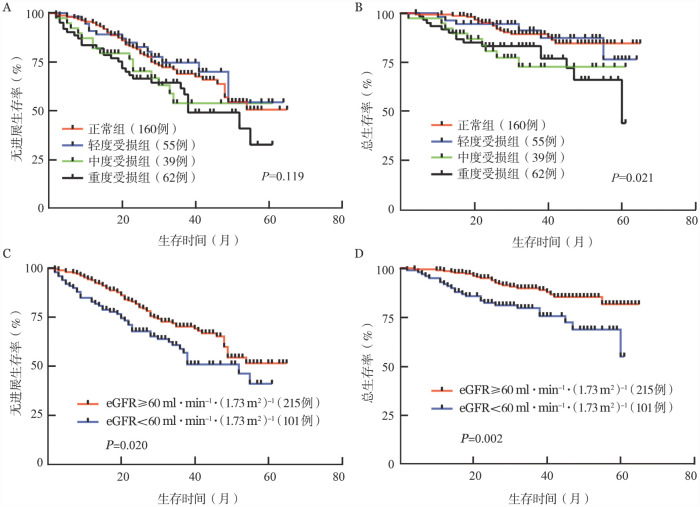 Figure 1
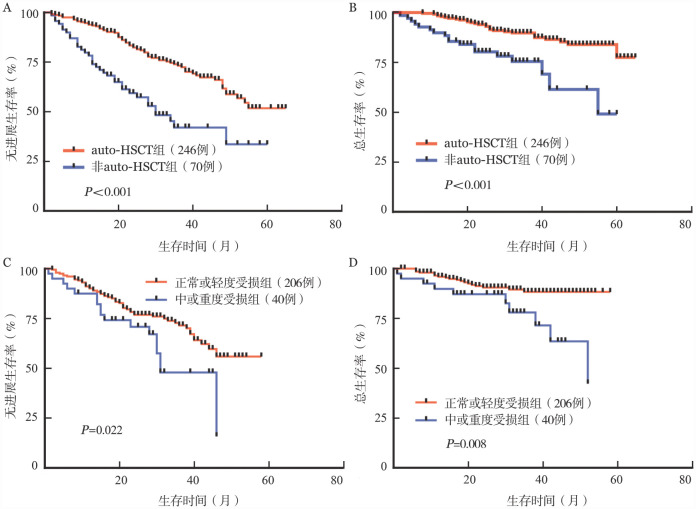 Figure 2
Peer Reviews
No public reviews on file for this paper yet. If you reviewed it on a platform where reviews are public (OpenReview, ICLR, NeurIPS, ICML), you can paste yours below so the community can read it here.
Videos
No videos yet. Explain this paper in a talk, walkthrough, or lecture? Add one.