Knowledge and Awareness of Glaucoma Among Medical Students in Aseer Region, Saudi Arabia
Abdulrahman Alamri, Hanan A AlKaabi, Ameera T Alzahrani, Atheer H AlMatar, Dalia S Almosleh, Fahad M Wadai, Khadija T Habib, Mohammed E Nizam, Nada M Asiri, Ruba O Alansari, Sabah M Alshahrani, Salem A Alshehri, Yara A Alshehri, Yara A AIziyad

TL;DR
This study found that while most medical students in Saudi Arabia know about glaucoma, many lack understanding of its asymptomatic nature and treatment options.
Contribution
The study provides new insights into glaucoma knowledge gaps among Saudi medical students and identifies factors associated with better understanding.
Findings
Only 12% of students had undergone glaucoma screening, and 53% incorrectly believed glaucoma-induced blindness is reversible.
Most students (86%) had heard of glaucoma, but only 42% understood it can be asymptomatic.
Good knowledge was found in 54.9% of students, with older age and proper information sources linked to better understanding.
Abstract
Background Glaucoma is one of the causes of irreversible blindness. Early diagnosis and intervention are critical due to the disease's asymptomatic nature in its early stages. As future healthcare professionals, medical students are pivotal in public awareness and education. This study aimed to assess the glaucoma knowledge level among King Khalid University medical students. Methods A cross-sectional study was conducted among medical students at King Khalid University between March and May 2025. A sample size of 385 was calculated using Richard Geiger’s formula with an estimated proportion of 50%. Four hundred eighty-one students responded to a self-administered, Arabic questionnaire distributed via Google Forms (Google, Mountain View, CA, US). The tool was adopted from the literature, validated, and piloted for clarity. Data were analyzed using SPSS version 26 (IBM Corp., Armonk,…
Genes, proteins, chemicals, diseases, species, mutations and cell lines named across the full text — each resolved to its canonical identifier and authoritative record.
Click any figure to enlarge with its caption.
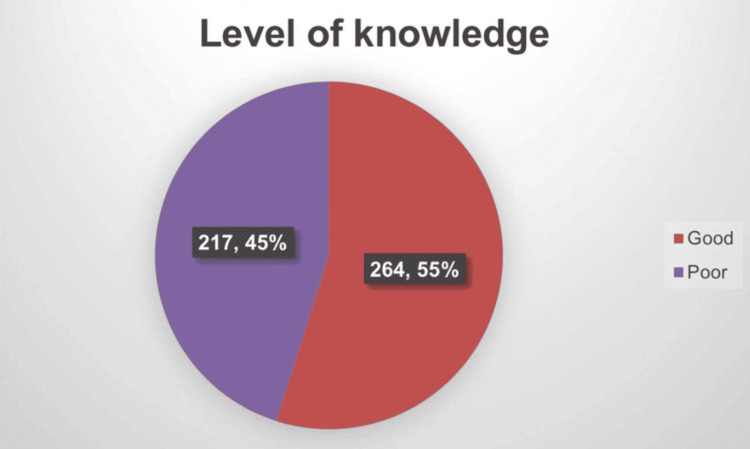 Figure 1
| Characteristic | n (%); median (IQR) |
| Gender | |
| Female | 275 (57%) |
| Male | 206 (43%) |
| Age (years) | 22.00 (20.0, 23.0) |
| Source of information about glaucoma | |
| Books & magazine | 86 (18%) |
| Doctor | 245 (51%) |
| Friends | 27 (5.6%) |
| Social media | 123 (26%) |
| Duration till consulting a physician in case of having eye problems | |
| Immediately | 383 (80%) |
| A day or two | 72 (15%) |
| After 2 days | 26 (5.4%) |
| History of screening for glaucoma before | |
| No | 423 (88%) |
| Yes | 58 (12%) |
| Characteristic | No | Yes |
| Heard about glaucoma before | 65 (14%) | 416 (86%)* |
| Glaucoma should be treated early | 26 (5.4%) | 455 (95%)* |
| Regular check-ups of the eyes from the age of 40 are necessary to detect glaucoma early | 40 (8.3%) | 441 (92%)* |
| Glaucoma will lead to blindness | 41 (8.5%) | 440 (91%)* |
| The blindness resulting from glaucoma can be treated | 228 (47%) | 253 (53%)* |
| Red eye is a symptom of glaucoma | 194 (40%) | 287 (60%)* |
| Symptoms of glaucoma include eye pain | 84 (17%) | 397 (83%)* |
| Nausea and vomiting are one of the symptoms of glaucoma | 201 (42%) | 280 (58%)* |
| Headache and blurred vision are one of the symptoms of glaucoma | 33 (6.9%) | 448 (93%)* |
| Glaucoma is an asymptomatic disease | 281 (58%) | 200 (42%)* |
| Glaucoma is a hereditary disease | 229 (48%) | 252 (52%)* |
| Chronic diseases (diabetes mellitus, hypertension) are risk factors for glaucoma | 56 (12%) | 425 (88%)* |
| People more than 60 years of age are more susceptible to glaucoma | 29 (6.0%) | 452 (94%)* |
| Surgeries or a previous eye injury are risk factors for glaucoma | 114 (24%) | 367 (76%)* |
| Farsightedness and severe nearsightedness are risk factors for glaucoma | 188 (39%) | 293 (61%)* |
| Early screening helps avoid complications of glaucoma | 37 (7.7%) | 444 (92%)* |
| The only treatment for glaucoma is surgical | 261 (54%) | 220 (46%)* |
| It is important to tell your doctor you have glaucoma to avoid medication that can exacerbate the glaucoma | 39 (8.1%) | 442 (92%)* |
| Glaucoma results from | ||
| Damage to the optic nerve* | 157 (33%) | |
| Blurry lens | 218 (45%) | |
| I do not know | 106 (22%) | |
| Characteristic | Good, N = 2641 | Poor, N = 2171 | Test statistic | p-value2 |
| Gender | 0.7 | 0.6 | ||
| Female | 154 (56%) | 121 (44%) | ||
| Male | 110 (53%) | 96 (47%) | ||
| Age (years) | 22.0 (21.0, 23.0) | 21.0 (20.0, 23.0) | 230,880 | <0.001 |
| Source of information about glaucoma | 27.5 | <0.001 | ||
| Books & magazine | 54 (63%) | 32 (37%) | ||
| Doctor | 152 (62%) | 93 (38%) | ||
| Friends | 9 (33%) | 18 (67%) | ||
| Social media | 49 (40%) | 74 (60%) | ||
| Duration till consulting a physician in case of having eye problems | 8.9 | 0.047 | ||
| Immediately | 221 (58%) | 162 (42%) | ||
| A day or two | 31 (43%) | 41 (57%) | ||
| After 2 days | 12 (46%) | 14 (54%) | ||
| History of screening for glaucoma | 0.2 | 0.2 | ||
| No | 228 (54%) | 195 (46%) | ||
| Yes | 36 (62%) | 22 (38%) | ||
| Characteristic | OR | 95% CI | p-value |
| Gender | |||
| Female | — | — | |
| Male | 1.4 | 0.9, 2.1 | 0.08 |
| Age | 1 | 0.9, 1.1 | 0.7 |
| Source of information about glaucoma | |||
| Doctor | — | — | |
| Books & magazine | 0.9 | 0.6, 1.6 | 0.9 |
| Friends | 3.1 | 1.4, 7.7 | 0.009 |
| Social media | 2.4 | 1.5, 3.9 | <0.001 |
| Duration till consulting a physician in case of having eye problems | |||
| Immediately | — | — | |
| A day or two | 1.4 | 0.8, 2.4 | 0.2 |
| After 2 days | 1.4 | 0.6, 3.2 | 0.4 |
| History of screening for glaucoma | |||
| No | — | — | |
| Yes | 0.7 | 0.4, 1.3 | 0.3 |
Peer Reviews
No public reviews on file for this paper yet. If you reviewed it on a platform where reviews are public (OpenReview, ICLR, NeurIPS, ICML), you can paste yours below so the community can read it here.
Videos
No videos yet. Explain this paper in a talk, walkthrough, or lecture? Add one.
Taxonomy
TopicsGlaucoma and retinal disorders · Retinal Imaging and Analysis · Retinal Diseases and Treatments
Introduction
Glaucoma encompasses a group of progressive optic neuropathies characterized by irreversible damage to the optic nerve, frequently-but not exclusively-associated with elevated intraocular pressure (IOP). It is recognized globally as the second leading cause of irreversible blindness [1]. Recent epidemiological estimates indicate that more than 76 million individuals were affected by glaucoma worldwide in 2020, with projections suggesting an increase to over 111 million by the year 2040 [2].
In the Kingdom of Saudi Arabia, a cross-sectional study conducted in 2019 in the Riyadh governorate reported a glaucoma prevalence of 5.6% [3]. This prevalence is comparable to findings from neighboring countries such as Qatar and Iran [4,5].
Multiple risk factors have been implicated in the development of glaucoma. These include elevated IOP, age above 40 years, diabetes mellitus, systolic hypertension, and a positive family history of glaucoma [6].
A major challenge in the management of glaucoma is its typically asymptomatic course in the early stages, which has led to its description as "the silent thief of sight" [7]. Given the irreversible nature of vision loss due to glaucoma, early detection and timely intervention are essential, highlighting the critical need for disease awareness among future healthcare providers [8].
As future physicians and public health educators, medical students are pivotal in the early detection and awareness campaigns related to glaucoma. Studies assessing their level of awareness have shown varying degrees of knowledge. Most students know glaucoma and understand it is a treatable condition [9,10]. However, the depth of their knowledge remains inconsistent. For example, a study from Punjab reported that 45% of medical students correctly identified glaucoma as the leading cause of irreversible blindness, and 48% recognized its genetic predisposition [11]. Similarly, in Southern Nigeria, medical students displayed good general knowledge of the disease, but confidence in performing ocular examinations was low [9].
A study conducted in Ghana revealed that while the term "glaucoma" was widely recognized among healthcare students, substantial gaps existed in understanding key elements such as risk factors, disease pathophysiology, and available treatment options [12]. Notably, many students lack adequate awareness regarding the asymptomatic nature and irreversibility of primary open-angle glaucoma (POAG). Only 30% of students in the Punjab study were aware that POAG is typically asymptomatic, and less than half recognized the irreversible nature of glaucoma-related vision loss [11]. Another study reported that only 12.2% of students correctly identified POAG as asymptomatic [13]. These findings suggest that enrollment in a health sciences program does not inherently ensure a comprehensive understanding of glaucoma [10].
Despite the clinical importance of glaucoma, data regarding knowledge levels among medical students in Saudi Arabia remain limited, particularly in the southern regions such as Aseer. Therefore, this study aims to assess the knowledge of glaucoma among medical students at King Khalid University.
Materials and methods
Study design, setting, and population
A cross-sectional study was conducted among the medical students in King Khalid University of Saudi Arabia between March and May 2025. We excluded students with cognitive problems who could not respond to the questionnaire and those who refused to participate in the study. Non-students, physicians, and men and women from colleges other than Medicine, Pharmacy, Dentistry, and Nursing were also excluded.
Sample size calculation
The sample size was calculated based on the Richard Geiger formula of sample size estimation [14]. With a margin of error of 5%, a confidence level of 95%, and an estimated proportion of attributes of 50%, 385 medical students were selected.
Sampling technique and study instrument
Data were collected conveniently through Google Forms (Google, Mountain View, CA, US) distributed through social media platforms using an Arabic self-administered questionnaire. The questionnaire was developed based on literature from an open-access study [15], and we used it following its open-access license. It underwent face validity evaluation by family medicine specialists.
A pilot study involving 20 students was conducted to assess the clarity and comprehensibility of the questionnaire. Feedback from the pilot study led to minor refinements, and responses from the pilot study were excluded from the final analysis.
The finalized version consisted of two sections; the first included demographic characteristics such as age, gender, sources of information about glaucoma, duration till consulting a physician in case of having eye problems, and history of screening for glaucoma before. The second assessed the knowledge of glaucoma regarding its signs and symptoms, risk factors, and consequences.
Statistical analysis
Data were gathered in Microsoft Excel (Microsoft Corp., Redmond, WA, US), cleaned, and analyzed using SPSS version 26 (IBM Corp., Armonk, NY, US). The normality of continuous variables was assessed using histograms and the Kolmogorov-Smirnov test. Descriptive statistics included frequencies and percentages for categorical variables and median with interquartile range (IQR) for continuous variables. Correct answers were coded as one for the knowledge score, incorrect answers were coded as zero, and the total score was calculated. Participants who scored ≥ the mean were considered to have good knowledge of glaucoma. Pearson's Chi-squared and Wilcoxon rank sum tests were performed to identify predictors of good knowledge of glaucoma. Statistical significance was set at p < 0.05.
Ethical considerations
The study was approved by the scientific research ethics committee of King Khalid University (Institutional Review Board (IRB) registration number 2025-708). Informed consent was obtained electronically via a mandatory consent checkbox in Google Forms before participants could proceed with the survey. Data confidentiality was maintained by anonymizing responses, with no personally identifiable information collected.
Results
A total of 481 participants were included in the study. The majority were women, 275 (57%), while men accounted for 206 (43%). The median age was 22.00 years (IQR: 20.00, 23.00). Regarding the source of information about glaucoma, 245 (51%) participants reported doctors as their primary source, followed by 123 (26%) who relied on social media, 86 (18%) who referred to books and magazines, and 27 (5.6%) who mentioned friends.
Regarding health-seeking behavior, 383 (80%) participants reported that they would immediately consult a physician in case of eye problems. Additionally, 72 (15%) reported consulting a physician within a day or two, and 26 (5.4%) would do so after more than two days. Despite this awareness, only 58 (12%) participants reported having been screened for glaucoma before (Table 1).
Most participants, 414 (86%), had previously heard of glaucoma, and a significant proportion, 457 (95%), acknowledged the necessity of early treatment. In addition, 443 (92%) recognized the importance of routine eye examinations starting at 40 for early detection, and 440 (91%) correctly identified that glaucoma can lead to blindness. However, only 255 (53%) were aware that blindness resulting from glaucoma is irreversible.
Concerning symptoms, 399 (83%) correctly reported eye pain as a symptom, 279 (58%) recognized nausea and vomiting, and 448 (93%) identified headache and blurred vision as associated features. Notably, 202 (42%) correctly understood that glaucoma can be asymptomatic.
More than half of the participants, 250 (52%), were aware of the hereditary nature of the disease, and 423 (88%) identified chronic conditions such as diabetes mellitus and hypertension as risk factors. Approximately 452 (94%) acknowledged that individuals above 60 are at higher risk, and 366 (76%) recognized previous eye trauma or surgery as contributing factors. Additionally, 294 (61%) correctly identified refractive errors (such as farsightedness and high myopia) as risk factors. Furthermore, 443 (92%) agreed that early screening prevents complications.
Despite this, 260 (54%) correctly believed that surgery is the only treatment for glaucoma. While a high proportion, 443 (92%), understood the importance of informing healthcare providers about a glaucoma diagnosis to avoid medications that may worsen the condition, only 158 (33%) correctly identified optic nerve damage as the underlying cause of glaucoma, as shown in Table 2.
The mean knowledge score was 13.9 ± 2.5, with a median of 14, minimum of 6, and maximum of 19. However, 264 (54.9%) had good knowledge of glaucoma, while 217 (45.1%) had poor knowledge (Figure 1).
Level of knowledge regarding glaucoma
Gender was not significantly associated with the level of knowledge regarding glaucoma (p = 0.6); however, women had higher knowledge than men (56% vs. 53.4%). However, participants with a higher level of knowledge had a significantly greater median age than those with lower knowledge levels (p < 0.001). Participants who reported obtaining information about glaucoma from books and magazines (62.8%) had good knowledge compared to 62% of those who got their information from doctors (p < 0.001), 33.3% from friends, and 39.8% from social media.
Additionally, 57.7% of those who stated they would consult a physician immediately upon experiencing eye problems had significantly greater knowledge than 43.1% of those who consult within a day or two and 46.2% of those who consult after two days, respectively (p = 0.047). Similarly, participants who had screened for glaucoma before had higher levels of good knowledge than those who did not (62.1% vs. 53.9%); however, the association was not statistically significant (p = 0.2) (Table 3).
Among the examined factors, only the source of information about glaucoma showed a significant association with the knowledge level. Students who reported friends (odds ratio (OR): 3.1, 95% confidence interval (CI): 1.4, 7.7, p = 0.009) or social media (OR: 2.4, 95% CI: 1.5, 3.9, p < 0.001) as their primary sources demonstrated higher knowledge scores compared to those who cited doctors as their main source of information (Table 4).
Discussion
Glaucoma is a group of eye disorders characterized by progressive optic nerve damage, often associated with elevated IOP, and is recognized as the second leading cause of irreversible blindness worldwide [1]. It is estimated that over 76 million people were affected by glaucoma globally in 2020, and the number is expected to rise to over 111 million by 2040 [2]. One of the most challenging aspects of glaucoma is its asymptomatic nature in the early stages, earning it the label "the silent thief of sight" [7]. Since early diagnosis and timely management are crucial to preventing permanent vision loss, awareness and understanding of the disease among future healthcare professionals are essential [8]. Medical students, in particular, play a key role in promoting early detection and educating the public. Despite this, limited data exist regarding their level of knowledge and awareness of glaucoma, especially in the Aseer Region of Saudi Arabia. This study evaluated the awareness and understanding of glaucoma among medical students at King Khalid University.
When compared with previous literature, our findings demonstrate relatively higher general awareness among medical students. For instance, a study conducted among medical students in North India found that while 100% knew glaucoma is an eye disease, many were unaware of its silent progression, risk factors, and complications. Only 45% recognized that glaucoma can be asymptomatic, and misconceptions about treatment were common [16]. In our study, 42% correctly identified glaucoma as potentially asymptomatic, which is slightly lower, reflecting a similar trend in insufficient understanding of the disease’s silent nature.
In a Saudi study conducted in Taif City, 58.5% of participants had heard of glaucoma, and 74.5% knew it could lead to blindness [17]. Our study demonstrated higher awareness levels in both categories (86% and 91%, respectively), possibly due to the medical background of our participants. However, both studies shared similarities in that participants often lacked knowledge about glaucoma’s irreversibility and underlying pathology. Moreover, our study revealed that 54% of participants incorrectly believed surgery is the sole treatment for glaucoma, highlighting a significant misconception. This aligns with findings from a study conducted in Jazan, Saudi Arabia, where only 27.8% of participants were aware of treatment options for glaucoma, indicating a substantial gap in public knowledge regarding glaucoma management [18]. Furthermore, a recent study conducted in Abha, Southern Saudi Arabia, reported that while 77.1% of participants had heard of glaucoma, detailed knowledge remained limited. Additionally, the study showed that awareness was significantly higher among participants who consulted a physician immediately upon experiencing eye problems (53.2%) compared to those who delayed consultation (38.7%), and among those who had undergone glaucoma screening (57.1%) versus those who had not (45.8%) (p = 0.042). These findings are consistent with our results, where older students and those with prior screening experiences demonstrated significantly better knowledge levels (p < 0.001 and p = 0.2, respectively) [15]. Another study from Ghana also indicated that health students had high awareness levels but still showed significant knowledge gaps in disease mechanisms and management options [12].
Our results also show an interesting trend in information sources. Students who obtained information from books and magazines demonstrated significantly higher knowledge than those who relied on doctors or social media (p < 0.001). This might indicate that more structured or academically rigorous sources promote better retention and understanding, consistent with the findings from Nigeria, where formal sources like lectures, seminars, and ophthalmologists dominated glaucoma awareness [19]. While 80% of our participants stated they would consult a physician immediately for eye problems, only 12% had ever undergone glaucoma screening. This highlights a disconnect between perceived importance and personal health-seeking behavior, echoing findings from previous studies in Saudi Arabia and other regions [20].
Our results showed an increased level of glaucoma knowledge associated with disease awareness (p < 0.001). Moreover, we found a significantly higher level of knowledge among women (p = 0.042); this is different from the results reported by a previous investigation among the adult population, showing significantly higher awareness in men than women [21].
Despite these valuable insights, this study has several limitations. First, it employed a cross-sectional design, which does not establish causality. Second, the self-reported nature of the questionnaire could introduce bias, particularly social desirability bias. Third, the findings may not be generalizable beyond the Aseer Region or to non-medical populations. Furthermore, we acknowledge that formal psychometric validation (e.g., reliability and construct validity) was not performed. Lastly, although the sample size was adequate, a more balanced representation from different academic years could have added more depth to our analysis.
Conclusions
In conclusion, medical students in the Aseer Region of Saudi Arabia demonstrate commendable awareness of glaucoma and its risk factors, but there are evident gaps in detailed clinical knowledge, particularly regarding irreversible outcomes and disease mechanisms. These findings highlight the need to integrate more structured ophthalmologic education into medical curricula and to promote routine screening practices among future healthcare providers.
The reference list from the paper itself. Each links out to its DOI / PubMed record.
- 1Global prevalence of glaucoma and projections of glaucoma burden through 2040: a systematic review and meta-analysis Ophthalmology Tham YC Li X Wong TY Quigley HA Aung T Cheng CY 2081209012120142497481510.1016/j.ophtha.2014.05.013 · doi ↗ · pubmed ↗
- 2The number of people with glaucoma worldwide in 2010 and 2020 Br J Ophthalmol Quigley HA Broman AT 2622679020061648894010.1136/bjo.2005.081224 PMC 1856963 · doi ↗ · pubmed ↗
- 3The prevalence and determinants of glaucoma among 40 years and older Saudi residents in the Riyadh Governorate (except the capital) - a community based survey Saudi J Ophthalmol Khandekar R Chauhan D Yasir ZH Al-Zobidi M Judaibi R Edward DP 3323373320193192044210.1016/j.sjopt.2019.02.006PMC 6950957 · doi ↗ · pubmed ↗
- 4Prevalence and determinants of glaucoma in citizens of Qatar aged 40 years or older: a community-based survey Middle East Afr J Ophthalmol Al-Mansouri FA Kanaan A Gamra H Khandekar R Hashim SP Al Qahtani O Ahmed MF 1411491820112173132510.4103/0974-9233.80703 PMC 3119283 · doi ↗ · pubmed ↗
- 5A population-based survey of the prevalence and types of glaucoma in central Iran: the Yazd Eye Study Ophthalmology Pakravan M Yazdani S Javadi MA 1977198412020132366446410.1016/j.ophtha.2013.02.029 · doi ↗ · pubmed ↗
- 6The association between cigarette smoking and primary open-angle glaucoma: a systematic review Int Ophthalmol Jain V Jain M Abdull MM Bastawrous A 2913013720172713859110.1007/s 10792-016-0245-0 · doi ↗ · pubmed ↗
- 7Global data on visual impairment in the year 2002 Bull World Health Organ Resnikoff S Pascolini D Etya’ale D Kocur I Pararajasegaram R Pokharel GP Mariotti SP 844851822004 https://europepmc.org/article/PMC/262305315640920 PMC 2623053 · pubmed ↗
- 8The Ocular Hypertension Treatment Study: a randomized trial determines that topical ocular hypotensive medication delays or prevents the onset of primary open-angle glaucoma Arch Ophthalmol Kass MA Heuer DK Higginbotham EJ 70171312020021204957410.1001/archopht.120.6.701 · doi ↗ · pubmed ↗