Impact of Studying Clinical Case Notes on the Learning of Medical Students: A Comparative Study
Shah Jehan, Tahreem Sajjad, Babajide Obidigbo

TL;DR
Medical students who studied real patient case notes improved more in knowledge than those who didn't, suggesting case notes are useful for learning.
Contribution
This study shows that using real clinical case notes enhances medical students' learning outcomes compared to standard teaching.
Findings
Students who studied case notes scored significantly higher after training (19.6 vs. 17.1).
Pre-placement scores were similar between groups, but post-placement scores showed significant improvement in the case note group.
Case note review is a practical and effective addition to traditional medical education.
Abstract
Objectives The purpose of this study was to evaluate the impact of case notes on the learning of medical students. Patients’ case notes reflect real-life events and may be used as valuable learning resources for medical students. This study aims to investigate whether learning is improved when students study real case notes compared to students who do not. Design We allocated 14 third-year medical students into two groups during their six weeks of surgical clinical placement. Both groups received teaching on five common surgical conditions from the same clinical teaching fellow. Group 1 received standard teaching, while Group 2 received standard teaching and were also given the task of summarising clinical case notes featuring the same five conditions. Students’ knowledge was assessed at the beginning and end of their placement by a multiple-choice written paper using 25 standardised…
Genes, proteins, chemicals, diseases, species, mutations and cell lines named across the full text — each resolved to its canonical identifier and authoritative record.
Click any figure to enlarge with its caption.
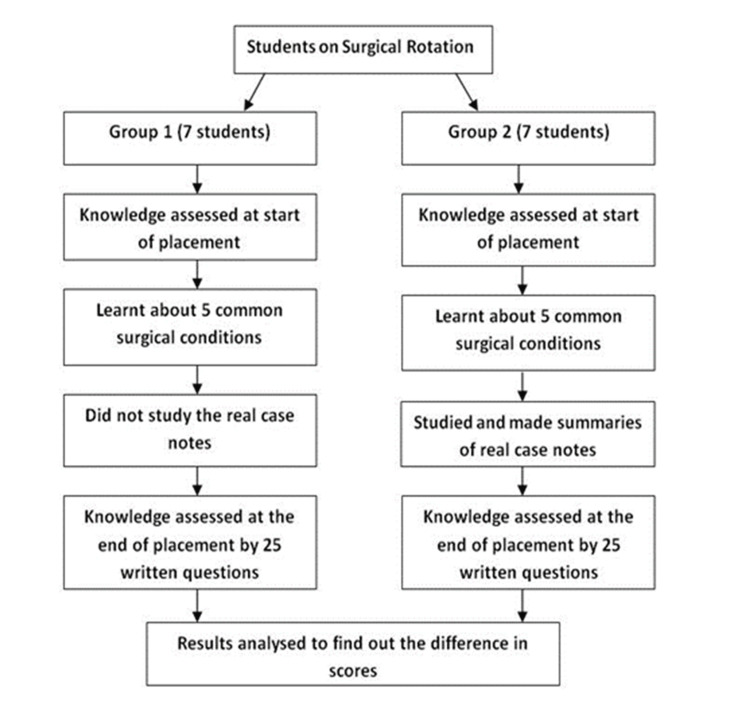 Figure 1
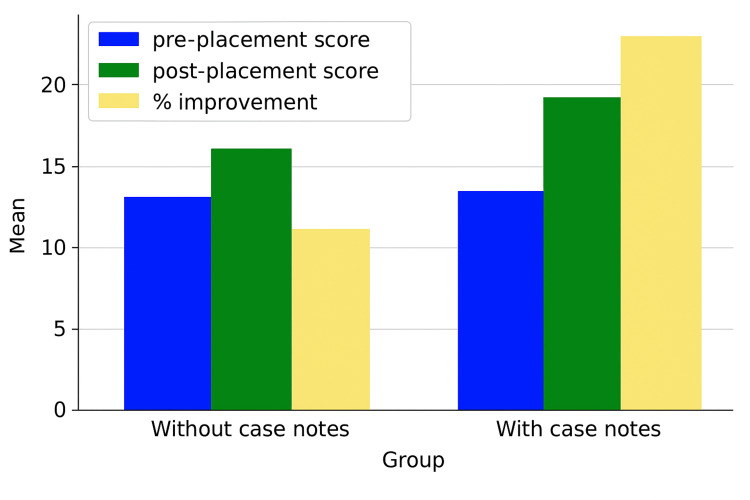 Figure 2
| Group 1 | Group 2 | ||||
| Pre-placement | Post-placement | Improvement (% improvement) | Pre-placement | Post-placement | Improvement (% improvement) |
| 13 | 16 | 3 (12%) | 14 | 23 | 9 (36%) |
| 15 | 16 | 1 (4%) | 13 | 18 | 5 (20%) |
| 13 | 18 | 5 (20%) | 20 | 22 | 2 (8%) |
| 13 | 17 | 4 (16%) | 14 | 20 | 6 (24%) |
| 16 | 17 | 1 (4%) | 13 | 18 | 5 (20%) |
| 17 | 17 | 0 (0%) | 11 | 16 | 5 (20%) |
| 13 | 19 | 6 (24%) | 13 | 20 | 7 (28%) |
Peer Reviews
No public reviews on file for this paper yet. If you reviewed it on a platform where reviews are public (OpenReview, ICLR, NeurIPS, ICML), you can paste yours below so the community can read it here.
Videos
No videos yet. Explain this paper in a talk, walkthrough, or lecture? Add one.
Taxonomy
TopicsInnovations in Medical Education · Problem and Project Based Learning · Clinical Reasoning and Diagnostic Skills
Introduction
Medical education requires a careful balance between the acquisition of theoretical knowledge and its practical application in clinical settings. To support this, educational strategies must be tailored from the earliest stages of training. Experiential learning, where students engage with real-life clinical situations, provides opportunities to integrate conceptual understanding with hands-on application. These approaches have been shown to enhance students’ ability to register, retain, and reproduce new information effectively [1,2].
However, experiential learning in clinical settings can be inconsistent and limited by patient availability, placement variability, and time constraints. To bridge this gap, a structured review of real patient case notes offers a complementary approach that preserves the authenticity of clinical encounters while ensuring consistent exposure to diverse conditions.
At the undergraduate level, exposure to a diverse range of clinical cases can be limited by time constraints and placement variability. Structured engagement with real patient case notes offers a potential solution. When well-prepared, these documents can mirror real patient encounters and present clinical information in a logical sequence, aiding comprehension. Organised presentation of clinical events helps students categorise and assimilate information, thereby improving memory encoding and recall [3].
Traditionally, case notes have been used for documentation, audit, and research purposes. With improved systems of clinical documentation, their potential as educational tools is increasingly recognised. Senior medical students often possess sound theoretical knowledge, yet struggle to manage patients upon entering clinical practice, largely due to limited exposure to the complexity of real-world cases. Learners typically form “illness scripts” based on textbook examples and personal experience [4,5]. However, real patients often deviate from textbook patterns, presenting with comorbidities and psychosocial elements that challenge conventional diagnostic models. Exposure to full patient narratives through case notes can introduce students to this complexity, helping refine their clinical reasoning skills.
Traditionally, case-based learning has relied on instructor-generated or textbook-derived cases, which, although useful, often simplify or idealise clinical scenarios for teaching purposes. Such artificial cases lack the complexity, uncertainty, and contextual richness of real patient documentation, limiting opportunities for learners to engage with authentic clinical reasoning processes.
A recent study among general practitioners found that reviewing patient case notes stimulated reflective learning and prompted modifications in clinical decision-making [6]. All participants endorsed case-based reviews as a valuable method of professional development. Despite this, there is limited research investigating the impact of case note-based learning in undergraduate medical education [7]. While several studies have evaluated the educational benefits of case-based learning, few have specifically examined how reviewing genuine patient case notes influences learning outcomes in medical students. Real case notes reflect the nuanced decision-making, multidisciplinary communication, and evolving patient progress that typify real-world healthcare. This gap in current literature highlights the need to explore whether studying authentic patient case notes can enhance learning more effectively than traditional teaching methods alone.
The aim of this study is to evaluate whether engagement with real patient case notes can enhance learning among medical students. We hypothesise that students who study case notes will demonstrate superior knowledge retention and reproduction compared to those who do not.
Materials and methods
Fourteen third-year medical students participated in this study during their six-week surgical placement. The students were divided into two groups of seven, based on the pre-existing rotation schedule (Figure 1). The first rotation cohort was assigned to Group 1, and the subsequent rotation cohort was assigned to Group 2.
Study design
All students underwent a written assessment at the beginning and end of their placement, consisting of 25 standardised multiple-choice questions (MCQs). These questions assessed knowledge across five common surgical conditions: acute appendicitis, acute cholecystitis, acute pancreatitis, abdominal aortic aneurysm, and ischaemic limb. For each condition, five MCQs were developed by clinical teaching fellows, resulting in a total of 25 questions per student. The complete set of 25 MCQs is provided in Appendix A for transparency and reproducibility. The questions were designed to be appropriate for the students’ level of training and included items testing basic factual knowledge, clinical application, and ethical considerations. Question development was informed by standard surgical textbooks and examination guides, and the questions were reviewed by two senior clinicians with expertise in medical education to ensure face validity and alignment with curriculum standards. Each set of five questions per scenario addressed varied domains, including differential diagnosis, appropriate investigations, first-line management, and complications.
Group 1 received standard small-group teaching by a surgical clinical teaching fellow. The teaching fellow had four to five years of experience across multiple specialties, including general surgery, vascular surgery, orthopaedics, and intensive care, and held a Postgraduate Certificate in Biomedical Education and Membership of the Royal College of Surgeons (MRCS). The teaching sessions involved simulated cases and covered presentation, differential diagnoses, investigations, and management of the core surgical conditions. Group 1 was assessed using the same 25 MCQs in both the first and final week of their placement.
Group 2 was assessed using the same MCQ paper in the first week of placement. In addition to receiving the same standard teaching as Group 1, these students were also asked to independently study the case notes of real patients from the surgical wards. To confirm engagement with this material, students were required to produce a written summary of each of the five clinical cases. The case notes, while not standardised, followed a chronological structure and detailed the full clinical journey from admission to discharge. This included documentation of initial presentation, investigations, interdepartmental communication, operative notes (if applicable), post-operative course, and discharge planning. These notes did not include literature references or structured commentary on learning points but reflected authentic clinical documentation.
After completing their review of the case notes, Group 2 was reassessed using the same 25 MCQs. Both groups spent six weeks on their general surgical rotation and had equal contact time with the clinical teaching fellow. While Group 1 was encouraged to study textbook materials, Group 2 was instructed to study and summarise real patient case notes. However, it could not be verified whether students in Group 2 also used textbooks during their preparation.
The assessment scores of both groups were analysed to determine whether there was a statistically significant difference in performance. Data analysis, including the evaluation of pre- and post-test scores for both groups, was conducted using SPSS Statistics for Windows, version 16.0 (SPSS Inc., Chicago, Ill., USA). The Mann-Whitney U test was employed to compare changes in knowledge scores between the intervention and control groups. This non-parametric test was chosen because the small sample size and non-normal distribution of scores warranted a rank-based comparison of median differences.
This study involved human participants (medical students). Written informed consent was obtained from all participating students prior to inclusion. No identifiable patient data were collected, and therefore, patient consent was not required. The study was conducted as part of an educational evaluation within the surgical rotation and complied with institutional guidelines for student research; as such, no ethical clearance for human participants was necessary.
Results
A total of 14 students were included in the study, with seven students assigned to each group. Figure 2 illustrates the comparison between Group 1 and Group 2 in terms of mean assessment scores, expressed as percentages. Table 1 provides the detailed pre- and post-placement scores for both groups.
Comparison between two groupsThe scores at the beginning and end of the clinical attachment are shown with the percentage in improvement.
In Group 1, the average pre-placement score was 14.2 ± 1.4 (range: 13-17), while the post-placement average increased to 17.1 ± 1.2 (range: 16-19). In Group 2, the average pre-placement score was 14.0 ± 3.0 (range: 11-20), rising to an average post-placement score of 19.6 ± 2.8 (range: 16-23).
Although both groups showed improvement over the six-week placement, Group 2 demonstrated a greater increase in average score following the integration of case note review into their learning process. Statistical analysis using the Mann-Whitney U test indicated that the post-placement score difference between the groups was significant (p = 0.044).
Further analysis was performed to compare the baseline knowledge between the two groups at the start of the placement. There was no statistically significant difference in pre-placement test scores between Group 1 and Group 2 (p = 0.633), suggesting that both groups began the study with comparable knowledge of the five surgical conditions.
Each group's pre- and post-placement scores were then compared to assess individual knowledge gains over the six-week rotation. Both groups demonstrated improvement in their scores, as expected, following structured teaching.
To evaluate the effect of case note review, post-placement scores were compared between the two groups. The group that engaged with clinical case notes (Group 2) showed a statistically significant improvement in post-placement scores compared to Group 1 (p = 0.044). This suggests that supplementing traditional teaching with real patient case notes may enhance knowledge acquisition among undergraduate medical students.
Discussion
There are multiple ways to assimilate new knowledge, but effective learning is reflected in the learner’s ability to retain and reproduce knowledge when required, and to apply it flexibly across different clinical contexts [7]. In medicine, the application of knowledge is rarely straightforward. A clinician's ability to adapt depends not only on their understanding of medical theory but also on the situational context, available resources, clinical experience, and numerous patient-related factors [7].
While textbooks provide structured information on variables such as age, sex, comorbidities, and past medical history, they fall short in addressing more complex aspects of clinical care, such as communication, cultural competence, patient expectations, and psychological insight [8]. These aspects of practice are more effectively learned through real-life exposure and clinical experience [9]. Contextual learning-where students engage with patient care holistically-helps in understanding the interplay of these diverse factors and encourages integrated clinical thinking [7]. Case notes, as reflective narratives of actual patient journeys, illustrate these complexities and contextual interconnections between clinical, social, and systemic factors.
Adult learners benefit when they perceive the relevance and application of what they are learning [10,11]. Case notes support this type of experiential learning by offering a real-world stimulus. While they should not replace textbooks, they can highlight which elements of theoretical knowledge are applicable in specific clinical scenarios. In doing so, they help learners prioritise and deepen their understanding of relevant concepts.
Cox argued that clinical practice extends beyond the application of scientific knowledge, highlighting its inherently complex, multifaceted, and ambiguous nature [12]. Practising clinicians often face diagnostic, ethical, and managerial dilemmas. Case notes, when accurately and comprehensively documented, can reveal how different clinicians manage similar cases in varying ways. These discrepancies in clinical decision-making can provoke critical inquiry among learners. While answers may not be explicitly found in the notes, the questions they raise are pedagogically valuable. Educators can then use these moments to guide students through deeper learning and reflective discussion. In our study, students who reviewed case notes asked more questions, particularly around perceived discrepancies between textbook knowledge and observed clinical practice.
Despite their potential, clinical case notes are underutilised as formal teaching tools. While a few studies have acknowledged their educational value [6], there remains little published guidance on their systematic use in undergraduate training. Previous work has proposed integrating common clinical cases into pre-registration curricula, with an estimated 300 cases serving as a foundation for junior doctor training [13]. We believe this model could be adapted for undergraduate education by curating and standardising a bank of real case notes for each speciality rotation.
During clinical placements, students could complement real patient encounters with a structured review of multiple case notes. For example, a student who sees one patient with right iliac fossa pain due to appendicitis may primarily recall that diagnosis. However, reviewing five additional case notes presenting with similar symptoms but different diagnoses (e.g., ovarian torsion, mesenteric adenitis, ectopic pregnancy, Crohn’s disease, and renal colic) would encourage broader clinical reasoning. This combined exposure would better equip students to construct meaningful differentials, choose appropriate investigations, and plan context-specific management strategies.
Limitations of this study include a small sample size, with only 14 students in total, which limits the generalisability of the findings. In addition, the study assessed only short-term knowledge improvement; long-term retention of knowledge was not evaluated. Finally, although students in Group 2 were asked to focus on case notes, it cannot be excluded that they also used textbooks or other resources, which may have influenced their scores. Future studies should aim to include a larger cohort of medical students across multiple institutions and assess long-term retention to better evaluate the effectiveness of using case notes as a learning tool.
Conclusions
This study demonstrates that reviewing real patient case notes can have a positive impact on medical students’ learning outcomes. Both groups began with comparable baseline knowledge, received identical teaching from the same clinical tutor, and followed the same curriculum. The only additional intervention for Group 2, that is, studying and summarising real clinical case notes, resulted in a significantly greater improvement in assessment scores.
Incorporating real patient case notes into undergraduate teaching can significantly enhance students’ knowledge retention and understanding compared to standard teaching methods alone. Beyond reinforcing factual knowledge, exposure to authentic documentation encourages students to appreciate the complexity of real clinical practice and to develop early clinical reasoning skills. These findings suggest that structured review of patient case notes could be feasibly integrated into existing medical curricula as a low-cost, scalable, and practical supplement to conventional teaching, helping bridge the gap between theoretical learning and clinical application.
The reference list from the paper itself. Each links out to its DOI / PubMed record.
- 1Complexity, leadership, and management in healthcare organisations BMJ Plsek PE Wilson T 7467493232001 https://doi.org/10.1136/bmj.323.7315.7461157698610.1136/bmj.323.7315.746PMC 1121291 · doi ↗ · pubmed ↗
- 2Using theory and research to shape the practice of continuing professional development J Contin Educ Health Prof Fox RD 2382462020001120106310.1002/chp.1340200407 · doi ↗ · pubmed ↗
- 3The structure of medical knowledge in the memories of medical students and general practitioners: categories and prototypes Med Educ Bordage G Zacks R 406416181984650374810.1111/j.1365-2923.1984.tb 01295.x · doi ↗ · pubmed ↗
- 4A cognitive perspective on medical expertise: theory and implication Acad Med Schmidt HG Norman GR Boshuizen HP 611621651990226103210.1097/00001888-199010000-00001 · doi ↗ · pubmed ↗
- 5The influence of medical expertise, case typicality, and illness script component on case processing and disease probability estimates Mem Cognit Custers EJ Boshuizen HP Schmidt HG 38439924199610.3758/bf 032133018718771 · doi ↗ · pubmed ↗
- 6Learning based on patient case reviews: an interview study BMC Med Educ Andersen RS Hansen RP Søndergaard J Bro F 43820081877506310.1186/1472-6920-8-43PMC 2542359 · doi ↗ · pubmed ↗
- 7Coping with complexity: educating for capability BMJ Fraser SW Greenhalgh T 79980332320011158808810.1136/bmj.323.7316.799PMC 1121342 · doi ↗ · pubmed ↗
- 8Examining and recording clinical performance: a critique and some recommendations Educ Health (Abingdon) Cox K 45521320001474179310.1080/135762800110565 · doi ↗ · pubmed ↗