Unlocking hybrid vigor: a new genic male sterile gene in da house
María Flores-Tornero, Chong Teng (滕冲)

Abstract
Genes, proteins, chemicals, diseases, species, mutations and cell lines named across the full text — each resolved to its canonical identifier and authoritative record.
Click any figure to enlarge with its caption.
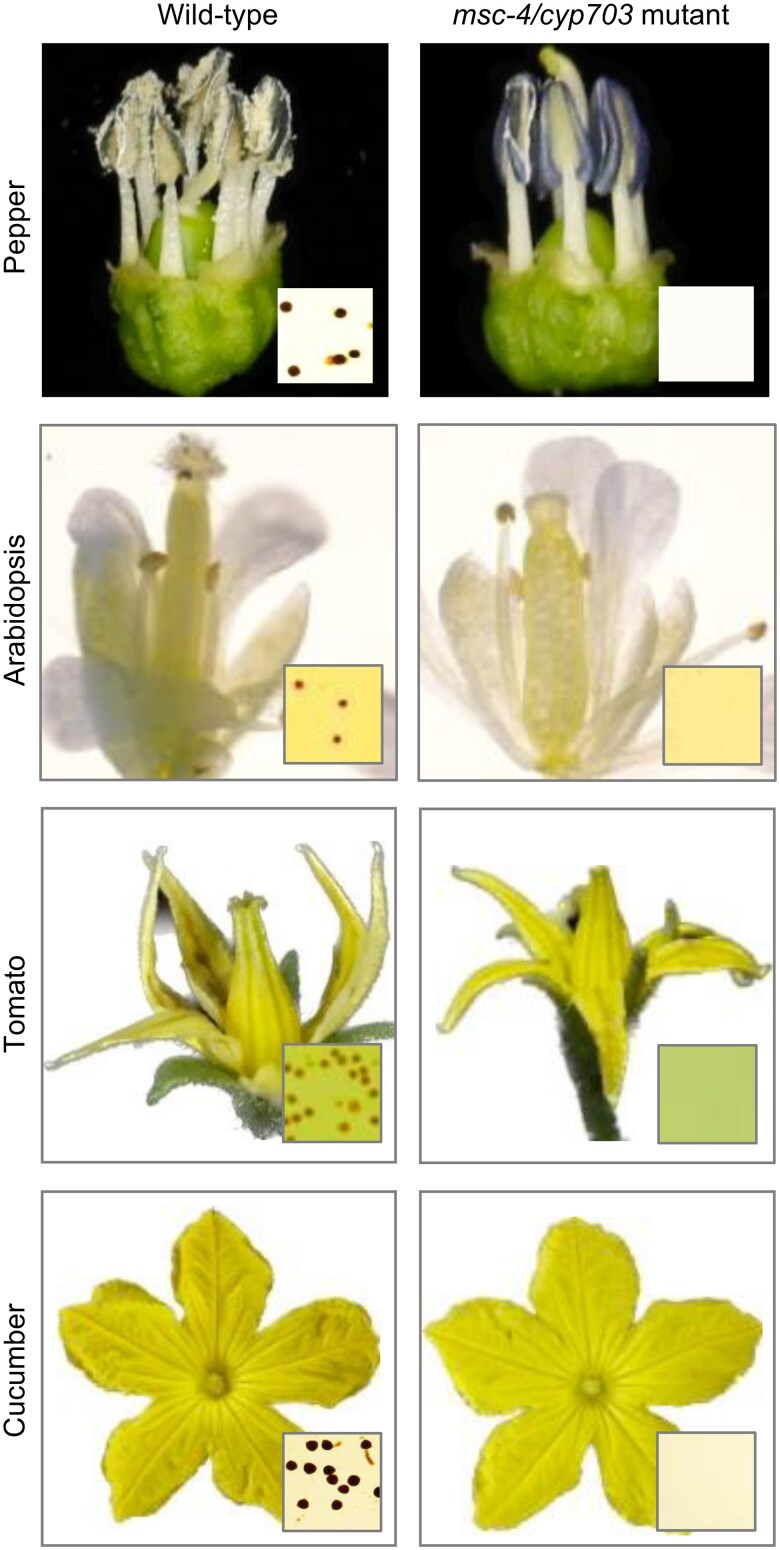 Figure 1
Peer Reviews
No public reviews on file for this paper yet. If you reviewed it on a platform where reviews are public (OpenReview, ICLR, NeurIPS, ICML), you can paste yours below so the community can read it here.
Videos
No videos yet. Explain this paper in a talk, walkthrough, or lecture? Add one.
Taxonomy
TopicsPlant Reproductive Biology · Sperm and Testicular Function · Genetic and Clinical Aspects of Sex Determination and Chromosomal Abnormalities
Seed and fruit production, the foundation of the human food supply, relies on sexual reproduction in plants. In flowering plants, pollen grains produced in the anthers fertilize ovules, forming seeds that will be protected inside the fruits. Many plants preferentially self-pollinate (Irish 2017), but this natural process can be agronomically disadvantageous.
Many plant breeders prefer to cross-pollinate their plants to produce hybrids with an improved agronomic performance compared with their parents, a phenomenon called hybrid vigor (Groszmann et al. 2014). Those hybrids are typically obtained either by artificial interventions or natural mechanisms that prevent self-pollination and ensure cross-pollination. In many crops such as pepper and soybean, hybrids are produced by anther removal before pollen releases, but this is a time- and labor-consuming task.
Fortunately, several mutations that cause male sterility and enable hybrid seed production have been identified that are either naturally occurring or produced by gene editing (Chen et al. 2021; Zhang et al. 2023). To trigger male sterility, plant breeders originally used cytoplasmic male sterility; however, due to its lack of stability, breeders are shifting to the gene male sterility approach (GMS). In Arabidopsis, rice, and maize, GMS is already widely used, whereas in other species such as pepper, tomato, cucumber, and related vegetables, hybrid production still relies on time-consuming emasculation practices. In pepper, more than 20 loci controlling GMS have been reported, but only 3 male-sterile (ms) loci have been identified (Jeong et al. 2018; Cheng et al. 2020; Dong et al. 2022).
In this issue of Plant Physiology, Du et al. identified and characterized Male sterile from China-4 (Msc-4), a new natural GMS allele in pepper, widening the possibilities for hybrid seed production.
The authors observed that the vegetative and reproductive growth of msc-4 resembles the fertile version, but fruits are smaller and seedless. Although msc-4 anthers have no pollen, the ovules are fertile, and cross-pollinations with fertile Msc-4 pollen produces fertile progeny (Fig. 1). Moreover, authors confirmed that msc-4 is a new independent allele by outcrossing with the other 3 already known msc lines. Furthermore, the authors confirmed the stability of the sterile phenotype regardless the location by growing msc-4 mutants in different locations.
To further dissect the cause of the sterility problem, Du et al. characterized anther and pollen development of msc-4 and wild type by using complementary microscopy techniques. At stage 5, Du et al. observed that tapetal cells, the outer layer of cells providing nutrients and waxy materials building the pollen wall of msc-4, were abnormally full of vacuoles and microspore formation was compromised, causing shrunken and collapsed microspores. These results indicate that male sterility is due to an abnormal tapetum and pollen wall formation.
To identify the gene corresponding to this defect, Du et al. used high-throughput short-read sequencing-based bulked segregation analysis and sequence variation calling to locate the msc-4 locus. In the region of interest, 11 candidate proteins were annotated (open reading frame [ORF]1-ORF11), but only 4 were expressed in developing anthers. ORF1 was the best candidate for the msc-4 locus because the authors identified in this region a point mutation that prematurely stops the protein, and silencing experiments of ORF1 yielded no pollen.
The ORF1 gene encodes CYP703A2, an ortholog of the Arabidopsis cytochrome P450 monooxygenase required for lipid metabolism during pollen wall formation and exine pollen development. It was previously shown that loss of CYP703 function disrupts pollen exine development, resulting in complete male sterility in Arabidopsis (Morant et al. 2007).
To understand the molecular mechanisms that produce male sterility in msc-4 peppers, transcriptomic sequencing was performed in anther samples at different developmental stages. After differentially expressed gene identification and clustering, the authors performed a gene enrichment analysis with differentially expressed genes from stage 5, relating them with pollen wall assembly and lipid metabolism.
In addition, phylogenetic analyses indicated the conservation of Msc-4 across species, so the authors used Msc-4 from pepper to complement the sterile phenotype of the Arabidopsis cyp703a2. Moreover, the CRISPR-generated knockout of CYP703 in tomato and cucumber caused male sterility (Fig. 1), strongly supporting the similar role of MSC-4 and CYP703A2 as well as its high conservation.
In conclusion, a natural mutant of CYP703 (msc-4) confers genic male sterility not only in pepper but also in tomato and cucumber because Msc-4/CYP703 encodes an enzyme involved in lipid metabolism during pollen exine formation. Future research may expand our understanding of this mechanism in other crops, clarifying how lipid metabolism integrates with tapetal development and leading to new biotechnological tools to improve hybrid production.
The reference list from the paper itself. Each links out to its DOI / PubMed record.
- 1Chen G, Zhou Y, Kishchenko O, Stepanenko A, Jatayev S, Zhang D, Borisjuk N. Gene editing to facilitate hybrid crop production. Biotechnol Adv. 2021:46:107676. 10.1016/j.biotechadv.2020.10767633285253 · doi ↗ · pubmed ↗
- 2Cheng Q, Li T, Ai Y, Lu Q, Wang Y, Wu L, Liu J, Sun L, Shen H. Phenotypic, genetic, and molecular function of msc-2, a genic male sterile mutant in pepper (Capsicum annuum L.). Theor Appl Genet. 2020:133(3):843–855. 10.1007/s 00122-019-03510-131863155 · doi ↗ · pubmed ↗
- 3Dong J, Hu F, Guan W, Yuan F, Lai Z, Zhong J, Liu J, Wu Z, Cheng J, Hu K. A 163-bp insertion in the Capana 10g 000198 encoding a MYB transcription factor causes male sterility in pepper (Capsicum annuum L.). Plant J. 2022:113(3):521–535. 10.1111/tpj.1606436534067 · doi ↗ · pubmed ↗
- 4Du H, Zhang X, Li R, Chen B, Zhang X, Wang Y, Wang J, Wang T, Wen C, Liu N, et al The natural Msc-4 allele confers genic male sterility via conserved and divergent gene regulatory mechanisms in pepper. Plant Physiol. 199:kiaf 474. 10.1093/plphys/kiaf 47441025884 · doi ↗ · pubmed ↗
- 5Groszmann M, Gonzalez-Bayon R, Greaves IK, Wang L, Huen AK, Peacock WJ, Dennis ES. Intraspecific Arabidopsis hybrids show different patterns of heterosis despite the close relatedness of the parental genomes. Plant Physiol. 2014:166(1):265–280. 10.1104/pp.114.24399825073707 PMC 4149712 · doi ↗ · pubmed ↗
- 6Irish V . The ABC model of floral development. Curr Biol. 2017:27(17):R 887–R 890. 10.1016/j.cub.2017.03.04528898659 · doi ↗ · pubmed ↗
- 7Jeong K, Choi D, Lee J. Fine mapping of the genic male-sterile ms 1 gene in Capsicum annuum L. Theor Appl Genet. 2018:131(1):183–191. 10.1007/s 00122-017-2995-029032401 · doi ↗ · pubmed ↗
- 8Morant M, Jørgensen K, Schaller H, Pinot F, Møller BL, Werck-Reichhart D, Bak S. CYP 703 is an ancient cytochrome P 450 in land plants catalyzing in-chain hydroxylation of lauric acid to provide building blocks for sporopollenin synthesis in pollen. Plant Cell. 2007:19(5):1473–1487. 10.1105/tpc.106.04594817496121 PMC 1913723 · doi ↗ · pubmed ↗