The influence of visual attention on letter recognition and reading acquisition in Arabic
Alaa Ghandour, Emmanuel Trouche, Dominique Guillo, Sylviane Valdois

TL;DR
The study explores how visual attention affects reading in Arabic, finding that letter knowledge mediates the relationship between visual attention and reading fluency.
Contribution
The study reveals that the influence of visual attention on reading in Arabic is mediated by letter knowledge, which differs from findings in Indo-European languages.
Findings
Visual attention span (VAS) was strongly related to letter knowledge (LK) and reading fluency.
The direct effect of VAS on reading disappeared when letter knowledge was considered.
Phonological awareness and VAS uniquely predicted reading outcomes, independent of rapid automatized naming.
Abstract
The involvement of phonological awareness (PA), rapid automatized naming (RAN) and letter knowledge (LK) in Arabic reading achievement is well established, but evidence for a unique contribution of visual attention span (VAS) remains limited. Studies in Indo-European languages have reported a direct and unique influence of VAS on reading, a relationship that might also be expected in Arabic. However, the recognition of the complex Arabic letters may require substantial attentional resources, thereby reducing the direct contribution of VAS to reading. We assessed PA, RAN, LK and VAS in Arabic-speaking beginning readers, along with their reading fluency for both nonsense syllables and real words. Strong relationships were found between all four predictors and both reading outcomes. LK and VAS were also substantially related. PA and VAS were unique predictors of reading, independent of…
Genes, proteins, chemicals, diseases, species, mutations and cell lines named across the full text — each resolved to its canonical identifier and authoritative record.
Click any figure to enlarge with its caption.
 Figure 1
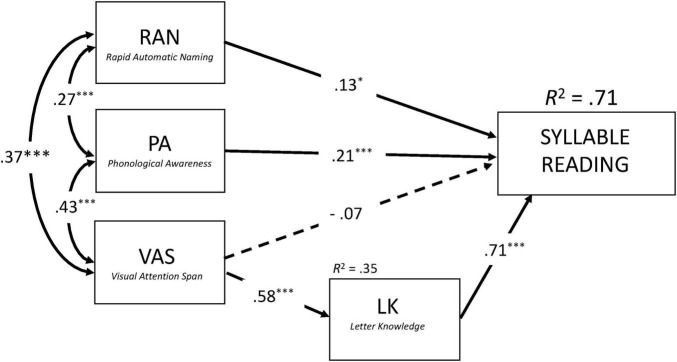 Figure 2
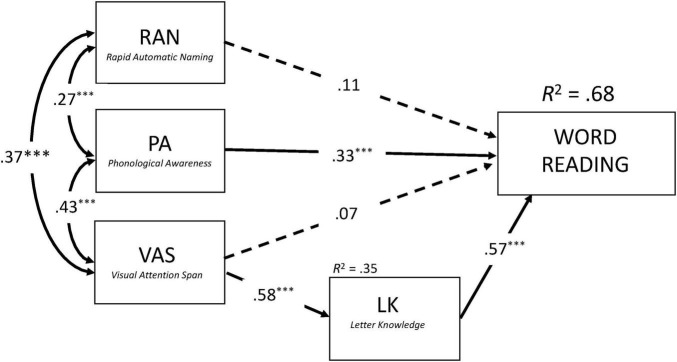 Figure 3
 Figure 4
 Figure 5
 Figure 6
 Figure 7
 Figure 8
 Figure 9
 Figure 10
 Figure 11
 Figure 12
 Figure 13
 Figure 14
 Figure 15
Peer Reviews
No public reviews on file for this paper yet. If you reviewed it on a platform where reviews are public (OpenReview, ICLR, NeurIPS, ICML), you can paste yours below so the community can read it here.
Videos
No videos yet. Explain this paper in a talk, walkthrough, or lecture? Add one.
Taxonomy
TopicsReading and Literacy Development · Cognitive and developmental aspects of mathematical skills · Hearing Impairment and Communication