Feasibility of Measuring Hair Glucocorticoids as a Potential Biomarker for Chronic Stress in Older Adults With Intellectual Disabilities
Jasper Steven Dijkema, Mylène Nathalie Böhmer, Patrick Jan Eugene Bindels, Dederieke Anne Maria Maes‐Festen, Alyt Oppewal

TL;DR
This study explores whether measuring glucocorticoids in hair can assess chronic stress in older adults with intellectual disabilities, finding moderate feasibility with challenges in males and those with severe disabilities.
Contribution
The study evaluates the practicality of using hair glucocorticoids as a stress biomarker in older adults with intellectual disabilities, highlighting demographic and biological factors affecting feasibility.
Findings
Overall feasibility of measuring hair glucocorticoids was moderate at 32%.
Males had significantly lower feasibility (15%) compared to females (50%).
Insufficient hair length or thickness was the main reason for failed sample collection.
Abstract
Chronic stress can significantly impact health, leading to conditions such as cardiovascular disease and mental health issues. Detecting chronic stress in older adults with intellectual disabilities (ID) is challenging, but measuring scalp hair glucocorticoids (HairGC) may offer a solution. This study aims to investigate the feasibility of measuring HairGC in older adults with ID and assess reasons for failed sample collection and analysis. Hair samples were collected in the Healthy Ageing and Intellectual Disabilities (HA‐ID) cohort study (n = 278, 71.3 years [SD 6.2]). Feasibility was described as overall feasibility (percentage of successful measurements out of the total group) and quantified by consent rate (participants who consented for hair sample collection), collection rate (successfully collected hair samples from those who consented), and analysis rate (successfully analysed…
Genes, proteins, chemicals, diseases, species, mutations and cell lines named across the full text — each resolved to its canonical identifier and authoritative record.
Click any figure to enlarge with its caption.
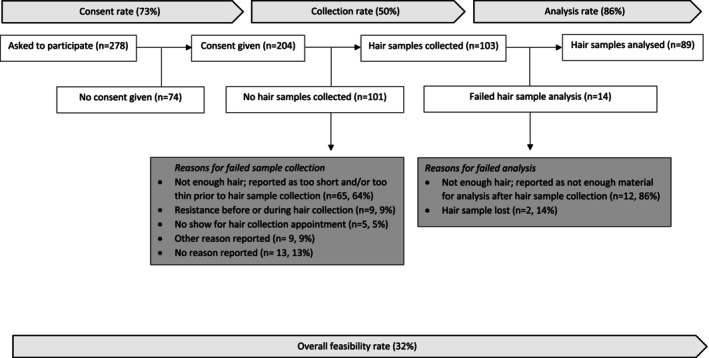 Figure 1
Peer Reviews
No public reviews on file for this paper yet. If you reviewed it on a platform where reviews are public (OpenReview, ICLR, NeurIPS, ICML), you can paste yours below so the community can read it here.
Videos
No videos yet. Explain this paper in a talk, walkthrough, or lecture? Add one.
Taxonomy
TopicsDermatology and Skin Diseases · Exercise and Physiological Responses · Stress Responses and Cortisol