Evaluation of centre‐specific machine learning models in predicting 2‐year outcomes of hip arthroscopy for mixed femoracetabular impingement syndrome
Gang Yang, Jiali Kang, Fan Hu, Yin Pei, Dingge Liu, Zhihua Zhang, Kaiping Liu, Langran Wang, Xi Gong, Haijun Wang, Shuangshuang Deng, Ruijie Liu, Xin Zhang

TL;DR
This study developed machine learning models to predict long-term outcomes of hip surgery for femoracetabular impingement syndrome based on preoperative factors.
Contribution
The study demonstrates that robust machine learning models can be built with limited center-specific data to predict patient outcomes after hip arthroscopy.
Findings
The random forest model showed the best performance with an AUROC of 0.99 and a C-index of 0.95.
Preoperative symptom duration, HOS-ADL, hip joint space, and alpha angle were key predictors of outcomes.
Machine learning models proved feasible for outcome prediction even with limited center-specific data.
Abstract
To construct a centre‐specific machine learning (ML) prediction model based on preoperative factors. It was hypothesised that the ML prediction model would accurately predict whether patient‐reported outcome scores (PROs) over at least 2 years would reach the minimal clinically important difference (MCID). A retrospective analysis was performed on mixed‐type femoroacetabular impingement syndrome (FAIS) patients who had hip arthroscopy at our institution between 2016 and 2018. The primary outcome was the rate of achieving MCID in PROs assessed at least 2 years after surgery, PROs included the hip outcome score‐activities of daily living (HOS‐ADL), modified Harris Hip Score (mHHS), visual analogue scale (VAS) for pain and international hip outcome tool‐12 (iHOT‐12), assessed at a minimum of 2 years postoperatively. Preoperative patient features were selected using the least absolute…
Genes, proteins, chemicals, diseases, species, mutations and cell lines named across the full text — each resolved to its canonical identifier and authoritative record.
Click any figure to enlarge with its caption.
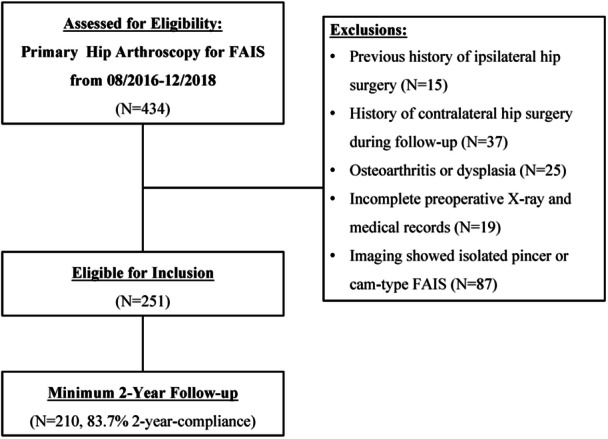 Figure 1
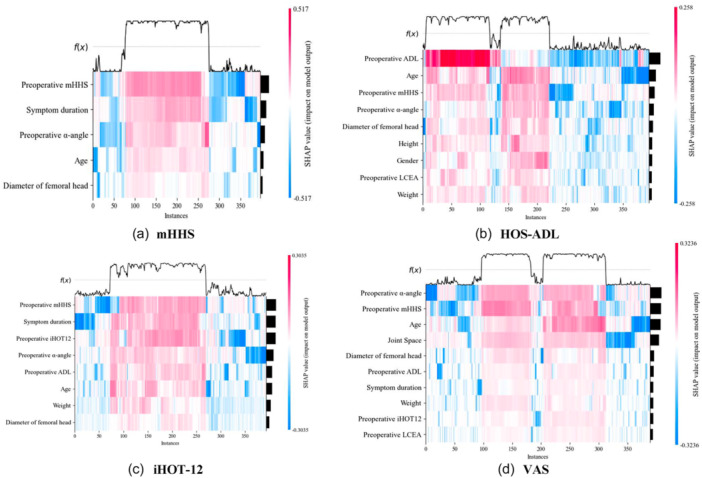 Figure 2
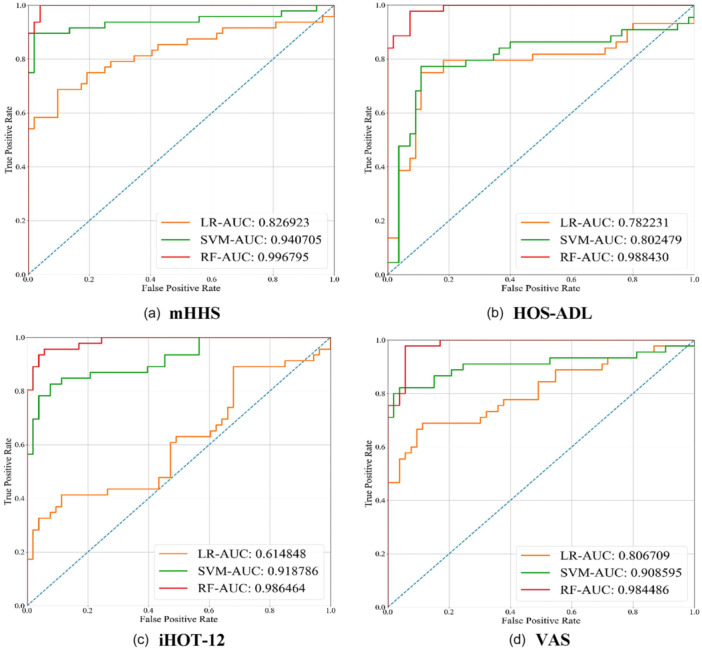 Figure 3
Peer Reviews
No public reviews on file for this paper yet. If you reviewed it on a platform where reviews are public (OpenReview, ICLR, NeurIPS, ICML), you can paste yours below so the community can read it here.
Videos
No videos yet. Explain this paper in a talk, walkthrough, or lecture? Add one.
Taxonomy
TopicsHip disorders and treatments · Shoulder Injury and Treatment · Orthopaedic implants and arthroplasty