Parent–adolescent discrepancies in perceptions of parental warmth: Cross‐cultural differences and longitudinal associations with internalizing symptoms
Concetta Esposito, Maria Concetta Miranda, W. Andrew Rothenberg, Ann T. Skinner, Jennifer E. Lansford, Sevtap Gurdal, Daranee Junla, Paul Oburu, Concetta Pastorelli, Emma Sorbring, Laurence Steinberg, Liliana Maria Uribe Tirado, Saengduean Yotanyamaneewong, Liane P. Alampay

TL;DR
This study explores how differences in how parents and teens view parental warmth affect teen mental health over time and across cultures.
Contribution
The study reveals bidirectional, longitudinal associations between parent–adolescent warmth perception discrepancies and internalizing symptoms.
Findings
Mothers reported higher warmth than adolescents, but no such discrepancy was found with fathers.
Greater discrepancies in warmth perceptions were linked to increased internalizing symptoms in adolescents.
Cross-cultural differences in parent–adolescent warmth perception discrepancies were identified.
Abstract
Research suggests that adolescents often perceive parental behaviors—such as expressions of warmth and affection—differently than their parents do. These parent–adolescent discrepancies offer meaningful insight into family functioning during adolescence and adolescent mental health, though existing findings remain mixed. Grounded in interpersonal acceptance–rejection theory (IPARTheory), this study investigates longitudinal, bidirectional associations between parent–adolescent discrepancies in perceived parental warmth and adolescent internalizing symptoms. The sample included 1219 parent–adolescent dyads (both mothers and fathers) from 12 cultural groups across 9countries, followed across three time points spanning 5 years, with children's mean age being 10.72 years (SD = 0.67) at Wave 1, 13.19 years (SD = 0.90) at Wave 2, and 15.60 years (SD = 0.94) at Wave 3. The results of latent…
Genes, proteins, chemicals, diseases, species, mutations and cell lines named across the full text — each resolved to its canonical identifier and authoritative record.
Click any figure to enlarge with its caption.
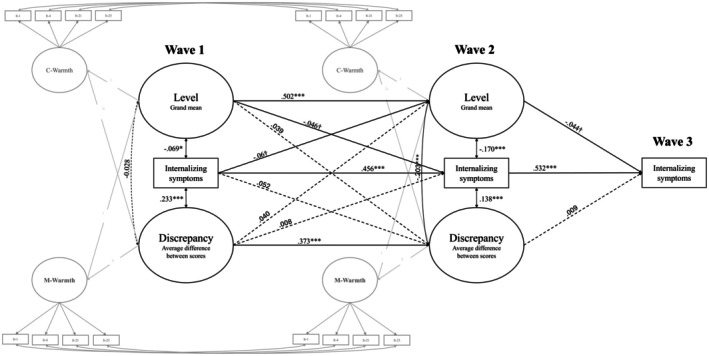 Figure 1
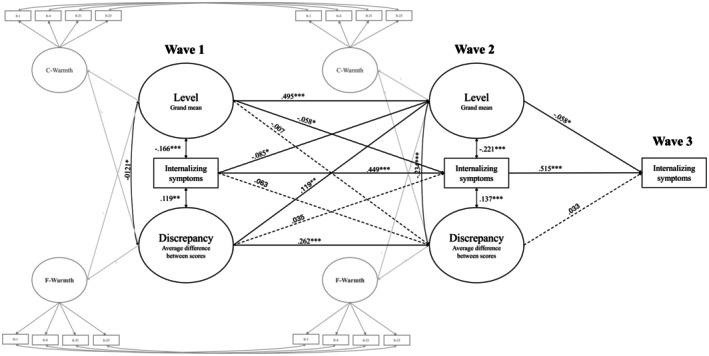 Figure 2
Peer Reviews
No public reviews on file for this paper yet. If you reviewed it on a platform where reviews are public (OpenReview, ICLR, NeurIPS, ICML), you can paste yours below so the community can read it here.
Videos
No videos yet. Explain this paper in a talk, walkthrough, or lecture? Add one.
Taxonomy
TopicsChild and Adolescent Psychosocial and Emotional Development · Attachment and Relationship Dynamics · Cultural Differences and Values