Algebraic methods and computational strategies for pseudoinverse-based MR image reconstruction (Pinv-Recon)
Kylie Yeung, Christine Tobler, Rolf F. Schulte, Benjamin White, Anthony McIntyre, Sébastien Serres, Peter Morris, Dorothee Auer, Fergus V. Gleeson, Damian J. Tyler, James T. Grist, Florian Wiesinger

TL;DR
This paper revisits pseudoinverse-based MRI reconstruction, showing it is now computationally efficient and versatile for various imaging tasks.
Contribution
The study demonstrates a two-order-of-magnitude improvement in computational efficiency using Cholesky decomposition for Pinv-Recon.
Findings
Cholesky decomposition improves Pinv-Recon efficiency by two orders of magnitude compared to SVD-based methods.
Pinv-Recon is versatile for diverse in vivo datasets, including low- to high-resolution imaging.
Modern hardware and optimized routines make Pinv-Recon computationally feasible and robust.
Abstract
Image reconstruction in Magnetic Resonance Imaging (MRI) is fundamentally a linear inverse problem, such that the image can be recovered via explicit pseudoinversion of the encoding matrix by solving \documentclass[12pt]{minimal} \usepackage{amsmath} \usepackage{wasysym} \usepackage{amsfonts} \usepackage{amssymb} \usepackage{amsbsy} \usepackage{mathrsfs} \usepackage{upgreek} \setlength{\oddsidemargin}{-69pt} \begin{document}\end{document}—a method referred to here as Pinv-Recon. While the benefits of this approach were acknowledged in early studies, the field has historically favored fast Fourier transforms (FFT) and iterative techniques due to perceived computational limitations of the pseudoinversion approach. This work revisits Pinv-Recon in the context of modern hardware,…
Genes, proteins, chemicals, diseases, species, mutations and cell lines named across the full text — each resolved to its canonical identifier and authoritative record.
Click any figure to enlarge with its caption.
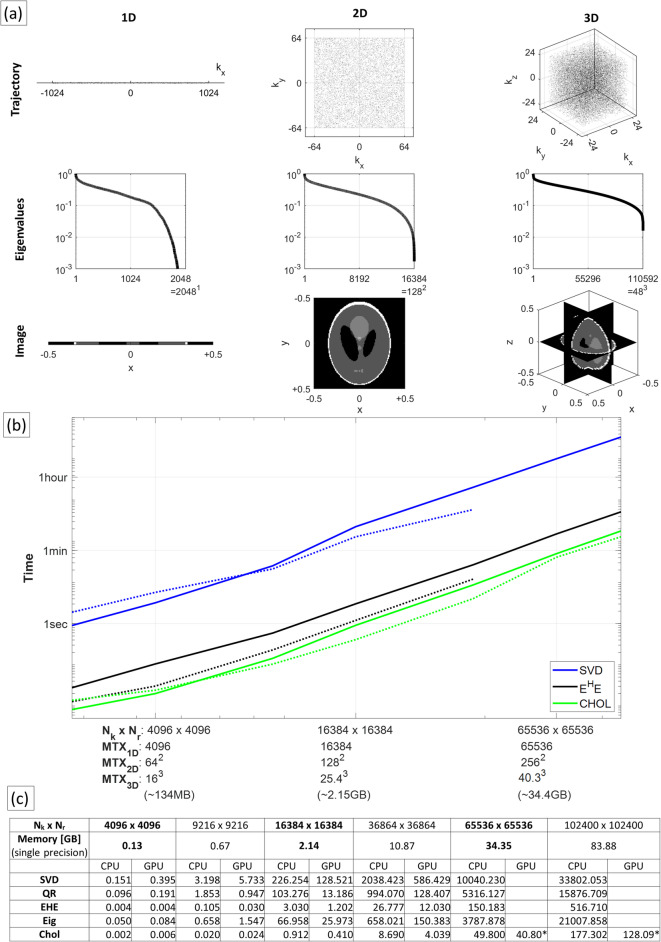 Figure 1
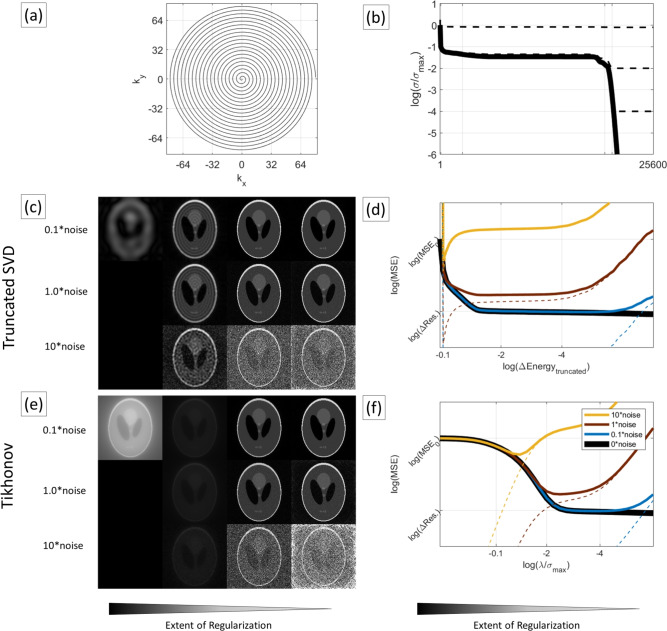 Figure 2
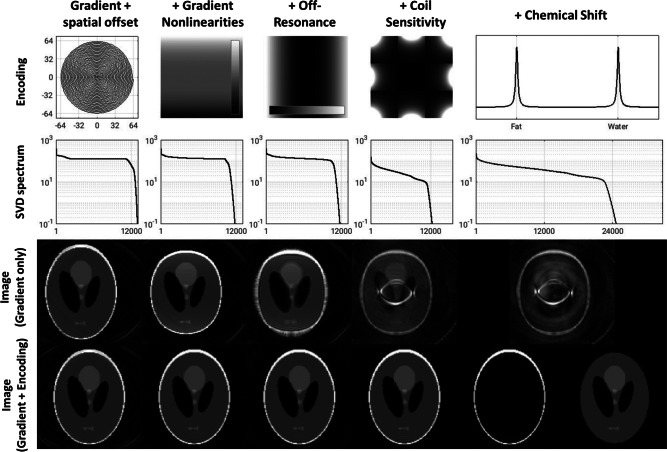 Figure 3
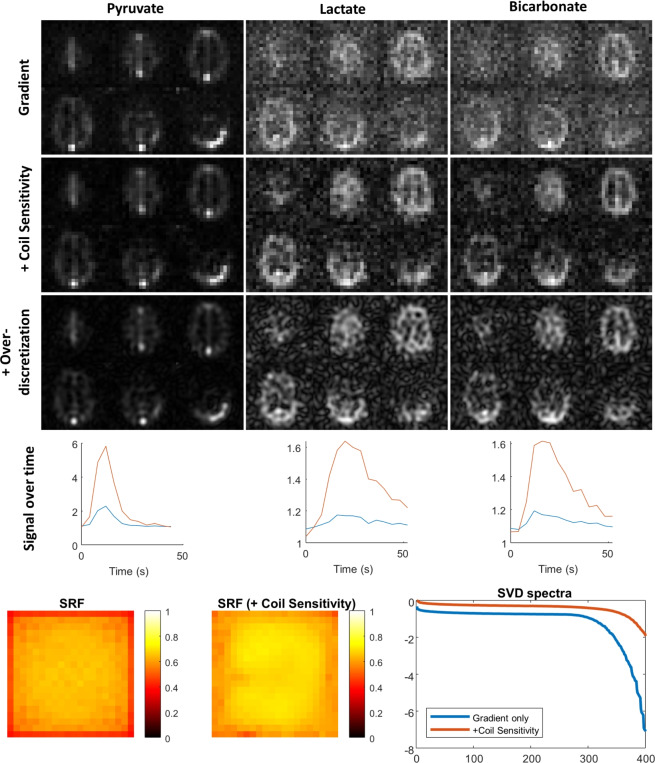 Figure 4
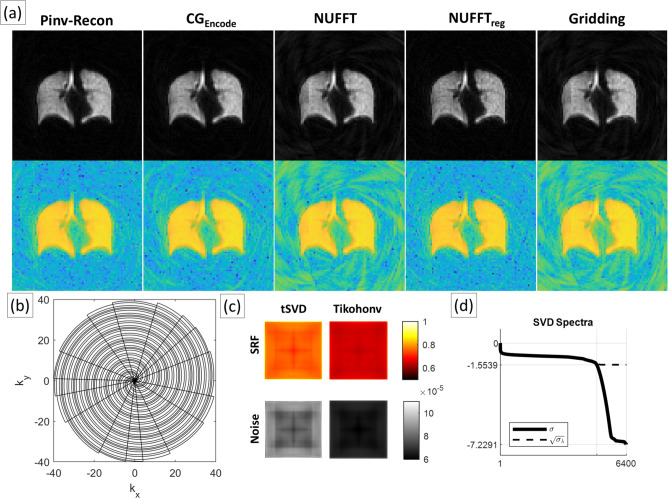 Figure 5
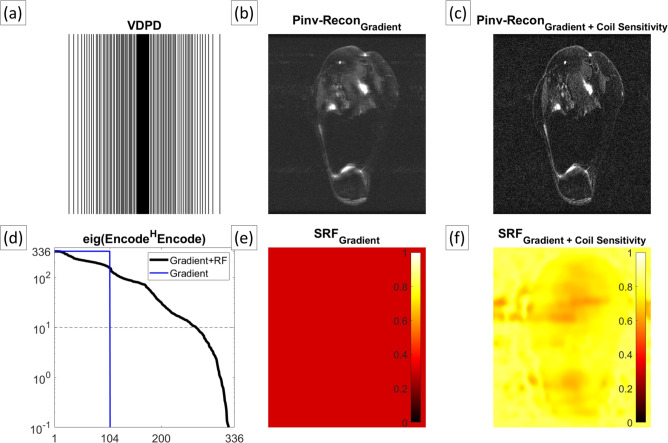 Figure 6
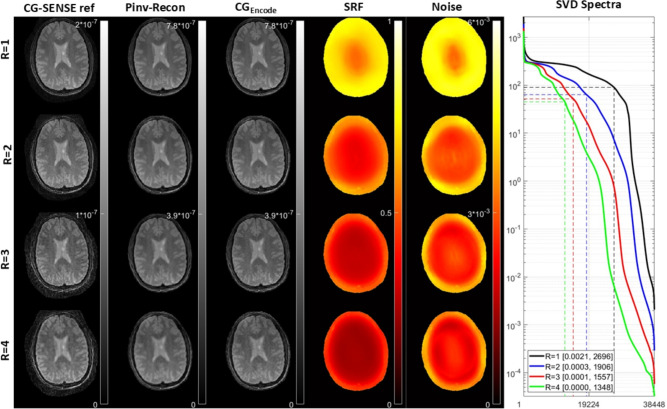 Figure 7
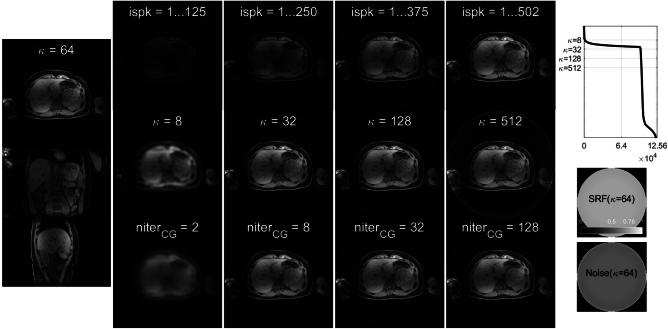 Figure 8
Peer Reviews
No public reviews on file for this paper yet. If you reviewed it on a platform where reviews are public (OpenReview, ICLR, NeurIPS, ICML), you can paste yours below so the community can read it here.
Videos
No videos yet. Explain this paper in a talk, walkthrough, or lecture? Add one.
Taxonomy
TopicsAdvanced MRI Techniques and Applications · Medical Imaging Techniques and Applications · NMR spectroscopy and applications