Surgeon experience and patient selection influence the learning curve in robotic inguinal hernia repair
Victor Rodrigues-Gonçalves, Mireia Verdaguer-Tremolosa, Pilar Martínez-López, Manuel López-Cano

TL;DR
The learning curve for robotic hernia repair is influenced by surgeon experience and patient selection complexity.
Contribution
The study shows that patient and hernia complexity significantly affect learning curve phases in robotic surgery.
Findings
More experienced surgeons showed two-phase learning curves, while a less experienced surgeon had a four-phase curve.
Patient and hernia complexity varied significantly across learning phases for the less experienced surgeon.
Structured training with progressive case selection is recommended to improve skill acquisition.
Abstract
Robotic-assisted laparoscopic inguinal hernia repair offers ergonomic and technical advantages over conventional approaches, but its adoption requires a learning process influenced by multiple factors. While prior surgical experience is a known determinant of performance, the impact of patient selection and hernia complexity on the learning trajectory remains insufficiently explored. This retrospective single-center study evaluated the learning curves of three surgeons with varying levels of prior open, laparoscopic, and robotic experience, who performed robotic-assisted transabdominal preperitoneal (rTAPP) inguinal hernia repairs between September 2018 and May 2023. Operative time was plotted against sequential case number to identify distinct phases in each surgeon’s learning curve. Associations between clinical variables and curve phases were analyzed statistically. Additional…
Genes, proteins, chemicals, diseases, species, mutations and cell lines named across the full text — each resolved to its canonical identifier and authoritative record.
Click any figure to enlarge with its caption.
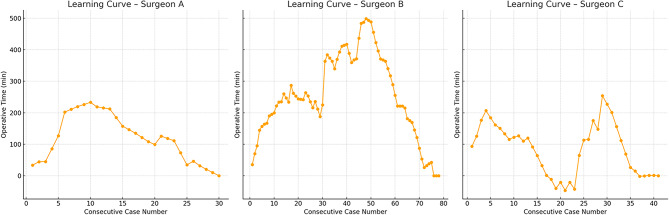 Figure 1
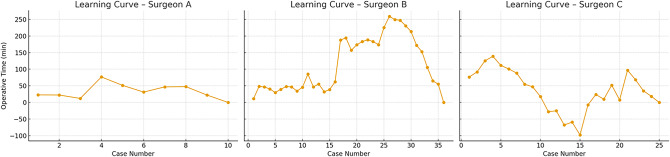 Figure 2
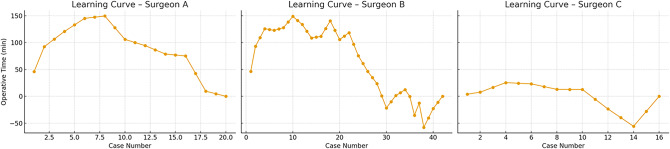 Figure 3
Peer Reviews
No public reviews on file for this paper yet. If you reviewed it on a platform where reviews are public (OpenReview, ICLR, NeurIPS, ICML), you can paste yours below so the community can read it here.
Videos
No videos yet. Explain this paper in a talk, walkthrough, or lecture? Add one.
Taxonomy
TopicsHernia repair and management · Surgical Simulation and Training · Minimally Invasive Surgical Techniques