Toward a Differentiated Conceptualization of Extreme Experiences and Their Relevance To Integrative Mental Health Theory
Dominik Stefan Mihalits

TL;DR
This paper proposes a new way to understand extreme experiences as meaningful psychological phenomena with both destructive and transformative potential, moving beyond traditional views of pathology.
Contribution
The paper introduces a novel integrative framework with six dimensions to conceptualize extreme experiences in mental health theory.
Findings
Extreme experiences should be viewed as multidimensional constructs rather than deviations from a norm.
The proposed model includes dimensions like intensity, impact, demand, control, novelty, and identification.
This framework allows for a nuanced understanding of extremes beyond binary categories like normal vs. pathological.
Abstract
Extreme experiences lie at the edges of human existence—and precisely for that reason, they demand the attention of psychology and psychotherapy science. However, in this context, extremes are often interpreted as pathological deviations from an assumed norm. This article argues for a conceptual re-evaluation: extremes should not be understood primarily as symptomatic distortion or disorders, but as potentially meaningful states that are relevant to psychological development. Building on historical, theoretical, and empirical perspectives, an integrative framework model is proposed that analyzes extremes as multidimensional constructs: First, the dimension of intensity describes the extent of emotional, cognitive or physical arousal—from overwhelming overstimulation to emotional numbness. Second, the impact dimension reflects the extent to which an experience can lead to transformation…
Genes, proteins, chemicals, diseases, species, mutations and cell lines named across the full text — each resolved to its canonical identifier and authoritative record.
Click any figure to enlarge with its caption.
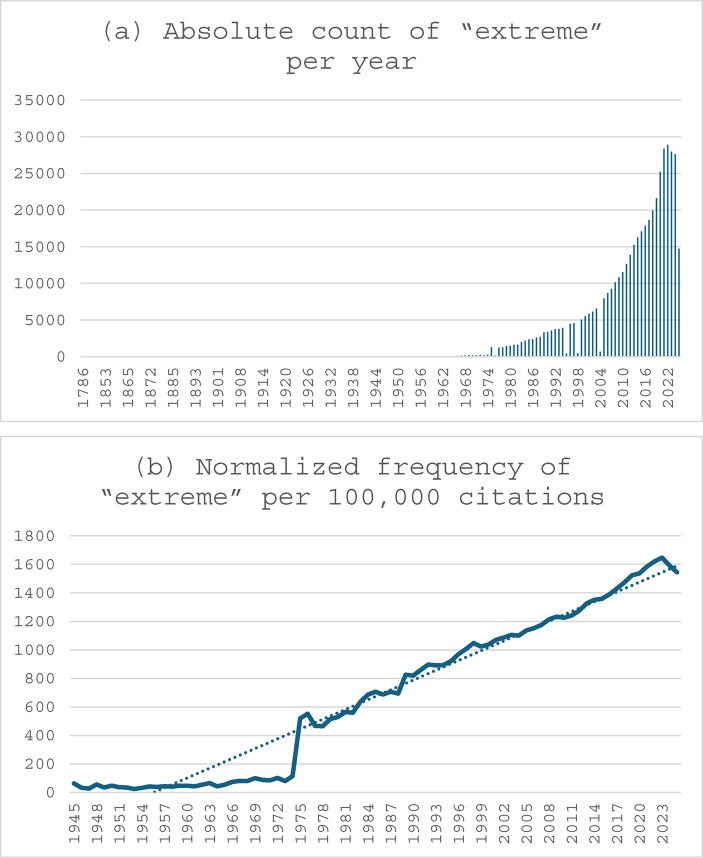 Figure 1
Peer Reviews
No public reviews on file for this paper yet. If you reviewed it on a platform where reviews are public (OpenReview, ICLR, NeurIPS, ICML), you can paste yours below so the community can read it here.
Videos
No videos yet. Explain this paper in a talk, walkthrough, or lecture? Add one.
Taxonomy
TopicsAdventure Sports and Sensation Seeking · Posttraumatic Stress Disorder Research · Outdoor and Experiential Education