Reference and Solution Architecture for GenAI- and GIS-Enhanced Physical Activity Interventions: Towards Implementing the AI4Motion Platform
Michal Doležel, Radim Lískovec

TL;DR
This paper introduces an AI and GIS-based platform to improve digital health interventions by making them more personalized and context-aware.
Contribution
The paper presents a novel reference architecture integrating LLMs and GIS for adaptive digital health interventions.
Findings
A pilot AI4Motion platform was implemented using open-source technologies and Open APIs.
The integration of LLM and GIS components enhances personalization and context-awareness in DBCIs.
The work contributes to system design patterns for platforms supporting EMA, ESM, and JITAI.
Abstract
Digital Behaviour Change Interventions (DBCIs) aim at improving individual health by engaging various means of Information and Communication Technology (ICT), including mobile apps and wearables. Participant intervention fatigue may happen when DBCIs become too frequent, repetitive, demanding, or lack perceived relevance, and this may result in participants’ reduced motivation and adherence over time. Advancing technology-supported engagement mechanisms is therefore of utmost importance. To address this problem, we present a reference and solution architecture based on open-source technologies and open Application Programming Interfaces (Open APIs). First, we integrated a Large Language Model (LLM) component into the DBCI design. Second, to support context-awareness, we enhanced this integration by adding a Geographic Information Systems (GIS) element. Our pilot implemented AI4Motion…
Genes, proteins, chemicals, diseases, species, mutations and cell lines named across the full text — each resolved to its canonical identifier and authoritative record.
Click any figure to enlarge with its caption.
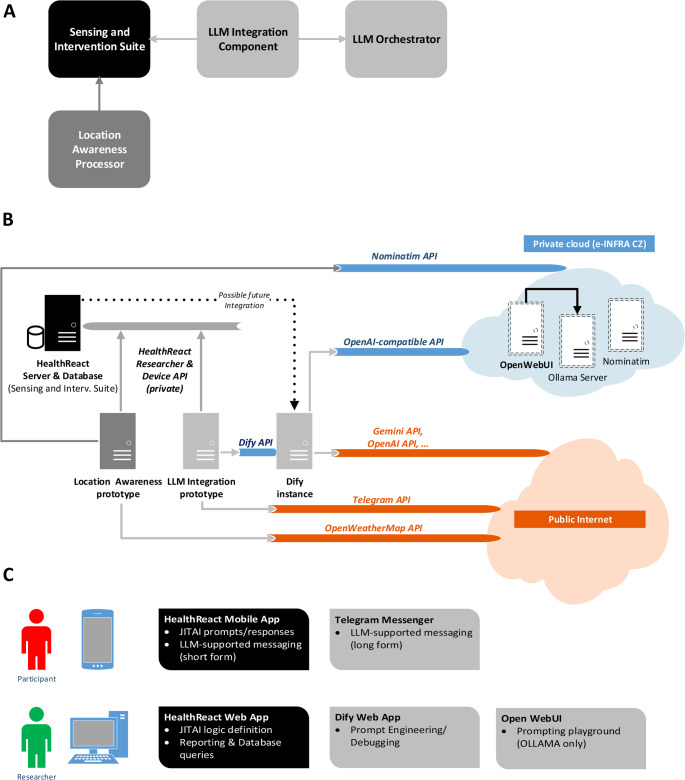 Figure 1
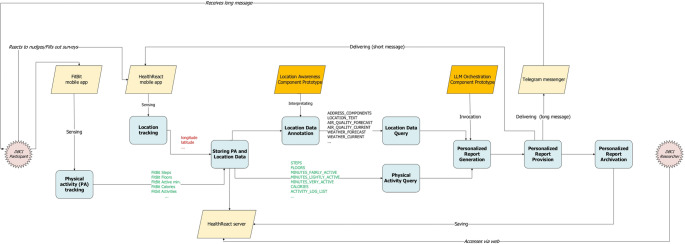 Figure 2
Peer Reviews
No public reviews on file for this paper yet. If you reviewed it on a platform where reviews are public (OpenReview, ICLR, NeurIPS, ICML), you can paste yours below so the community can read it here.
Videos
No videos yet. Explain this paper in a talk, walkthrough, or lecture? Add one.
Taxonomy
TopicsDigital Mental Health Interventions · Innovative Human-Technology Interaction · Mental Health Research Topics