Functional Trade-Offs of Regulatory Mechanisms in the Management of Body Energy, Frontal Plane Angular Momentum and Mediolateral Margin of Stability During Hole Negotiation Gait
Adamantios Arampatzis, Maria-Elissavet Nikolaidou, Christos Theodorakis, Morteza Ghasemi, Falk Mersmann, Sebastian Bohm

TL;DR
This study explores how the body manages energy and stability when walking over uneven terrain, revealing trade-offs between different regulatory mechanisms.
Contribution
The paper identifies specific trade-offs in regulatory mechanisms managing energy and stability during hole negotiation gait.
Findings
Increased peak-to-peak range of total CoM energy and angular momentum during hole negotiation steps.
Anticipatory adjustments prioritize CoM energy management over angular momentum control.
Foot placement strategies reduce mediolateral margin of stability to control angular momentum.
Abstract
The functional interaction of regulatory mechanisms that manage total centre of mass (CoM) energy, frontal plane whole-body angular momentum and mediolateral margin of stability (MoS) during hole negotiation gait was investigated. Joint kinematics, leg posture, total CoM energy, frontal plane whole-body angular momentum, mediolateral MoS and muscle activation patterns of seven bilateral lower leg muscles were assessed in 18 participants. During hole negotiation, we found an increase in the peak-to-peak range of total CoM energy and frontal plane whole-body angular momentum during the preparation, hole and recovery steps, and a decrease in mediolateral MoS at touch-down during the preparation and hole steps compared to level walking, providing evidence of an increased challenge in stability control. Anticipatory adjustments in CoM trajectories, joint kinematics and muscle activation…
Genes, proteins, chemicals, diseases, species, mutations and cell lines named across the full text — each resolved to its canonical identifier and authoritative record.
Click any figure to enlarge with its caption.
 Figure 1
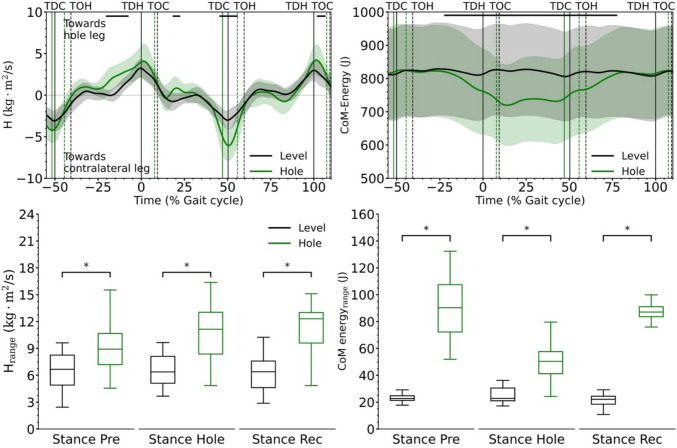 Figure 2
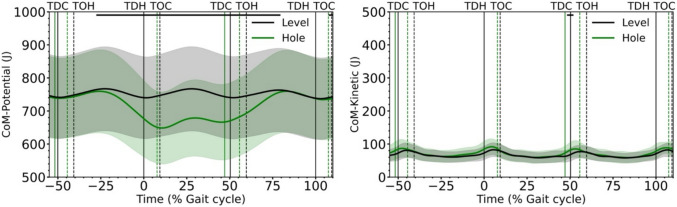 Figure 3
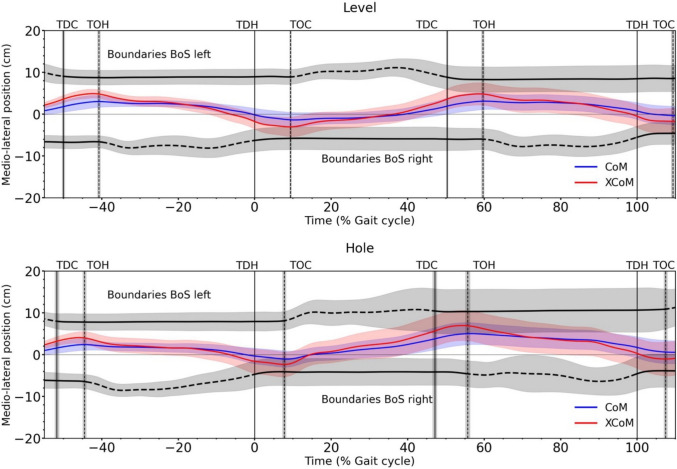 Figure 4
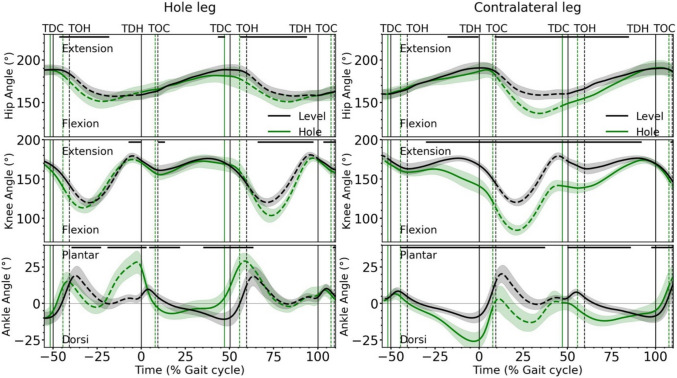 Figure 5
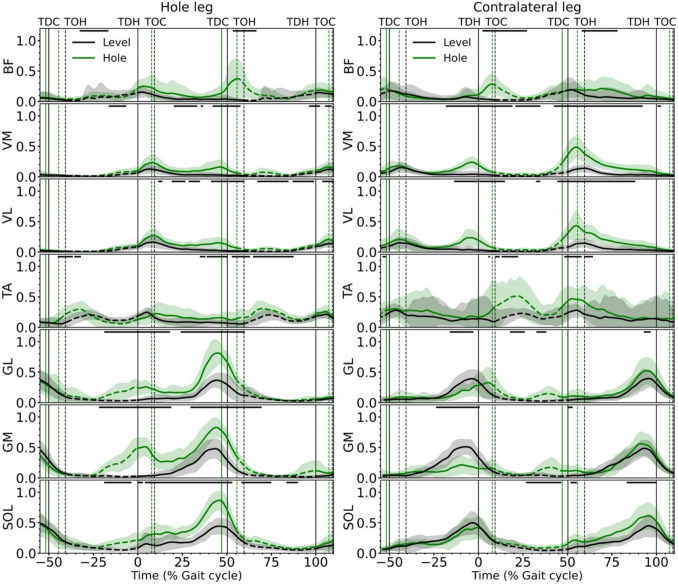 Figure 6
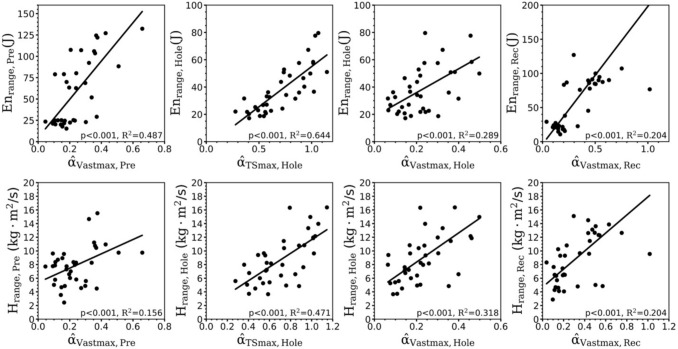 Figure 7
Peer Reviews
No public reviews on file for this paper yet. If you reviewed it on a platform where reviews are public (OpenReview, ICLR, NeurIPS, ICML), you can paste yours below so the community can read it here.
Videos
No videos yet. Explain this paper in a talk, walkthrough, or lecture? Add one.
Taxonomy
TopicsBalance, Gait, and Falls Prevention · Cerebral Palsy and Movement Disorders · Muscle activation and electromyography studies