PDZSeg: adapting the foundation model for dissection zone segmentation with visual prompts in robot-assisted endoscopic submucosal dissection
Mengya Xu, Wenjin Mo, Guankun Wang, Huxin Gao, An Wang, Ning Zhong, Zhen Li, Xiaoxiao Yang, Hongliang Ren

TL;DR
This paper introduces PDZSeg, a new model for dissection zone segmentation in endoscopic surgery that uses visual prompts to improve accuracy and user experience.
Contribution
The novel contribution is the first integration of visual prompts like scribbles and bounding boxes into dissection zone segmentation for endoscopic submucosal dissection.
Findings
PDZSeg outperforms state-of-the-art segmentation methods in dissection zone tasks.
The model improves performance and user experience through a specialized dataset and visual referral method.
The ESD-DZSeg dataset is introduced as a benchmark for future research in this area.
Abstract
The intricate nature of endoscopic surgical environments poses significant challenges for the task of dissection zone segmentation. Specifically, the boundaries between different tissue types lack clarity, which can result in significant segmentation errors, as the models may misidentify or overlook object edges altogether. Thus, the goal of this work is to achieve the precise dissection zone suggestion under these challenges during endoscopic submucosal dissection (ESD) procedures and enhance the overall safety of ESD. We introduce a prompted-based dissection zone segmentation (PDZSeg) model, aimed at segmenting dissection zones and specifically designed to incorporate different visual prompts, such as scribbles and bounding boxes. Our approach overlays these visual cues directly onto the images, utilizing fine-tuning of the foundational model on a specialized dataset created to…
Genes, proteins, chemicals, diseases, species, mutations and cell lines named across the full text — each resolved to its canonical identifier and authoritative record.
Click any figure to enlarge with its caption.
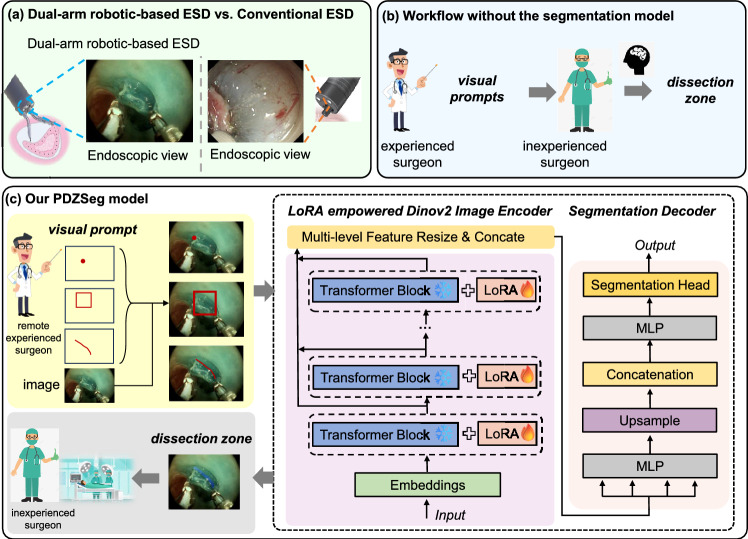 Figure 1
 Figure 2
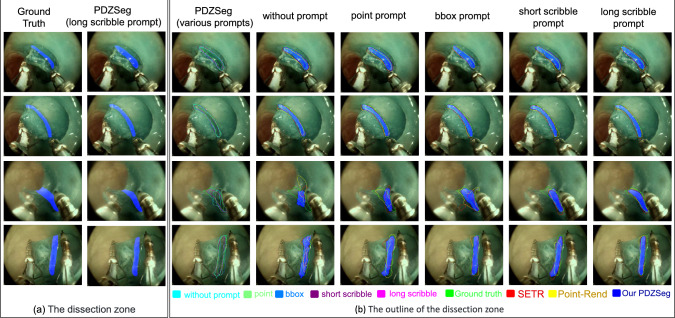 Figure 3
 Figure 4
Peer Reviews
No public reviews on file for this paper yet. If you reviewed it on a platform where reviews are public (OpenReview, ICLR, NeurIPS, ICML), you can paste yours below so the community can read it here.
Videos
No videos yet. Explain this paper in a talk, walkthrough, or lecture? Add one.
Taxonomy
TopicsColorectal Cancer Screening and Detection · Surgical Simulation and Training · Advanced Neural Network Applications