Elucidating the role of APOE ε4 gene variants in the clinical manifestation of Parkinson's disease
Gita Vita Soraya, Yusran Ady Fitrah, Andi Kurnia Bintang, Muhammad Akbar, Alfi Raudatil Jannah, Zulvikar Syambani Ulhaq, Jumraini Tammasse, Cahyono Kaelan, Muhammad Nasrum Massi, Ai Obinata, Norikazu Hara, Akinori Miyashita, Takeshi Ikeuchi

TL;DR
This study explores how the APOE ε4 gene variant affects Parkinson's disease, finding it is linked to earlier onset but not severity or cognitive decline.
Contribution
A meta-analysis reveals APOE ε4 carriers develop Parkinson's disease earlier than non-carriers.
Findings
APOE ε4 carriers had a significantly younger age of Parkinson's disease onset compared to non-carriers.
No significant differences were found in disease severity or cognitive scores between APOE ε4 carriers and non-carriers.
Abstract
Parkinson's Disease (PD) is the most common movement disorder, and remains a major cause of mortality and morbidity worldwide. Studies have uncovered the potential role of the Apolipoprotein (APOE) gene in PD, although results have been conflicting. This study aimed to characterize the APOE ε4 status of Indonesian PD subjects and perform a meta-analysis to elucidate it's role in PD onset age, disease severity, and cognition. APOE ε4 genotyping was performed on PD patients and their respective healthy families. Clinical parameters were obtained from PD patients. Secondly, we conducted a meta-analysis on the role of APOE ε4, with studies collected until January 2025. Retrieved parameters include the number of PD APOE ε4 allele carriers and non-carriers, age of onset, disease severity, and mini-mental state examination (MMSE) scores. Four of the 7 recruited subjects were APOE ε4…
Genes, proteins, chemicals, diseases, species, mutations and cell lines named across the full text — each resolved to its canonical identifier and authoritative record.
Click any figure to enlarge with its caption.
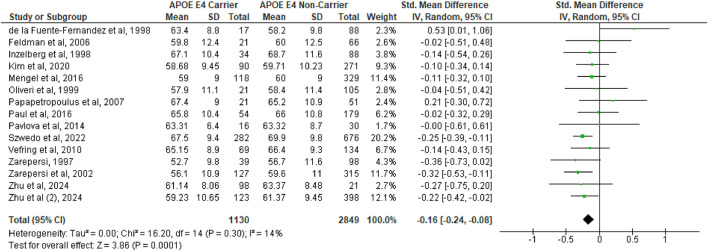 Figure 1
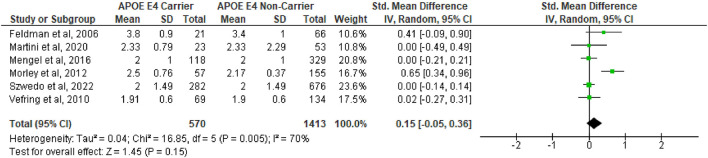 Figure 2
 Figure 3
Peer Reviews
No public reviews on file for this paper yet. If you reviewed it on a platform where reviews are public (OpenReview, ICLR, NeurIPS, ICML), you can paste yours below so the community can read it here.
Videos
No videos yet. Explain this paper in a talk, walkthrough, or lecture? Add one.
Taxonomy
TopicsParkinson's Disease Mechanisms and Treatments · Nuclear Receptors and Signaling · Autism Spectrum Disorder Research