Skeleton keys and Trojan horses: a review of therapeutic delivery to the brain
Rachel E. Stoub, Barbara J. Bailus

TL;DR
This review explores various strategies to deliver genetic therapies to the brain by overcoming the blood-brain barrier.
Contribution
The paper provides a comprehensive review of BBB-crossing delivery methods and their clinical applications.
Findings
Several delivery vehicles can cross the BBB and deliver genetic therapies to neurons.
Some delivery methods have already been approved for clinical use in patients.
Optimizing these strategies could treat a wide range of neurological diseases.
Abstract
The advances in genetic medicine that have occurred in the last few decades have been tempered by the challenges in delivering those medicines to the desired organs and cell types. Nowhere has this delivery challenge been greater than in the brain, due to the blood brain barrier (BBB), often illustrated as an impenetrable castle wall. As the need for neurological therapies grows, an assortment of Trojan horse and skeleton key strategies have been designed to allow passage of therapeutics through the BBB, These range from designer viral vectors, to cell penetrating peptides that can target cell surface receptors, to genetically modifying hematopoietic stem cells, to lipid nanoparticles that pass through the cell membrane. This review will examine the precise method that each delivery vehicle uses to enter and transverse the endothelial layer of the to BBB and arrive in the brain…
Genes, proteins, chemicals, diseases, species, mutations and cell lines named across the full text — each resolved to its canonical identifier and authoritative record.
Click any figure to enlarge with its caption.
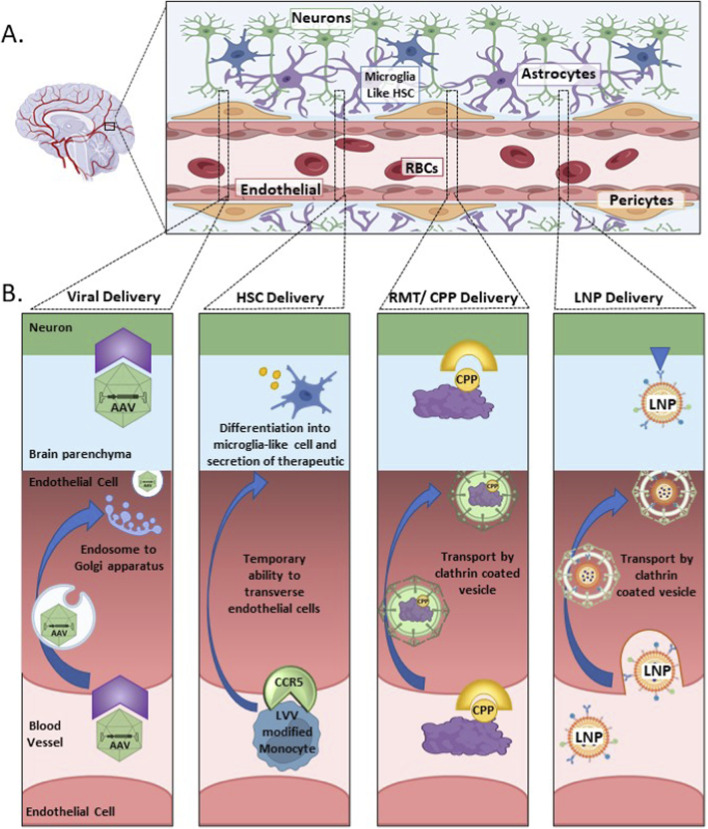 Figure 1
Peer Reviews
No public reviews on file for this paper yet. If you reviewed it on a platform where reviews are public (OpenReview, ICLR, NeurIPS, ICML), you can paste yours below so the community can read it here.
Videos
No videos yet. Explain this paper in a talk, walkthrough, or lecture? Add one.
Taxonomy
TopicsNeurogenesis and neuroplasticity mechanisms · Neuroscience and Neuropharmacology Research · Nerve injury and regeneration