Development and validation of an interpretable machine learning model and online web-based calculator based on social-ecosystem theory for early prediction of postpartum depression: a longitudinal study
Shusen Lin, Peng Wang, Chongyu Yue, Guofang Kuang, Xuefei Han, Yanxia Zhang, Xiaojing Wang, Min Wang, Shanshan Huan, Xinwei Zhang, Ping Tan, Huawei Li

TL;DR
This study creates an interpretable machine learning model and online calculator to predict postpartum depression early, using social-ecosystem theory and longitudinal data.
Contribution
A novel interpretable ML model and web-based calculator for early postpartum depression prediction based on social-ecosystem theory.
Findings
The random forest model achieved an AUC of 0.91 in internal validation and 0.77 in external validation.
K-Means clustering identified three risk levels for postpartum depression based on predicted probabilities.
An online calculator was developed to facilitate clinical use of the prediction model.
Abstract
Postpartum depression (PPD) has emerged as a global public health issue that can cause significant harm to mothers and their families. Currently, there is an urgent need for a robust early risk prediction model to enable accurate predictions of postpartum depression in hospitals. This was a longitudinal study. Using social ecosystem theory, we collected multi-dimensional and multi-angle risk factors for early postpartum depression from delivery to discharge, and conducted 42-day postpartum follow-ups using the Edinburgh Postnatal Depression Scale (EPDS). We strictly adhered to the Transparent Reporting of a Multivariable Prediction Model for Individual Prognosis or Diagnosis (TRIPOD) checklist, used 10 machine learning (ML) algorithms to construct and validate the prediction model, and employed the Shapley additive explanation (SHAP) algorithm to explain the model. Risk stratification…
Genes, proteins, chemicals, diseases, species, mutations and cell lines named across the full text — each resolved to its canonical identifier and authoritative record.
Click any figure to enlarge with its caption.
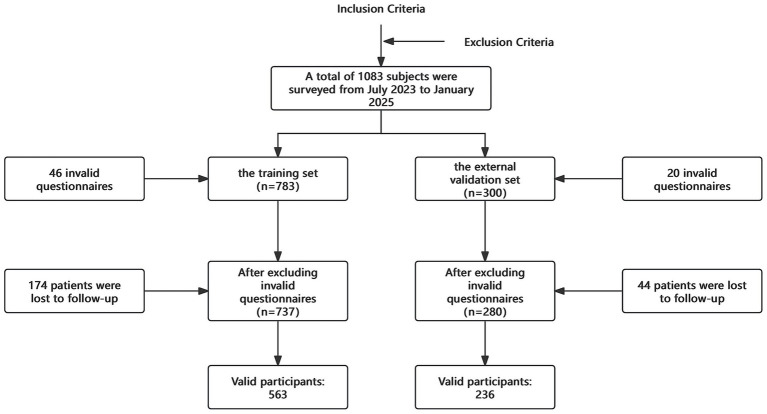 Figure 1
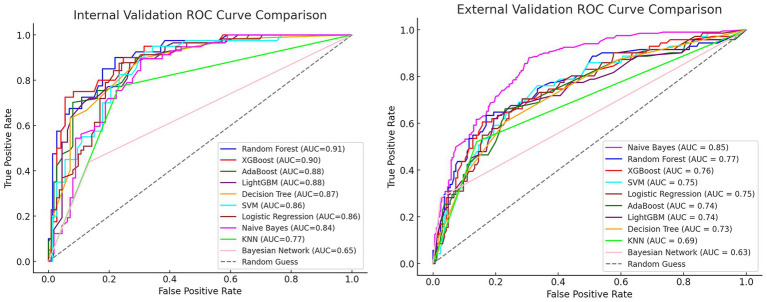 Figure 2
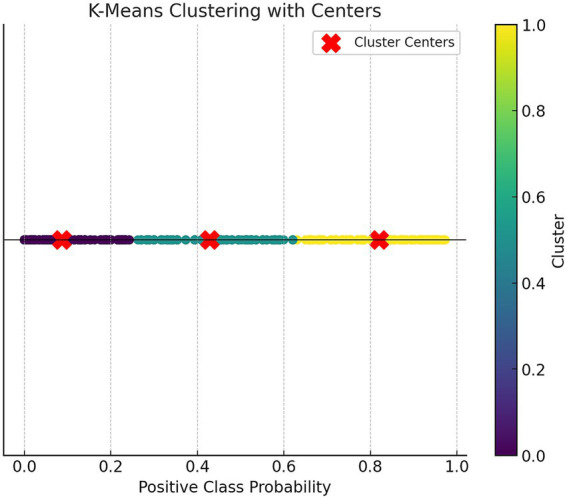 Figure 3
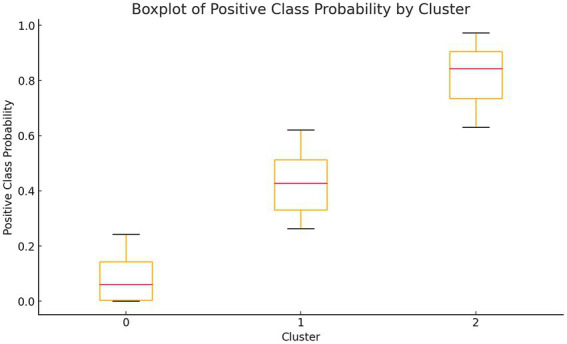 Figure 4
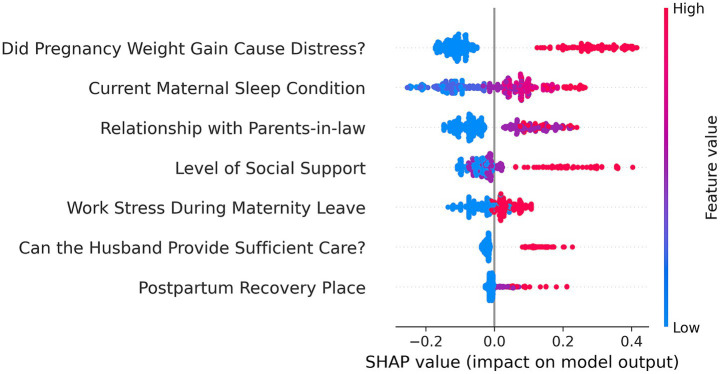 Figure 5
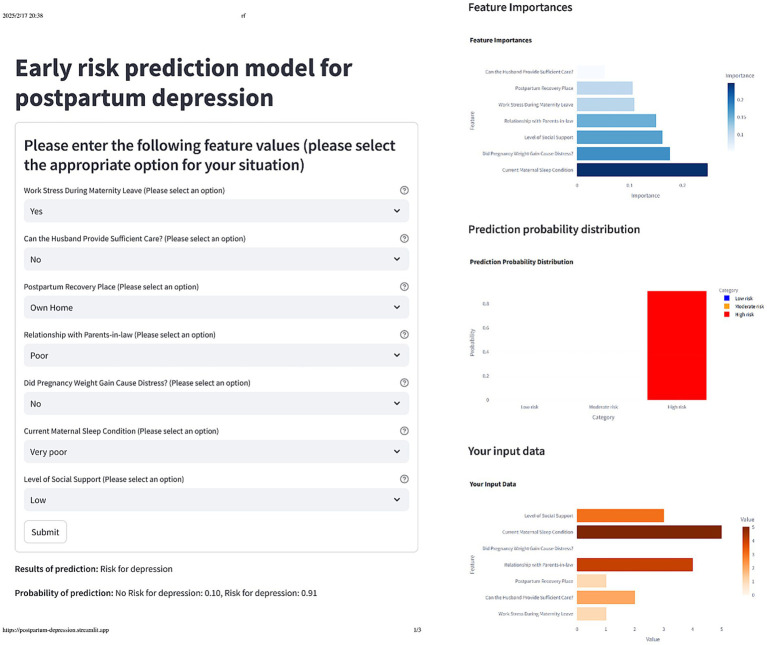 Figure 6
Peer Reviews
No public reviews on file for this paper yet. If you reviewed it on a platform where reviews are public (OpenReview, ICLR, NeurIPS, ICML), you can paste yours below so the community can read it here.
Videos
No videos yet. Explain this paper in a talk, walkthrough, or lecture? Add one.
Taxonomy
TopicsMaternal Mental Health During Pregnancy and Postpartum · Child and Adolescent Psychosocial and Emotional Development · Attachment and Relationship Dynamics