Characterization and phylogenetic analysis of a novel filamentous polymycovirus GbPmV1
Hongjuan Bai, Linhao Song, Xin Luo, Weijie Chang, Jia Mi, Cheng Jin, Xiao Liu

TL;DR
This study discovers a new mycovirus in a fungus that helps the fungus resist stress and antifungal drugs.
Contribution
The discovery of a novel filamentous polymycovirus, GbPmV1, in the zygomycete fungus Gongronella butleri.
Findings
GbPmV1 has a genome of over 10,000 nucleotides with six dsRNAs.
Infection by GbPmV1 increases the host fungus's resistance to stress and antifungal azoles.
GbPmV1 produces unusual filamentous, virus-like particles.
Abstract
Mycoviruses are common in fungi and can change their host's functions. Here, we identify a novel dsRNA mycovirus GbPmV1 from the fungus Gongronella butleri. The genome of GbPmV1 exceeds 10,000 nucleotides and comprises six dsRNAs, with dsRNA1 encoding the RdRp and dsRNA6 encoding the capsid protein. GbPmV1 belongs to the family Polymycoviridae and shows unusual filamentous, virus‐like particles. Infection by GbPmV1 enhances the resistance of its fungal host to stresses and antifungal azoles. This study not only identifies a novel mycovirus in the zygomycete fungus G. butleri but also provides insights into the evolution and biological properties of polymycoviruses.
Genes, proteins, chemicals, diseases, species, mutations and cell lines named across the full text — each resolved to its canonical identifier and authoritative record.
Click any figure to enlarge with its caption.
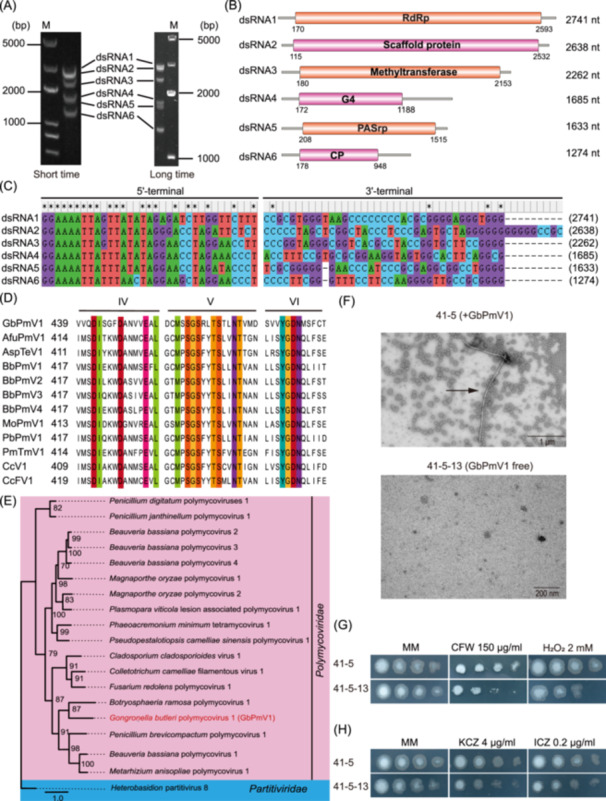 Figure 1
Peer Reviews
No public reviews on file for this paper yet. If you reviewed it on a platform where reviews are public (OpenReview, ICLR, NeurIPS, ICML), you can paste yours below so the community can read it here.
Videos
No videos yet. Explain this paper in a talk, walkthrough, or lecture? Add one.
Taxonomy
TopicsPlant and Fungal Interactions Research · Plant Virus Research Studies · Plant Disease Management Techniques