Nextpie: a web-based reporting tool and database for reproducible nextflow pipelines
Bishwa Ghimire, Nicholas Booth, Tapio Lönnberg, Tero Aittokallio

TL;DR
Nextpie is a web-based tool that helps manage and visualize resource usage data from Nextflow pipelines, making genomic data analysis more efficient and reproducible.
Contribution
Nextpie introduces a database and reporting system for Nextflow pipelines, enabling streamlined resource usage tracking and visualization.
Findings
Nextpie stores pipeline resource usage in a relational database for easier analysis.
The tool provides interactive visualizations and a reporting interface for pipeline performance.
Nextpie is publicly available with example data and documentation.
Abstract
High-throughput genomic data analysis consists of the inexorably intertwined inputs and outputs of a vast array of bioinformatic analysis tools. To guarantee streamlined and reproducible analyses, the often complex data analysis pipelines need to be run using workflow management tools. Nextflow is one popular tool commonly used to automate such pipelines. Nextflow records key pipeline data, such as the submission time, start time, completion time, CPU usage, memory usage, and disk usage for each task run. These data are stored in log files, often scattered across a file system. Therefore, aggregating information about resource usage critical for the optimization of Nextflow pipelines and improving reproducibility, as well as parsing and managing such log data, can quickly become cumbersome. Here, we present a web-based tool, Nextpie, which provides both a database and a reporting tool…
Genes, proteins, chemicals, diseases, species, mutations and cell lines named across the full text — each resolved to its canonical identifier and authoritative record.
Click any figure to enlarge with its caption.
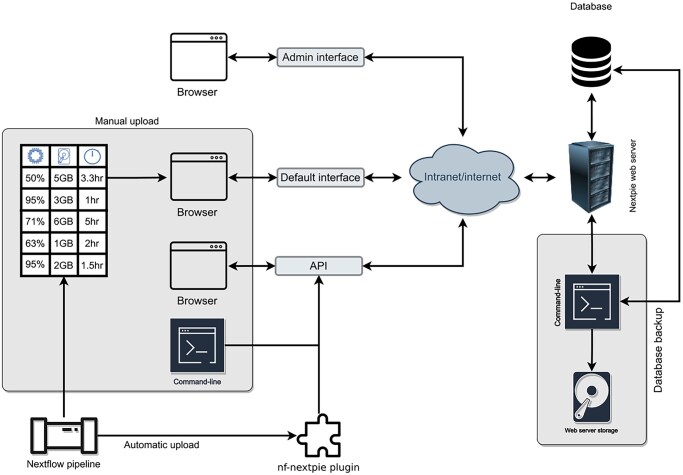 Figure 1
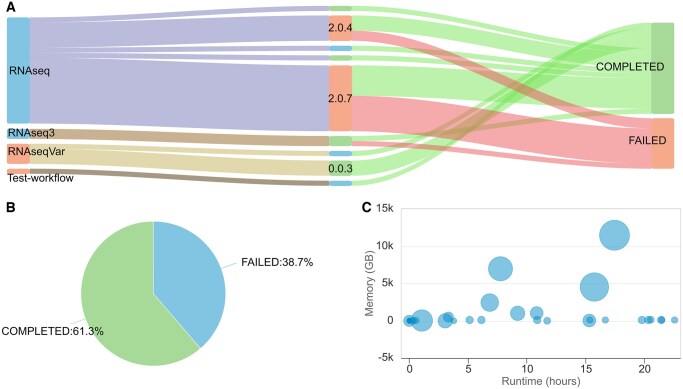 Figure 2
Peer Reviews
No public reviews on file for this paper yet. If you reviewed it on a platform where reviews are public (OpenReview, ICLR, NeurIPS, ICML), you can paste yours below so the community can read it here.
Videos
No videos yet. Explain this paper in a talk, walkthrough, or lecture? Add one.
Taxonomy
TopicsScientific Computing and Data Management