Sequential Thresholds Shape Drylands' Multitrophic Response to Aridification
Jon Morant, José Antonio Sánchez‐Zapata, Marta Monfort‐Calatayud, Santiago Soliveres

TL;DR
The study finds that biodiversity in drylands drops abruptly at certain aridity thresholds, with losses varying by species type and worsened by human activity.
Contribution
The paper reveals sequential aridity thresholds affecting biodiversity across multiple trophic levels in drylands, with novel insights into herbivore and detritivore vulnerability.
Findings
All taxonomic and trophic groups show abrupt biodiversity declines at aridity thresholds between 0.45 and 0.95.
Biodiversity losses range from 19% to 54.3%, with herbivores and detritivores most affected in semi-arid regions.
Human disturbance and land-use change exacerbate biodiversity losses, while primary productivity offers partial buffering.
Abstract
Drylands, supporting significant global biodiversity, exhibit abrupt, non‐linear responses to increasing aridity with drastic declines after threshold crossing. While plant and soil responses are documented, impacts on other organisms remain unclear, as well as their potential interactions with other anthropogenic drivers. We investigated changes in taxonomic and trophic richness of multiple organisms, from bacteria to mammals, in response to aridity across 290 dryland ecoregions globally. All groups showed sequential threshold responses to aridity with threshold values ranging from 0.45 to 0.95 aridity levels, resulting in varying biodiversity losses (19%–54.3% depending on trophic group) after crossing such thresholds. Responses were most widespread in hyper‐arid and arid regions, primarily affecting herbivores and detritivores in semi‐arid areas, and were exacerbated by human…
Genes, proteins, chemicals, diseases, species, mutations and cell lines named across the full text — each resolved to its canonical identifier and authoritative record.
Click any figure to enlarge with its caption.
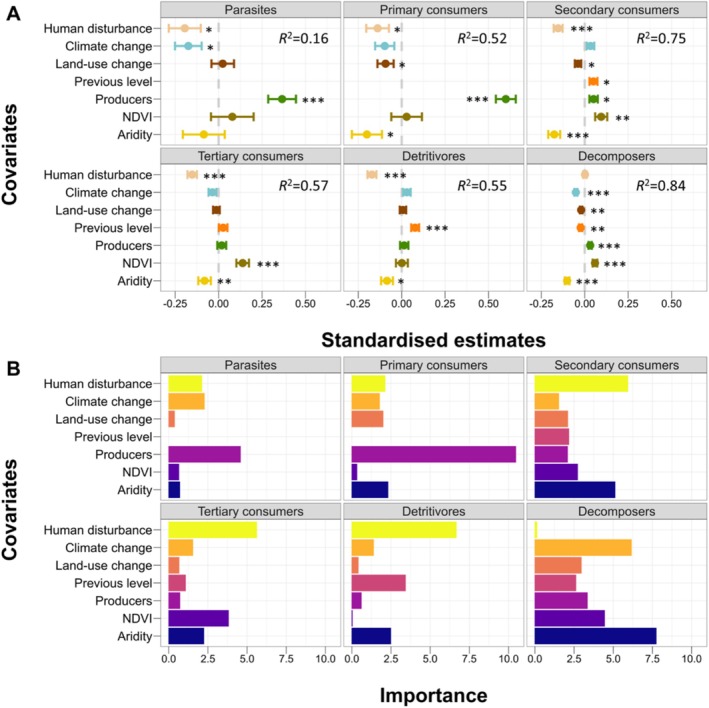 Figure 1
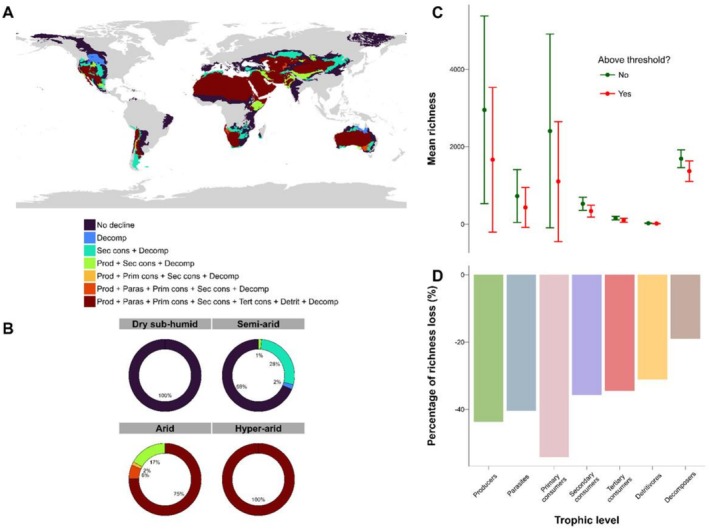 Figure 2
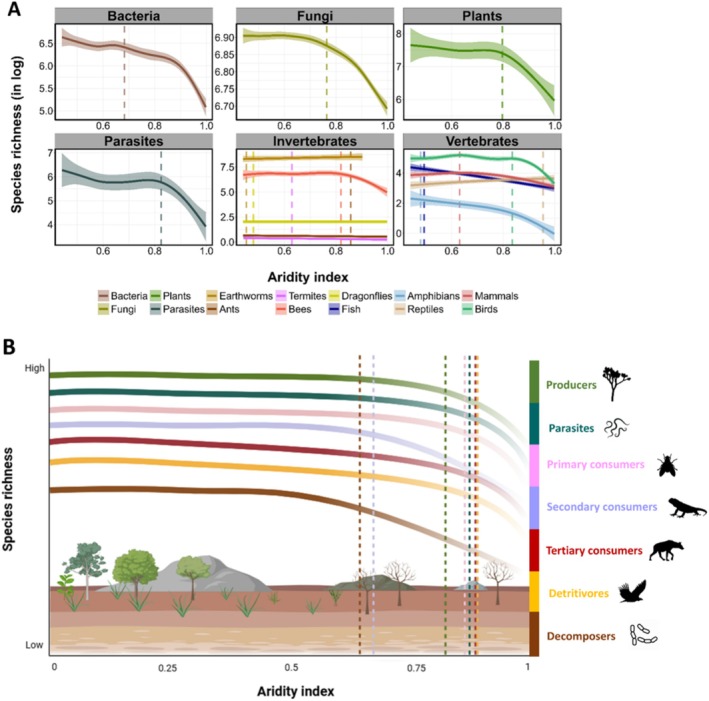 Figure 3
 Figure 4
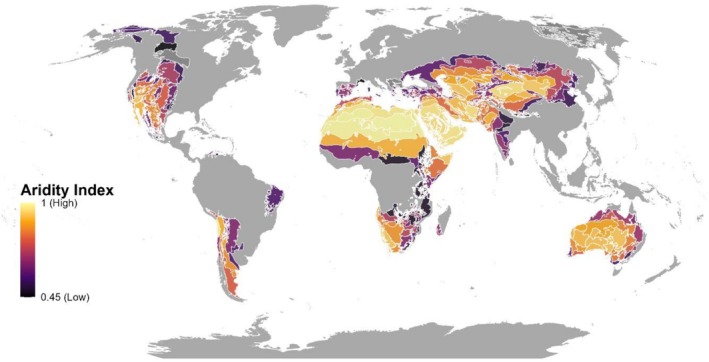 Figure 5
Peer Reviews
No public reviews on file for this paper yet. If you reviewed it on a platform where reviews are public (OpenReview, ICLR, NeurIPS, ICML), you can paste yours below so the community can read it here.
Videos
No videos yet. Explain this paper in a talk, walkthrough, or lecture? Add one.
Taxonomy
TopicsEcology and Vegetation Dynamics Studies · Ecosystem dynamics and resilience · Biocrusts and Microbial Ecology