A viable but nonculturable state of Mycobacterium avium in response to macrolide antibiotics: a recipe for relapses?
Iris Schuiermanni, Eva Terschlüsen, Henrieke de Man, Jelmer Raaijmakers, Sandra Salillas, Jodie A. Schildkraut, Jakko van Ingen

TL;DR
This study explores how Mycobacterium avium becomes drug-tolerant by entering a nonculturable state when exposed to macrolide antibiotics, which may explain treatment failures and relapses.
Contribution
The study provides evidence that macrolides induce a viable but nonculturable state in M. avium, offering a new perspective on drug tolerance mechanisms.
Findings
Clarithromycin induces a viable but nonculturable state in M. avium.
Bacteria in this state show lipid accumulation and reduced acid-fastness.
Resuscitation-promoting factors can revive these nonculturable bacteria.
Abstract
Mycobacterium avium complex disease is difficult to treat, with high failure and recurrence rates despite multidrug, macrolide-based treatments. The bacterial mechanisms involved in this drug tolerance and persistence are incompletely understood. Recent evidence has suggested persistence through metabolic adaptations indicative of the viable but nonculturable state, including a decreased respiratory rate and a switch to lipid accumulation and metabolism. To assess the contribution of switching to viable but nonculturable state to macrolide tolerance, we performed time–kill kinetics assays for clarithromycin against M. avium. In these experiments, we performed Auramine-O (for acid-fastness, representing active mycobacteria) and Nile red (for lipid accumulation) staining and stimulation using resuscitation-promoting factors of Mycobacterium tuberculosis. Loss of auramine staining,…
Genes, proteins, chemicals, diseases, species, mutations and cell lines named across the full text — each resolved to its canonical identifier and authoritative record.
Click any figure to enlarge with its caption.
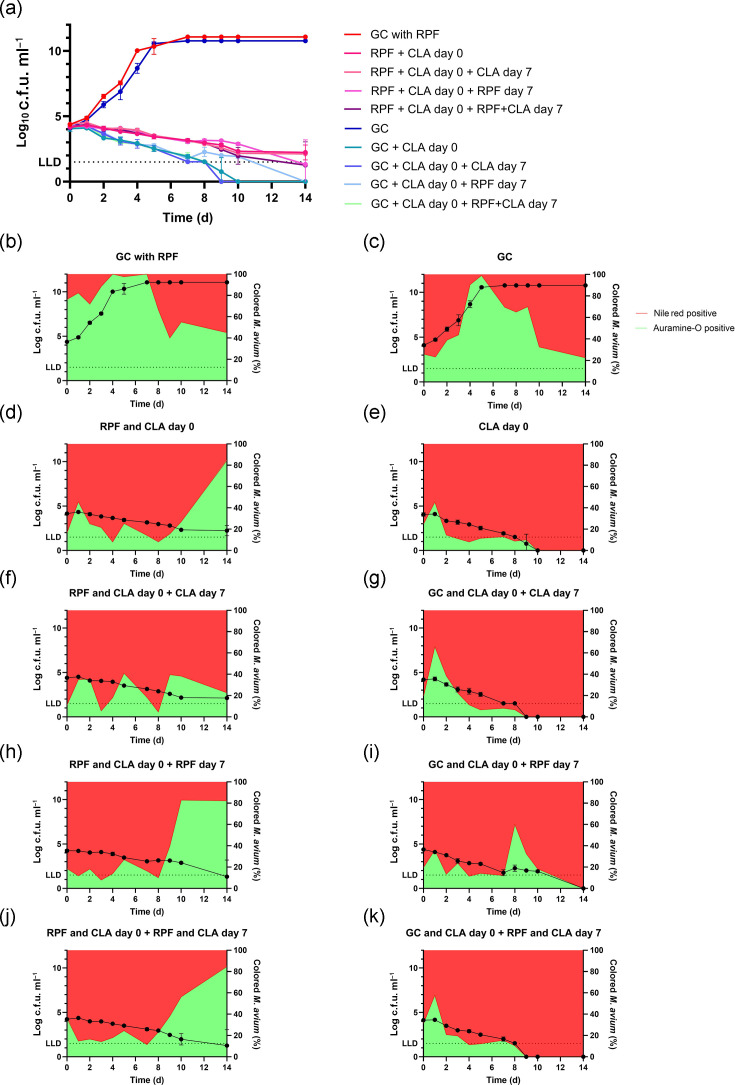 Figure 1
Peer Reviews
No public reviews on file for this paper yet. If you reviewed it on a platform where reviews are public (OpenReview, ICLR, NeurIPS, ICML), you can paste yours below so the community can read it here.
Videos
No videos yet. Explain this paper in a talk, walkthrough, or lecture? Add one.
Taxonomy
TopicsTuberculosis Research and Epidemiology · Mycobacterium research and diagnosis · Bacterial Genetics and Biotechnology