Ocular movement abnormalities and ptosis after glaucoma surgery: A retrospective decade long analysis
Carlo Catti, Federica Tessitore, Daniele Ferrari, Federica Milanesi, Silvia Acerra, Luigi Peci, Arianna Rizzi, Silvio Semeria, Irene Schiavetti, Carlo Alberto Cutolo, Michele Iester, Aldo Vagge, Nader Bayoumi, Nader Bayoumi, Nader Bayoumi, Nader Bayoumi

TL;DR
This study found that ptosis and strabismus are rare but possible complications after glaucoma surgery, especially when muscle isolation is involved.
Contribution
The study identifies muscle isolation surgery as the most likely to cause ptosis and strabismus after glaucoma procedures.
Findings
Ptosis occurred in 3.7% of patients, with the highest incidence after muscle isolation surgery (5.7%).
Strabismus occurred in 1.7% of patients and was most frequent after extraocular muscle manipulation (7.5%).
Combined ptosis and strabismus occurred in 1.0% of patients, with higher prevalence after muscle isolation surgery (1.9%).
Abstract
To evaluate the prevalence of ptosis, strabismus and the combination of both after glaucoma surgery and determine which kind of surgery is most likely to be linked to these complications. A total of 705 clinical records of patients who underwent glaucoma surgery at the University Eye Clinic of IRCCS Ospedale Policlinico San Martino, Genoa, from January 1, 2010, to December 31, 2020, were retrospectively evaluated. Surgery procedures were divided in three groups: “Ab interno”, “Ab externo” and “Muscle isolation”. Out of all patients 26 developed ptosis alone (3.7%), two developed bilateral ptosis, with a mean of 2.2 ± 1.08 procedures per patient. Highest incidence of ptosis was noticed in patients who underwent muscle isolation surgery (5.7%). Twelve patients developed strabismus alone (1,7%), four underwent unilateral surgery and eight bilateral surgery, with an average of 3.3 ± 1.78…
Genes, proteins, chemicals, diseases, species, mutations and cell lines named across the full text — each resolved to its canonical identifier and authoritative record.
Click any figure to enlarge with its caption.
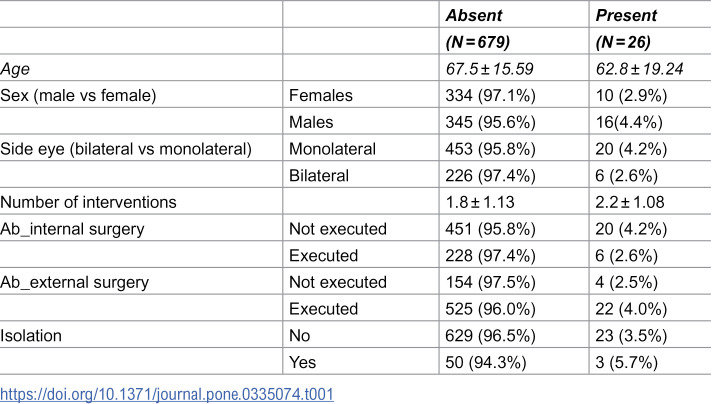 Figure 1
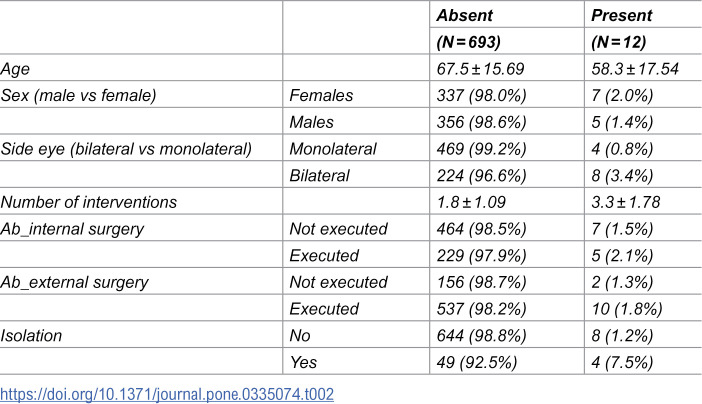 Figure 2
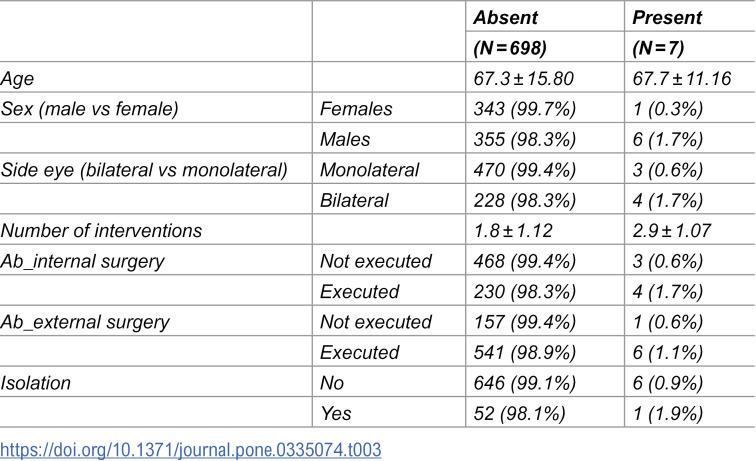 Figure 3
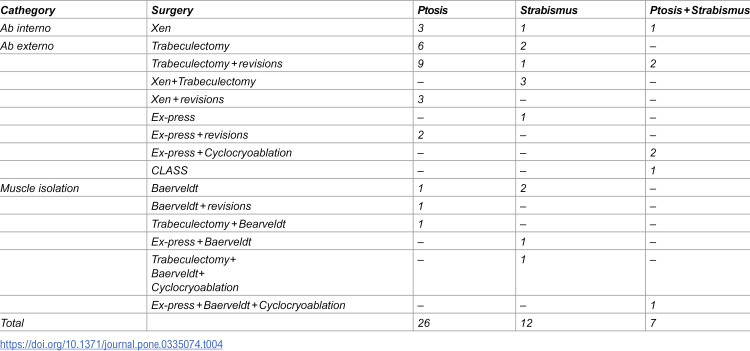 Figure 4
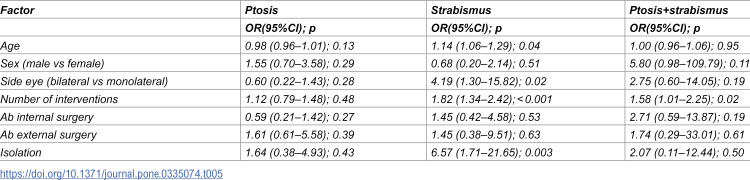 Figure 5
Peer Reviews
No public reviews on file for this paper yet. If you reviewed it on a platform where reviews are public (OpenReview, ICLR, NeurIPS, ICML), you can paste yours below so the community can read it here.
Videos
No videos yet. Explain this paper in a talk, walkthrough, or lecture? Add one.
Taxonomy
TopicsOphthalmology and Eye Disorders · Intraoperative Neuromonitoring and Anesthetic Effects · Botulinum Toxin and Related Neurological Disorders