A familial case of Kallmann syndrome: novel variants in ANOS1 and GNRHR genes
Ana L. Piedra Pacheco, Luis F. Moya Porras, Ana B. Santos Rojo, Anthony Hong Lo, Jose E. Esquivel Vargas, Laura Ulate Oviedo

TL;DR
A family with Kallmann syndrome shows new gene mutations that cause varied symptoms, highlighting the role of multiple genes in the disorder.
Contribution
The study identifies novel mutations in ANOS1 and GNRHR genes and suggests a digenic inheritance pattern in Kallmann syndrome.
Findings
Novel X-linked ANOS1 and autosomal recessive GNRHR mutations were found in a family with Kallmann syndrome.
Individuals with mutations in both genes had more severe symptoms than those with single mutations.
Next-generation sequencing revealed oligogenic contributions to Kallmann syndrome.
Abstract
Kallmann syndrome (KS) is a rare genetic disorder characterized by hypogonadotropic hypogonadism and anosmia or hyposmia, stemming from the defective migration of GnRH and olfactory neurons during embryogenesis. This study investigated a multigenerational family with KS, identifying novel mutations in the ANOS1 (c.78_108del, X-linked) and GNRHR (c.974del, autosomal recessive) genes through genetic testing. Affected males carrying the ANOS1 mutations displayed a range of phenotypes, all of which were associated with hypogonadism and varying degrees of anosmia. Furthermore, isolated mutations in the GNRHR gene were linked to milder forms of hypogonadism. Individuals possessing mutations in both genes exhibited more severe phenotypes, suggesting a digenic mode of inheritance. These findings broaden the known mutational landscape of KS, illustrating how variations and combinations of…
Genes, proteins, chemicals, diseases, species, mutations and cell lines named across the full text — each resolved to its canonical identifier and authoritative record.
Click any figure to enlarge with its caption.
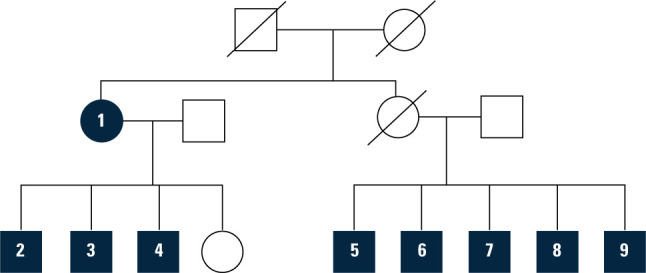 Figure 1
Peer Reviews
No public reviews on file for this paper yet. If you reviewed it on a platform where reviews are public (OpenReview, ICLR, NeurIPS, ICML), you can paste yours below so the community can read it here.
Videos
No videos yet. Explain this paper in a talk, walkthrough, or lecture? Add one.
Taxonomy
TopicsHypothalamic control of reproductive hormones · Congenital Ear and Nasal Anomalies · Hearing, Cochlea, Tinnitus, Genetics