Aβ and tau clearance through aerobic exercise: unveiling the β2-adrenergic receptor’s role in regulating autophagy-lysosomal pathways
Liu Yang, Haitao Yu, Gao-Shang Chai

TL;DR
This study explores how aerobic exercise helps clear harmful proteins in Alzheimer's disease by activating a specific receptor that boosts cellular cleanup processes.
Contribution
The study identifies the β2-adrenergic receptor as a key mediator of aerobic exercise's effects on autophagy-lysosomal pathways in Alzheimer's disease.
Findings
Aerobic exercise activates β2-AR signaling to promote lysosomal acidification and Aβ clearance via VMA21 upregulation.
Aerobic exercise enhances autophagosome–lysosome fusion through the β2-AR–RXRα–CHMP4B axis, promoting tau degradation.
Pharmacological inhibition of β2-AR abolishes the beneficial effects of aerobic exercise on proteostatic pathways.
Abstract
The systematic dissection of molecular mechanisms through which aerobic exercise (AE) mitigates neurodegenerative pathologies remains a significant challenge. Alzheimer’s disease (AD) is characterized by impaired autophagy-lysosomal flux and the accumulation of amyloid-β (Aβ) and hyperphosphorylated tau. We recently identified the β2-adrenergic receptor (β2-AR) as a key mediator of exercise-induced bene = d sought to dissect its role in regulating distinct proteostatic pathways. We revealed that AE activates β2-AR signaling to promote lysosomal acidification via upregulation of VMA21, an essential assembly factor for the vacuolar ATPase (V-ATPase) proton pump, thereby facilitating Aβ clearance. Concurrently, AE enhanced autophagosome–lysosome fusion through the β2-AR – retinoid X receptor alpha (RXRα) – charged multivesicular body protein 4B (CHMP4B) axis, promoting tau degradation.…
Genes, proteins, chemicals, diseases, species, mutations and cell lines named across the full text — each resolved to its canonical identifier and authoritative record.
Click any figure to enlarge with its caption.
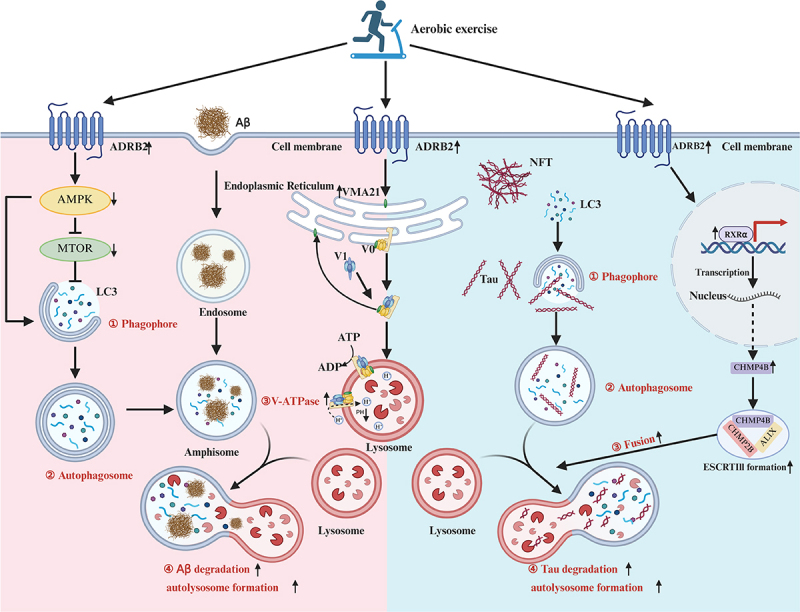 Figure 1
 Figure 2
Peer Reviews
No public reviews on file for this paper yet. If you reviewed it on a platform where reviews are public (OpenReview, ICLR, NeurIPS, ICML), you can paste yours below so the community can read it here.
Videos
No videos yet. Explain this paper in a talk, walkthrough, or lecture? Add one.
Taxonomy
TopicsAutophagy in Disease and Therapy · Alzheimer's disease research and treatments · Neuroscience and Neuropharmacology Research