Awareness, Knowledge, and Acceptance of Living Wills Among Chinese Cancer Patients: A Cross‐Sectional Study
Longxia Hu, Jiaqing Wang, Deying Hu, Yilan Liu, Yanhong Han, Wenbin Liu, Fen Teng, Xiaoping Ding, Yi Dai, Lihong Bao, Hongling Zhang, Qingzhou Cheng, Yun Yang, Tingting Jiao, Fei Luo, Yali Yang, Zixi Wang, Xiaoping Yang, Shengli Yang

TL;DR
This study explores how much Chinese cancer patients know about living wills and finds that more educated patients are more likely to accept them.
Contribution
The study provides new insights into the awareness and acceptance of living wills among Chinese cancer patients, highlighting the role of education and self-care ability.
Findings
Over half of the patients expressed willingness to sign a living will after learning about it.
Educated patients and those with poorer self-care ability showed higher knowledge and acceptance of living wills.
Patients emphasized the importance of comfort, dignity, and pain relief in end-of-life care.
Abstract
Given the suboptimal quality of end‐of‐life care among patients with cancer in China, promoting living wills is critical in this population. Living wills ensure that individuals can receive the medical care they desire during the terminal phase of an illness, maintain their dignity, and ultimately achieve a good death. However, current awareness and attitudes about living wills among Chinese patients with cancer remain unclear. We administered a questionnaire survey on living wills to patients with malignant tumors to assess their most important needs and increase understanding about living wills. In this cross‐sectional study using convenience sampling, inpatients with malignant tumors in Wuhan completed our questionnaire between July 2020 and June 2021. We collected patients' sociodemographic characteristics and details regarding their knowledge and attitudes about living wills.…
Genes, proteins, chemicals, diseases, species, mutations and cell lines named across the full text — each resolved to its canonical identifier and authoritative record.
Click any figure to enlarge with its caption.
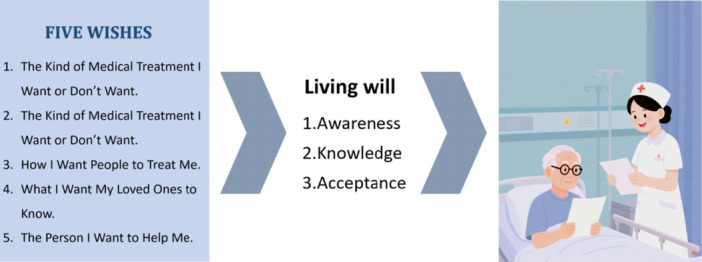 Figure 1
Peer Reviews
No public reviews on file for this paper yet. If you reviewed it on a platform where reviews are public (OpenReview, ICLR, NeurIPS, ICML), you can paste yours below so the community can read it here.
Videos
No videos yet. Explain this paper in a talk, walkthrough, or lecture? Add one.
Taxonomy
TopicsPalliative Care and End-of-Life Issues · Optimism, Hope, and Well-being · Patient-Provider Communication in Healthcare