Prevalence of reproductive tract and sexually transmitted infections among symptomatic and asymptomatic women, validity of syndromic management, in urban and periurban low to mid socioeconomic neighbourhoods of North Delhi: an observational study
Neeta Dhabhai, Barsha Gadapani Pathak, Gitau Mburu, Deepak More, Ranadip Chowdhury, Teodora E C Wi, Leena Chatterjee, Devjani De, Rita Kabra, James Kiarie, Ndema Habib, Arjun Dang, Manvi Dang, Aradhna Bhargav, Binish Jawed, Sarmila Mazumder

TL;DR
This study examines the prevalence of reproductive tract and sexually transmitted infections in women in Delhi, finding that many infections are asymptomatic and the syndromic approach has limited accuracy.
Contribution
The study provides recent data on infection prevalence in India and evaluates the effectiveness of syndromic management for diagnosing RTIs/STIs.
Findings
Bacterial vaginosis and Candida albicans were the most prevalent infections.
The syndromic approach had low sensitivity (62%) and specificity (45%) for diagnosing RTIs/STIs.
Younger age was associated with a higher risk of having a lab-confirmed STI/RTI.
Abstract
Reproductive tract infections (RTIs) including sexually transmitted infections (STIs) result in major reproductive health morbidity worldwide. There is a paucity of recent data on laboratory-confirmed prevalence in India of the curable pathogens responsible, Neisseria gonorrhoeae (NG), Chlamydia trachomatis (CT), Trichomonas vaginalis (TV), Bacterial vaginosis (BV) and Candida albicans (CA), with a significant proportion being asymptomatic. This study aims to determine the diagnostic accuracy of the syndromic approach and the prevalence of symptomatic and asymptomatic infections. An observational study was conducted with 440 married, reproductive age women in low-income and middle-income neighbourhoods of Delhi. Vaginal swabs were collected irrespective of symptoms. Nucleic acid amplification technique was used for NG, TV and CT, gram stain for CA and Nugent’s criteria for BV.…
Genes, proteins, chemicals, diseases, species, mutations and cell lines named across the full text — each resolved to its canonical identifier and authoritative record.
Click any figure to enlarge with its caption.
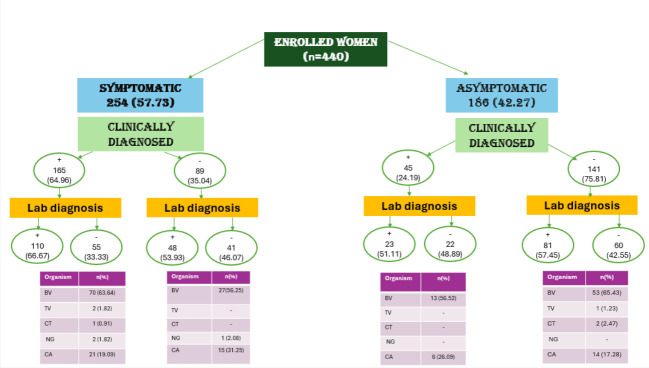 Figure 1
Peer Reviews
No public reviews on file for this paper yet. If you reviewed it on a platform where reviews are public (OpenReview, ICLR, NeurIPS, ICML), you can paste yours below so the community can read it here.
Videos
No videos yet. Explain this paper in a talk, walkthrough, or lecture? Add one.
Taxonomy
TopicsReproductive tract infections research · Syphilis Diagnosis and Treatment · Adolescent Sexual and Reproductive Health