Thermally Activated Negative Differential Resistance VO x Memristor with Switchable Rate and Leaky Integrate-and-Fire Spiking Dynamics
Li-Chung Shih, Zih-Siao Liao, Gennady Cherkashinin, Eszter Piros, Lambert Alff, Jen-Sue Chen

TL;DR
A VOx-based memristor can function as both a spiking encoder and a leaky integrate-and-fire neuron, enabling compact and efficient neuromorphic hardware.
Contribution
A VOx-based memristor is demonstrated to intrinsically support dual-mode spiking and LIF dynamics through thermal phase transitions.
Findings
The device achieves a maximum spiking frequency of 570 kHz and energy consumption as low as 4.7 nJ per spike.
The VOx memristor exhibits snap-back negative differential resistance due to a thermally driven insulator-to-metal transition.
Integrated into a passive circuit, the device generates high-frequency spike trains and tunable LIF responses.
Abstract
Spiking neural networks (SNNs) require neuron devices that are both compact and capable of supporting continuous-time and event-based dynamics. Here, we demonstrate a VO x -based threshold switching memristor (TSM) that intrinsically enables dual-mode operation, functioning as both a spiking encoder and a leaky integrate-and-fire (LIF) neuron. While such dual behavior is theoretically possible in volatile memristors, it has only been experimentally demonstrated in limited cases. It is achieved intrinsically in a single VO x -based device, arising from a thermally driven insulator-to-metal transition (IMT) within the VO x layer, confirmed by temperature-dependent XRD and correlated with snap-back negative differential resistance (NDR) observed in electrical measurements. Integrated into a passive circuit, the device generates high-frequency spike trains under analog input and tunable…
Genes, proteins, chemicals, diseases, species, mutations and cell lines named across the full text — each resolved to its canonical identifier and authoritative record.
Click any figure to enlarge with its caption.
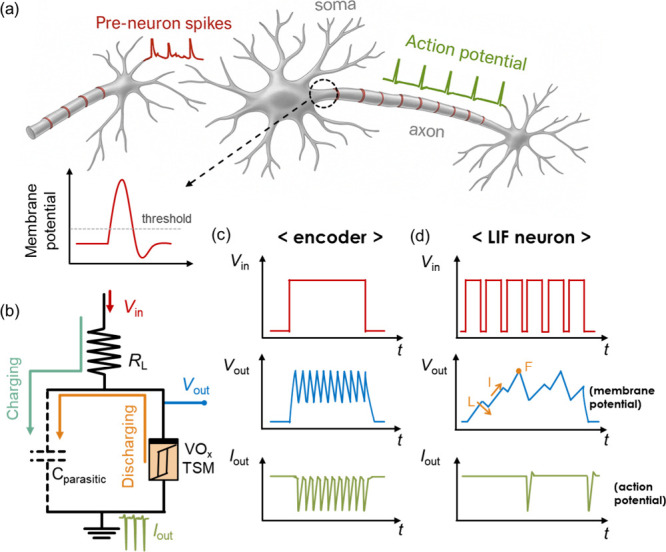 Figure 1
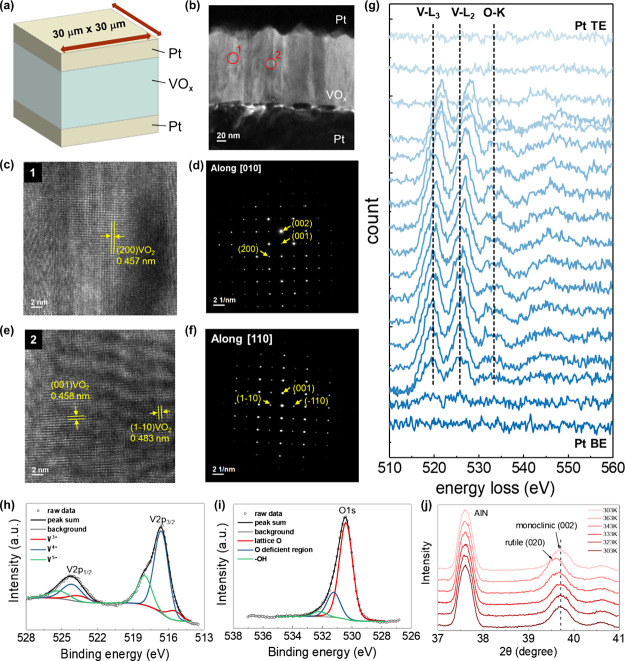 Figure 2
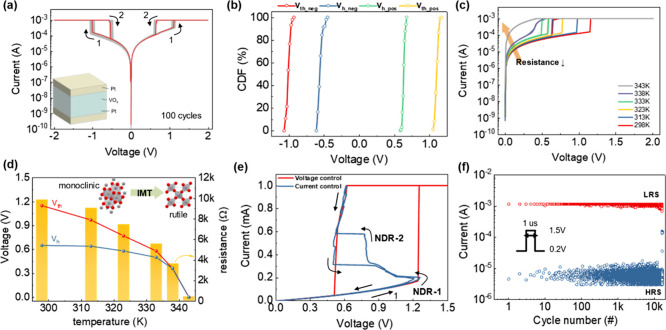 Figure 3
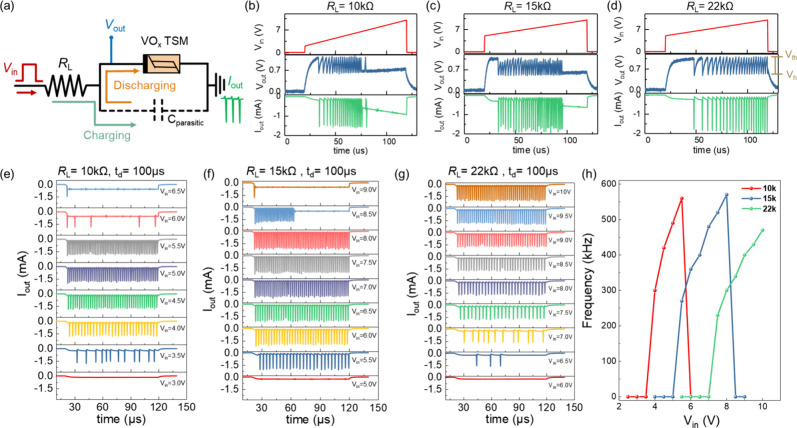 Figure 4
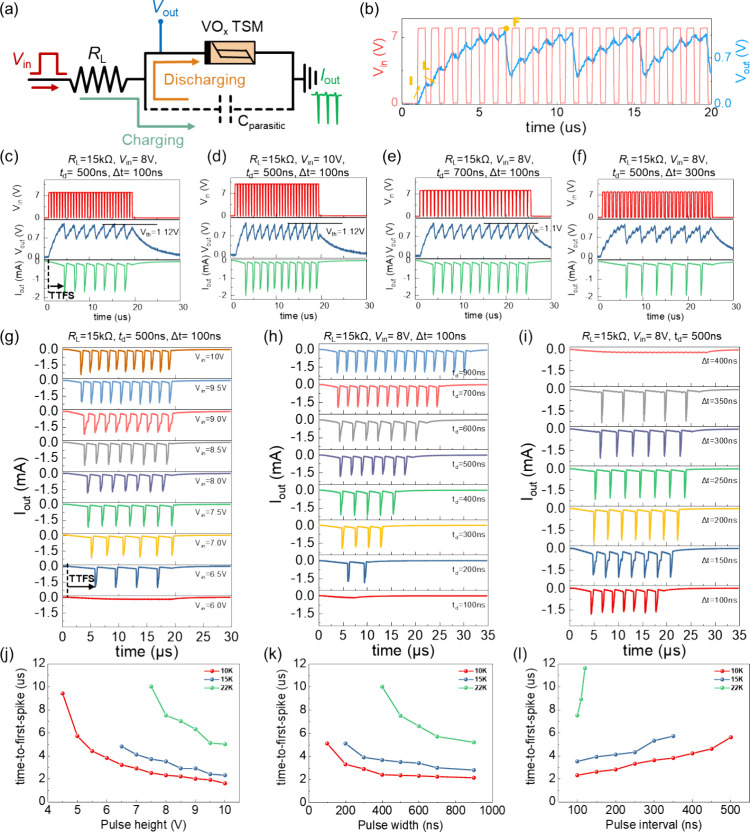 Figure 5
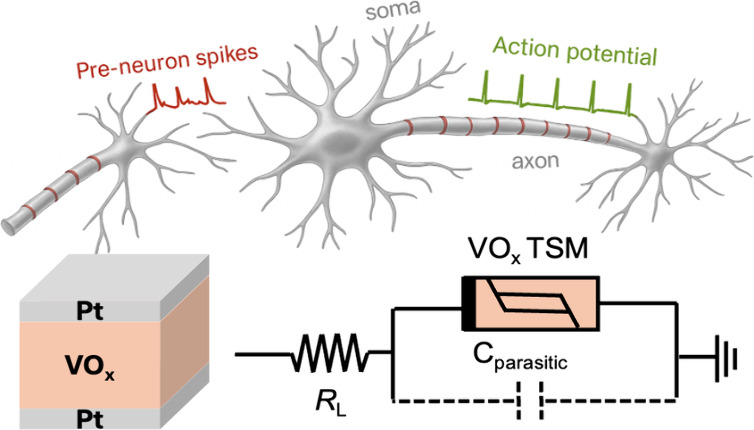 Figure 6
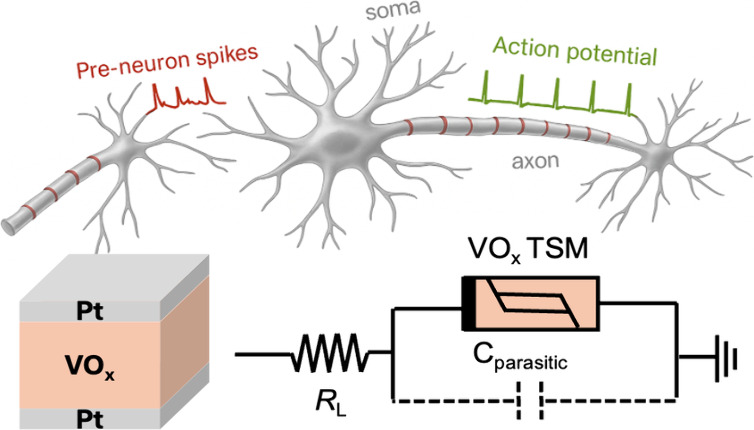 Figure 7
Peer Reviews
No public reviews on file for this paper yet. If you reviewed it on a platform where reviews are public (OpenReview, ICLR, NeurIPS, ICML), you can paste yours below so the community can read it here.
Videos
No videos yet. Explain this paper in a talk, walkthrough, or lecture? Add one.
Taxonomy
TopicsAdvanced Memory and Neural Computing · Photoreceptor and optogenetics research · Transition Metal Oxide Nanomaterials