Challenges and opportunities in achieving sustainable development goal 3 in KwaZulu-Natal: reflections from a research institute, South Africa
Rujeko Samanthia Chimukuche, Thembelihle Zuma, G. Nduku Wambua, Thabang Manyaapelo, Anita Edwards, Natsayi Chimbindi, Kingsley Orievulu, Dumsani Gumede, Nellie Myburgh, Allanise Cloete, Janet Seeley, Nothando Ngwenya

TL;DR
This paper explores the challenges and opportunities in achieving health and well-being goals in rural KwaZulu-Natal, South Africa, highlighting the impact of social, cultural, and environmental factors.
Contribution
The study provides new insights into community-driven interventions and gender-responsive strategies for improving health outcomes in rural South Africa.
Findings
Key challenges include limited healthcare access, socio-cultural norms, and climate-related stressors impacting health outcomes.
Community-driven programs like DREAMS and Stepping Stones show promise in improving adolescent and male engagement in health services.
Climate adaptation strategies and gender-responsive policies are essential for achieving SDG 3 in rural KwaZulu-Natal.
Abstract
South Africa is committed to achieving Sustainable Development Goal 3 (SDG 3), which aims to ensure health and well-being for all. However, in rural provinces like KwaZulu-Natal, structural inequalities, socio-cultural challenges, and environmental stressors hinder progress. This study synthesises findings from qualitative research conducted at the Africa Health Research Institute (AHRI) to explore the challenges and opportunities in meeting SDG 3 targets. An integrative literature review was conducted, analysing studies from 2015 to 2024 that focused on SDG 3related topics, including HIV/AIDS, tuberculosis, maternal and child health, sexual and reproductive health, and the impact of climate change. A framework analysis approach was applied to identify common themes, opportunities and challenges to achieving SDG 3 in rural KwaZulu-Natal. Key challenges to achieving SDG 3 include…
Genes, proteins, chemicals, diseases, species, mutations and cell lines named across the full text — each resolved to its canonical identifier and authoritative record.
Click any figure to enlarge with its caption.
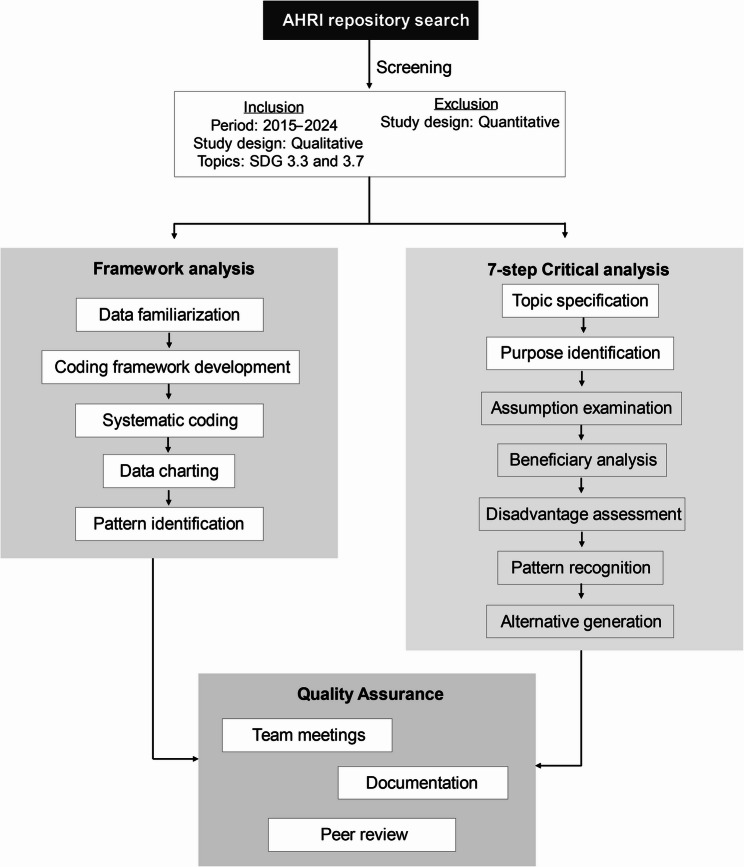 Figure 1
Peer Reviews
No public reviews on file for this paper yet. If you reviewed it on a platform where reviews are public (OpenReview, ICLR, NeurIPS, ICML), you can paste yours below so the community can read it here.
Videos
No videos yet. Explain this paper in a talk, walkthrough, or lecture? Add one.
Taxonomy
TopicsAdolescent Sexual and Reproductive Health · Climate Change and Health Impacts · Global Maternal and Child Health