Household crowding and mortality before and during the COVID-19 pandemic among adults: Findings from longitudinal population surveillance data in rural and peri-urban settings in Limpopo, South Africa
Kagiso Peace Seakamela, Jean Juste Harrisson Bashingwa, Joseph Tlouyamma, Cairo Bruce Ntimana, Modupi Peter Mphekgwana, Reneilwe Given Mashaba, Katlego Mothapo, Chodziwadziwa Whiteson Kabudula, Eric Maimela

TL;DR
This study shows that older adults in overcrowded households in South Africa had higher mortality rates during the pandemic, highlighting the need for targeted public health measures.
Contribution
The study provides novel insights into the impact of household crowding on age-specific mortality during the COVID-19 pandemic in rural and peri-urban South Africa.
Findings
Older adults (70+ years) had the highest mortality rates in overcrowded households.
Household crowding was a significant risk factor for mortality during the pandemic.
Mortality risk increased for older adults in densely populated households during the pandemic.
Abstract
Household overcrowding is a public health concern linked to increased morbidity and mortality. There is limited data available on the effects of COVID-19 on age-specific mortality in the context of household crowding in rural and peri-urban settings in Africa. Here we assess age-specific excess mortality in densely inhabited households before and during COVID-19. We used data collected three times annually between 2019 and 2021 in the health and demographic surveillance project in DIMAMO, South Africa. Data inaccuracies or inconsistencies were identified and corrected using data validation rules or algorithms implemented at both application and database levels. The number of persons-per-room was used to determine the degree of crowding or household crowding index (HCI). HCI tertiles were categorized as low, medium, and high density. Throughout the study, people aged 70 years and above…
Genes, proteins, chemicals, diseases, species, mutations and cell lines named across the full text — each resolved to its canonical identifier and authoritative record.
Click any figure to enlarge with its caption.
 Figure 1
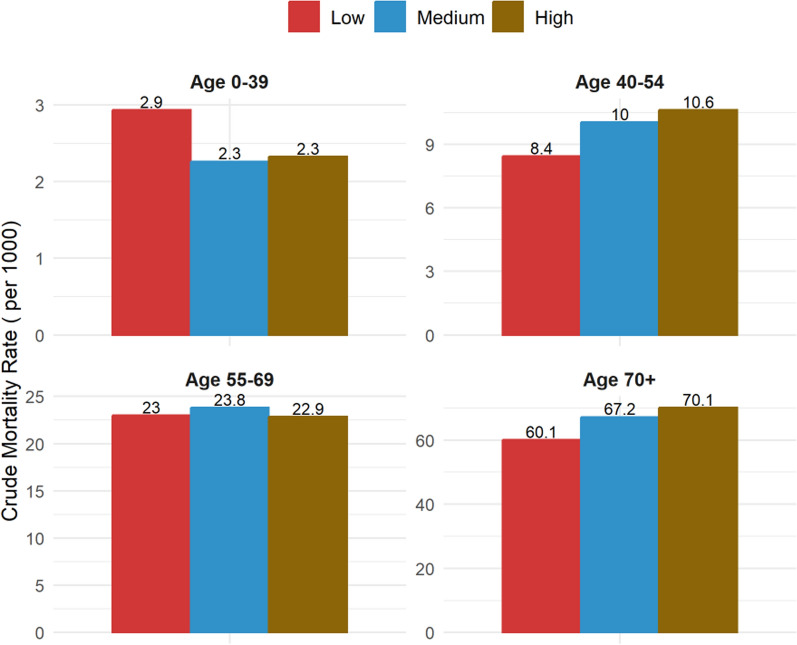 Figure 2
 Figure 3
Peer Reviews
No public reviews on file for this paper yet. If you reviewed it on a platform where reviews are public (OpenReview, ICLR, NeurIPS, ICML), you can paste yours below so the community can read it here.
Videos
No videos yet. Explain this paper in a talk, walkthrough, or lecture? Add one.
Taxonomy
TopicsCOVID-19 epidemiological studies · COVID-19 and Mental Health · Health disparities and outcomes