A rare case of atypical teratoid rhabdoid tumor (AT/RT) with homozygous SMARCB1 loss and one concurrent somatic heterozygous SMARCA4 variant
Ylvi Müller, Sebastian Bühner, Victoria Fincke, Katrin Mauch-Mücke, Markus J. Riemenschneider, Selma Manea, Friederike Liesche-Starnecker, Martin Hasselblatt, Sonja Dahlum, Matej Boros, Reiner Siebert, Michael C. Frühwald, Pascal Johann

TL;DR
A rare case of a brain tumor in a young child shows genetic changes in both SMARCB1 and SMARCA4 genes, monitored using a non-invasive liquid biopsy technique.
Contribution
First reported case of AT/RT with concurrent SMARCB1 homozygous loss and SMARCA4 somatic variant, using liquid biopsy for monitoring.
Findings
A three-year-old patient had AT/RT with biallelic SMARCB1 alterations and a heterozygous SMARCA4 variant.
Liquid biopsy was successfully used to track disease progression and relapse in this patient.
The combination of mutations in both SMARCB1 and SMARCA4 may influence tumor biology and clinical outcomes.
Abstract
Atypical teratoid rhabdoid tumors (AT/RT) are characterized by a poor prognosis and a manifestation within the first 2 years of life. Genetic hallmark of these tumors is the homozygous inactivation of SMARCB1 or, in some rare cases, of SMARCA4. While heterozygous pathogenic variants of SMARCA4 have been described, inter alia, in the context of other CNS malignancies such as medulloblastoma or glioblastoma, the co-occurrence of pathogenic variants in both, SMARCB1 and SMARCA4, in the same AT/RT has to our knowledge not been reported previously. Liquid biopsy, a rapidly developing and promising technique measuring cell-free DNA (cfDNA) in body fluids such as the cerebrospinal fluid (CSF), offers a minimally invasive method to assess disease status. It has yet to be established as a standard procedure in the diagnostic workup of CNS tumors. We present the case of a three-year-old male…
Genes, proteins, chemicals, diseases, species, mutations and cell lines named across the full text — each resolved to its canonical identifier and authoritative record.
Click any figure to enlarge with its caption.
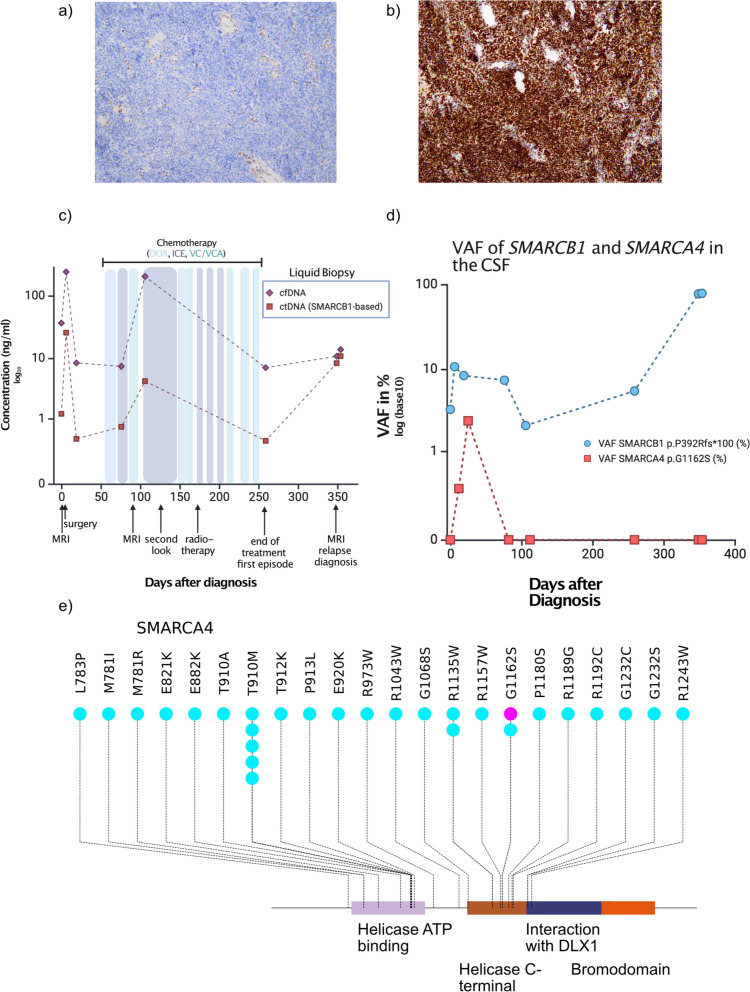 Figure 1
Peer Reviews
No public reviews on file for this paper yet. If you reviewed it on a platform where reviews are public (OpenReview, ICLR, NeurIPS, ICML), you can paste yours below so the community can read it here.
Videos
No videos yet. Explain this paper in a talk, walkthrough, or lecture? Add one.
Taxonomy
TopicsChromatin Remodeling and Cancer · Genomics and Chromatin Dynamics · RNA regulation and disease