Rational Design of Zwitterionic Polymers with Tunable Phase Separation Propensity
Timo N. Schneider, Suiying Ye, Nicola Carrara, Umberto Capasso Palmiero, Matteo Salvalaglio, Paolo Arosio

TL;DR
This paper introduces a method to design zwitterionic polymers that can form coacervates with predictable phase separation behavior for biomedical applications.
Contribution
A workflow combining simulations, theory, and experiments to predict and design zwitterionic polymer phase separation.
Findings
The workflow accurately predicts phase separation types in zwitterionic polymers.
Molecular simulations reveal how functional groups influence homotypic interactions and phase behavior.
Synthesized polymers validated the predictive power of the simulation-based approach.
Abstract
Zwitterionic polymers are emerging as promising candidates for forming fluid-like coacervates with desirable characteristics, including antifouling capabilities, stimulus responsiveness, and biocompatibility. These attributes make them particularly appealing for applications in the biomedical field, including bioseparation, biochemical analysis, and diagnostics. However, there are currently no clear guiding principles for predicting the phase separation behavior of zwitterionic polymers and informing the design of novel phase-separating polymers. In this study, we develop a workflow that combines molecular dynamics simulations, theory, and experiments to predict the phase separation propensity of zwitterionic polymers, as well as the material properties of the resulting coacervates. We validate our simulation-based workflow as a predictive tool by synthesizing new zwitterionic polymers…
Genes, proteins, chemicals, diseases, species, mutations and cell lines named across the full text — each resolved to its canonical identifier and authoritative record.
Click any figure to enlarge with its caption.
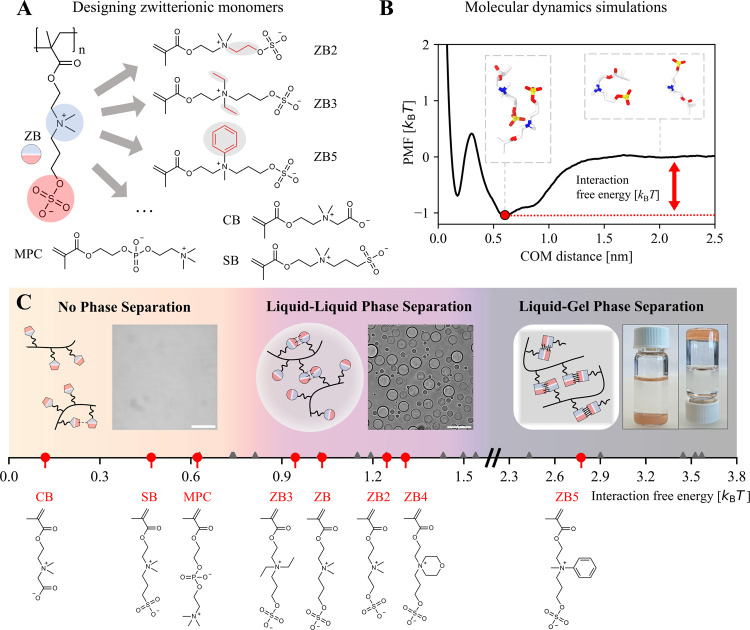 Figure 1
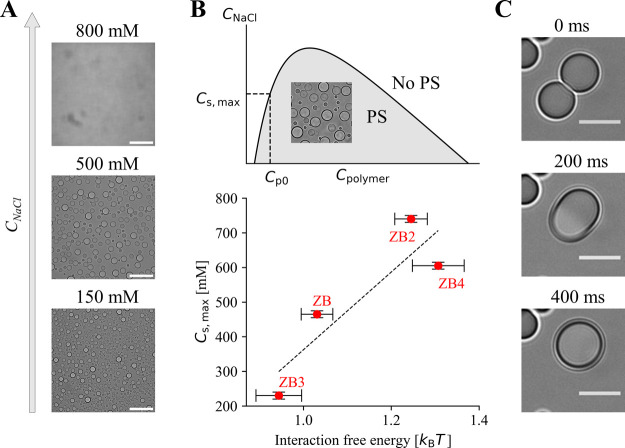 Figure 2
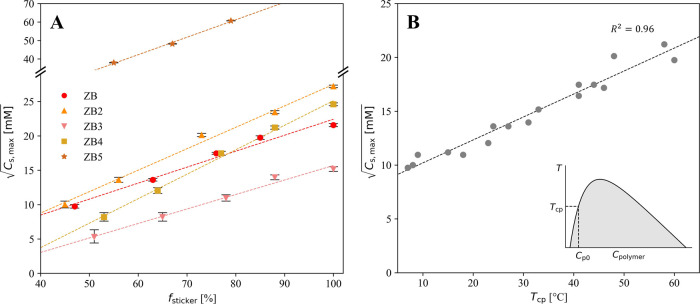 Figure 3
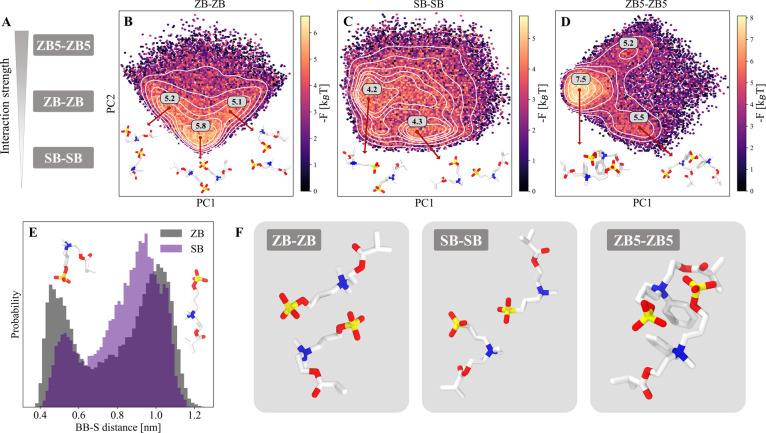 Figure 4
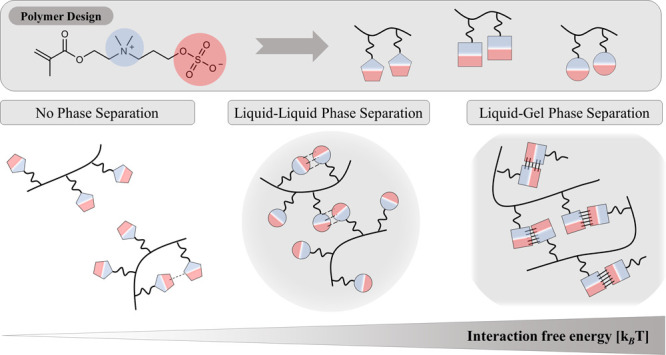 Figure 5
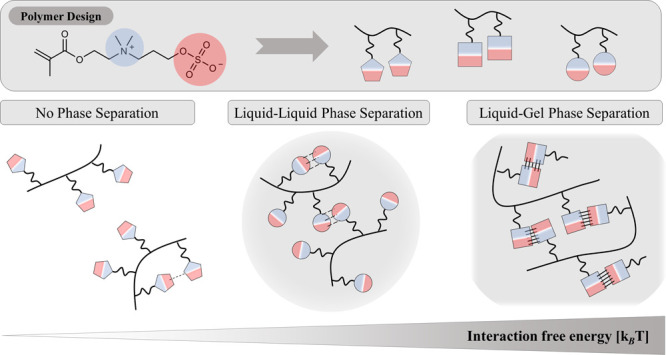 Figure 6
 Figure 7
 Figure 8
 Figure 9
 Figure 10
Peer Reviews
No public reviews on file for this paper yet. If you reviewed it on a platform where reviews are public (OpenReview, ICLR, NeurIPS, ICML), you can paste yours below so the community can read it here.
Videos
No videos yet. Explain this paper in a talk, walkthrough, or lecture? Add one.
Taxonomy
TopicsBlock Copolymer Self-Assembly · Synthesis and properties of polymers · Dielectric materials and actuators