Thiadiazolobenzotriazole-Based Donor–Acceptor Terpolymers That Can Be Processed from Green Solvents and Deliver 950 nm Emission in Light-Emitting Electrochemical Cells
Shi Tang, Tadele T. Filate, Zewdneh Genene, Krzysztof Kotewicz, Leandro R. Franco, Qiaonan Chen, Christian Larsen, Wendimagegn Mammo, Ergang Wang, Ludvig Edman

TL;DR
Scientists created new polymer materials that emit light at 950 nm using eco-friendly solvents, which could be useful for various applications.
Contribution
The novel contribution is the design of terpolymers with 950 nm emission processed from green solvents.
Findings
The terpolymers emit light at 935 nm and 950 nm in devices.
They are processed from a water:ethanol solvent blend.
The devices show fast turn-on and low voltage operation.
Abstract
Organic semiconductors that deliver emission with a wavelength exceeding 900 nm can enable a wide range of applications, but the unfortunate fact is that only a small number of such emitters have been synthesized and have demonstrated emissive function in devices. Here, this issue is addressed through the design and synthesis of two terpolymers that comprise a low energy-gap thiophene-thiadiazolobenzotriazole (TBTzTD) donor–acceptor unit as the minority guest incorporated in a majority donor–acceptor conjugated copolymer host, being either thiophene-quinoxaline (TQ) or thiophene-difluoroquinoxaline (TQ2F). These terpolymers are further endowed with high solubility in benign hydrophilic solvents through the grafting of branched oligo(ethylene glycol) side chains onto the quinoxaline unit. The application function of the terpolymer emitters is demonstrated through their implementation in…
Genes, proteins, chemicals, diseases, species, mutations and cell lines named across the full text — each resolved to its canonical identifier and authoritative record.
Click any figure to enlarge with its caption.
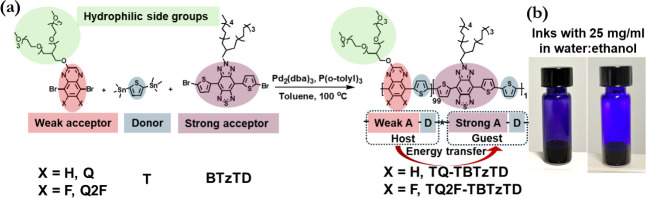 Figure 1
 Figure 2
 Figure 3
 Figure 4
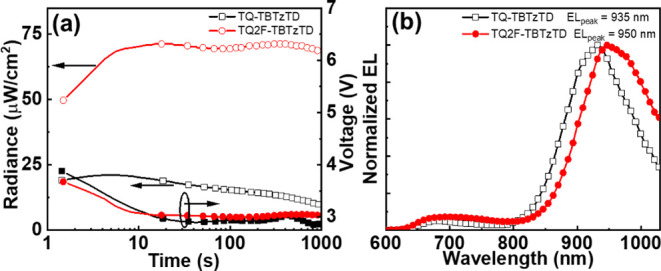 Figure 5
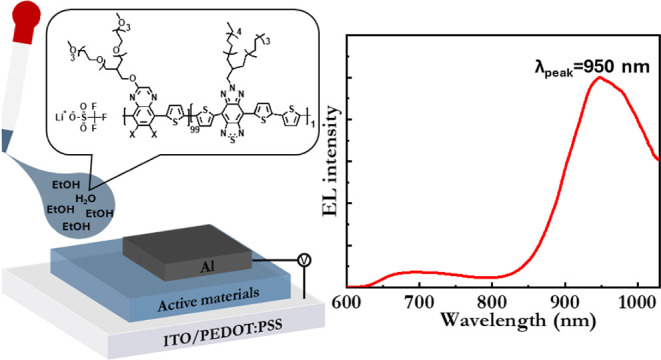 Figure 6
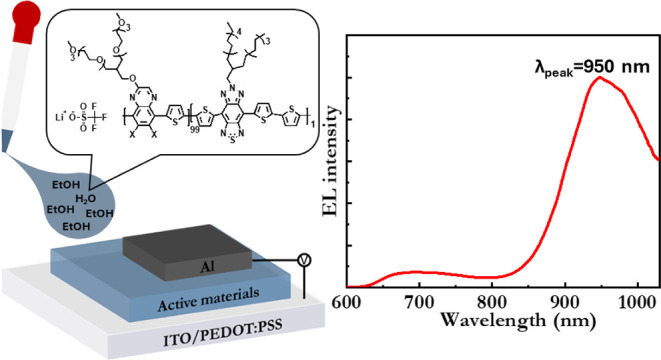 Figure 7
 Figure 8
 Figure 9
Peer Reviews
No public reviews on file for this paper yet. If you reviewed it on a platform where reviews are public (OpenReview, ICLR, NeurIPS, ICML), you can paste yours below so the community can read it here.
Videos
No videos yet. Explain this paper in a talk, walkthrough, or lecture? Add one.
Taxonomy
TopicsOrganic Electronics and Photovoltaics · Conducting polymers and applications · Organic Light-Emitting Diodes Research