NN-VRCTST: Neural Network Potentials Meet Variable Reaction Coordinate Transition State Theory for the Rate Constant Determination of Barrierless Reactions
Simone Vari, Carlo de Falco, Carlo Cavallotti

TL;DR
This paper introduces a new method called NN-VRCTST that uses neural networks to speed up the calculation of reaction rates for barrierless chemical reactions.
Contribution
The novel approach combines neural network potentials with variable reaction coordinate transition state theory to reduce computational costs.
Findings
NN-VRCTST achieves accuracy within 20% of traditional VRC-TST simulations.
The method reduces the number of single-point energy evaluations by at least a factor of 4.
ANN training and VRC-TST calculations can be decoupled for better optimization and data quality inspection.
Abstract
The determination of rate constants for barrierless reactions poses severe problems from a theoretical perspective. The main challenges concern the proper description of the electronic structure of the reacting system, which may have multireference character, the anharmonicity of the relative motions of the fragments, and the proper definition of the reaction coordinate. The literature state of the art in the context of transition state theory is its variable reaction coordinate implementation (VRC-TST), which overcomes these difficulties in determining the number of transition state ro-vibrational states through a Monte Carlo sampling of the potential energy surface (PES) defined by the relative orientation of the two fragments. Although approaching the accuracy of experiments, VRC-TST requires tens of thousands of single-point energy (SPE) evaluations, thus being computationally…
Genes, proteins, chemicals, diseases, species, mutations and cell lines named across the full text — each resolved to its canonical identifier and authoritative record.
Click any figure to enlarge with its caption.
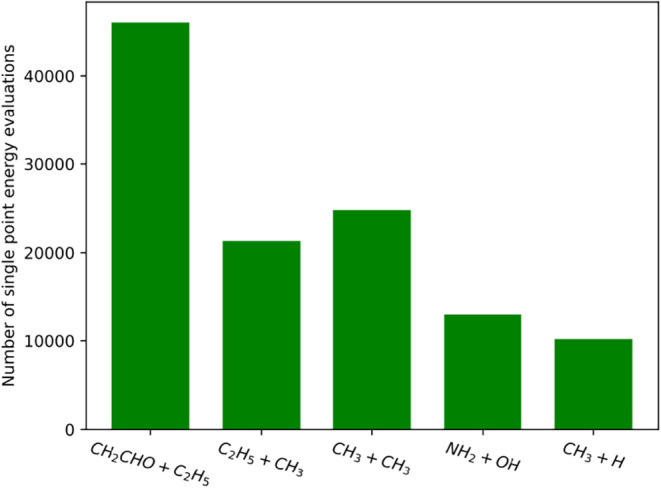 Figure 1
 Figure 2
 Figure 3
 Figure 4
 Figure 5
 Figure 6
 Figure 7
 Figure 8
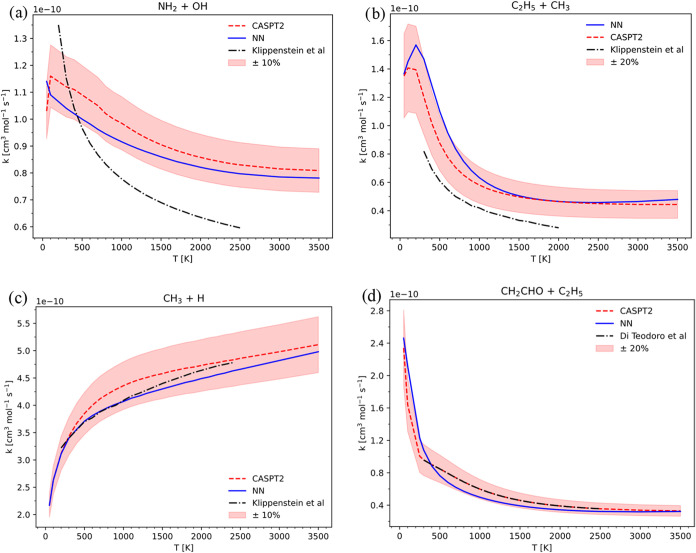 Figure 9
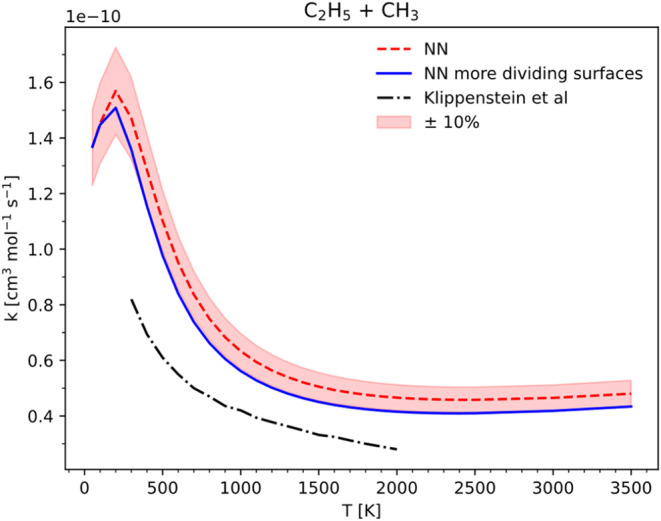 Figure 10
 Figure 11
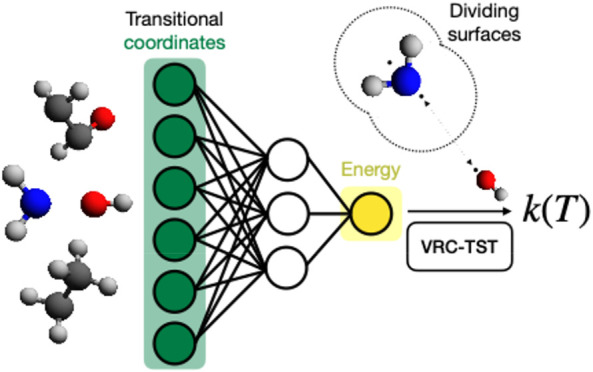 Figure 12
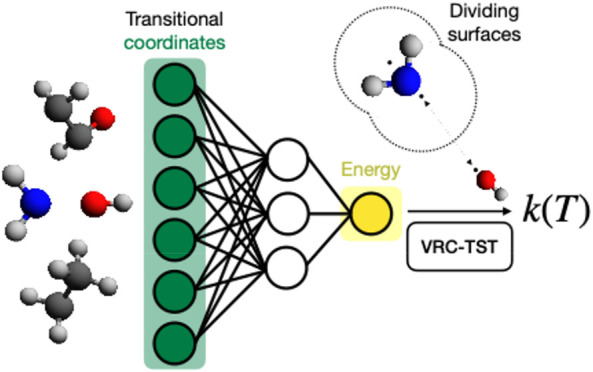 Figure 13
 Figure 14
 Figure 15
 Figure 16
 Figure 17
 Figure 18
 Figure 19
Peer Reviews
No public reviews on file for this paper yet. If you reviewed it on a platform where reviews are public (OpenReview, ICLR, NeurIPS, ICML), you can paste yours below so the community can read it here.
Videos
No videos yet. Explain this paper in a talk, walkthrough, or lecture? Add one.
Taxonomy
TopicsMachine Learning in Materials Science · Computational Drug Discovery Methods · Catalysis and Oxidation Reactions