Circulating Elabela-21 and Elabela-11 levels as predictive biomarkers in individuals with recently developed type 2 diabetes
Abdullah Abbas Hamzah Al-Rubaye, Walaa Esmail Jasim, Ahmed A Mohsin

TL;DR
This study shows that Elabela-21 and Elabela-11 levels increase in people with type 2 diabetes and prediabetes, suggesting they could be useful as early biomarkers.
Contribution
The study identifies Elabela-21 and Elabela-11 as potential predictive biomarkers for recently developed type 2 diabetes.
Findings
Elabela-21 and Elabela-11 levels were significantly higher in T2DM and prediabetic individuals compared to healthy controls.
The levels of Elabela-21 and Elabela-11 positively correlate with BMI, glycemic, and lipid profiles but negatively with HDL.
The increase in Elabela levels progresses from prediabetes to T2DM, indicating a potential role in disease progression.
Abstract
Type 2 diabetes mellitus (T2DM) is significantly influenced by the Elabela hormone, Elabela has been discovered to be a new endogenous apelin receptor (APJ) ligand. To detect the potential changes of Elabela-21 and Elabela-11 levels in recently developed T2DM. A recent cross-sectional study with 180 participants was conducted. The participants were divided into three groups based on WHO classifications: T2DM patients, prediabetic cases, and healthy controls. Five milliliters of blood samples were collected in the morning during 9-12 hours of fasting. Tests were carried out for each patient and control involving glucose and lipid profile using the enzymatic methods by a biochemical auto-analyzer, glycated hemoglobin using the ion exchange high-performance liquid chromatography (HPLC), Elabela-21, and Elabela-11 using an ELISA technique. Serum Elabela-21 level in T2DM patients was…
Genes, proteins, chemicals, diseases, species, mutations and cell lines named across the full text — each resolved to its canonical identifier and authoritative record.
Click any figure to enlarge with its caption.
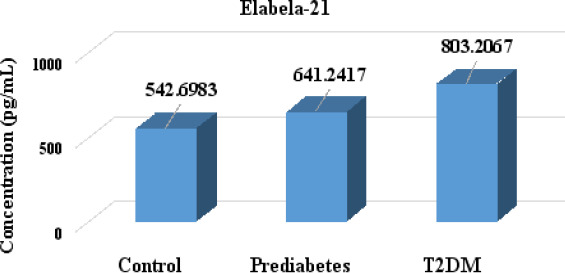 Figure 1
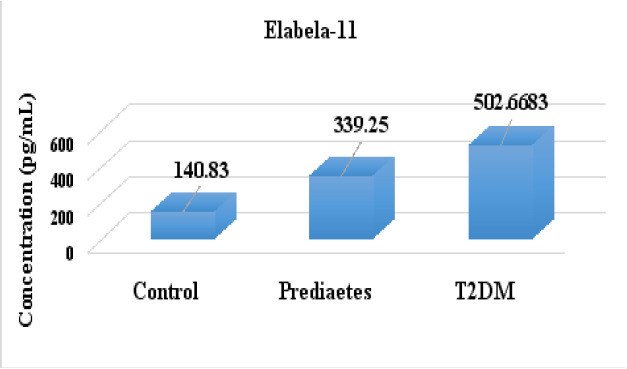 Figure 2
Peer Reviews
No public reviews on file for this paper yet. If you reviewed it on a platform where reviews are public (OpenReview, ICLR, NeurIPS, ICML), you can paste yours below so the community can read it here.
Videos
No videos yet. Explain this paper in a talk, walkthrough, or lecture? Add one.
Taxonomy
TopicsApelin-related biomedical research · Lipid metabolism and disorders · Cardiovascular, Neuropeptides, and Oxidative Stress Research