Deceleration Capacity as a Marker of Autonomic Cardiac Modulation in Prodromal and Manifest Parkinson's Disease, Multiple System Atrophy, and Progressive Supranuclear Palsy
Elisabeth Ruppert, Nuria Mix, Karl Kesper, Axel Bauer, David Vadasz, Vincent Ries, Elisabeth Sittig, Ulrich Koehler, Annette Janzen, Wolfgang H. Oertel

TL;DR
This study explores how heart rate variability, especially deceleration capacity, can help distinguish between different types of Parkinsonian diseases and their early stages.
Contribution
The study reveals that deceleration capacity is significantly reduced in PSP, a novel finding for this condition.
Findings
Deceleration capacity was significantly lower in MSA and PSP compared to healthy controls and PD.
HRV index was reduced in PSP, indicating overall impaired cardiac autonomic adaptability.
Deceleration capacity may help differentiate PD from atypical parkinsonian syndromes like MSA and PSP.
Abstract
Degenerative parkinsonian syndromes, including the alpha‐synucleinopathies (aSYN) Parkinson's disease (PD), and multiple system atrophy (MSA), and the tauopathy progressive supranuclear palsy (PSP), are characterized by motor and non‐motor symptoms. The later subsume autonomic dysfunction, which may appear early or progress with the disease. Cardiac dysfunction varies by syndrome and can also occur in isolated REM sleep behavior disorder (iRBD), a prodromal stage of aSYN. Overlapping motor features make early differentiation challenging. Heart rate variability (HRV) analysis is a noninvasive tool for evaluating cardiac autonomic function, with deceleration capacity (DC) as a sensitive parasympathetic marker. This study compares HRV and DC across parkinsonian syndromes to assess their potential in early diagnosis and differentiation. Using standardized 30‐min resting ECG recordings in…
Genes, proteins, chemicals, diseases, species, mutations and cell lines named across the full text — each resolved to its canonical identifier and authoritative record.
Click any figure to enlarge with its caption.
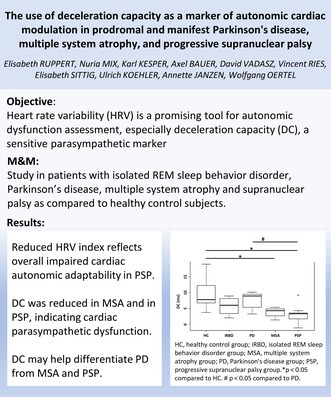 Figure 1
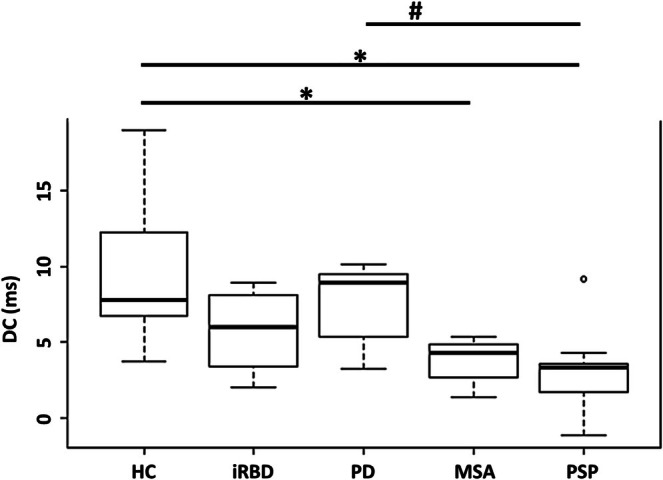 Figure 2
Peer Reviews
No public reviews on file for this paper yet. If you reviewed it on a platform where reviews are public (OpenReview, ICLR, NeurIPS, ICML), you can paste yours below so the community can read it here.
Videos
No videos yet. Explain this paper in a talk, walkthrough, or lecture? Add one.
Taxonomy
TopicsParkinson's Disease Mechanisms and Treatments · Cardiac electrophysiology and arrhythmias · Neurological disorders and treatments