Reproductive politics and women's empowerment; how does geopolitics control women?
Gayathri Delanerolle, Sohier Elneil, Abirame Sivakumar, Om Kurmi, Vindya Pathiraja, David Ikwuka, Nhan Thi Nguyen, Nirmala Rathnayake, Peter Phiri, George Uchenna Eleje

TL;DR
This paper explores how geopolitical forces influence women's reproductive rights and autonomy through laws, policies, and cultural norms.
Contribution
The paper highlights the historical and ongoing impact of geopolitical control on women's reproductive justice and gender equality.
Findings
Colonialism and population control initiatives have marginalized women in the Global South.
Pronatalist and antinatalist policies, like China's One-Child Policy, have led to coercive interventions.
Reproductive politics shape gender roles and state-controlled family structures globally.
Abstract
Reproductive politics lie at the intersection of gender, power, and governance, shaping women's autonomy through laws, policies, and cultural norms. Historically, colonialism and population control initiatives marginalized women, particularly in the Global South, fostering distrust in healthcare systems. Feminist movements advocate for reproductive justice, yet economic and nationalistic interests continue to influence access to care. Governments regulate reproduction to control demographics, labor markets, and national power. Pronatalist and antinatalist policies, such as China's One-Child Policy, have led to coercive interventions, disproportionately affecting marginalized communities. Reproductive politics also shape masculinity, fatherhood, and state-controlled family structures. Global reproductive policies reflect ideological struggles, from restrictive abortion laws in Poland and…
Genes, proteins, chemicals, diseases, species, mutations and cell lines named across the full text — each resolved to its canonical identifier and authoritative record.
Click any figure to enlarge with its caption.
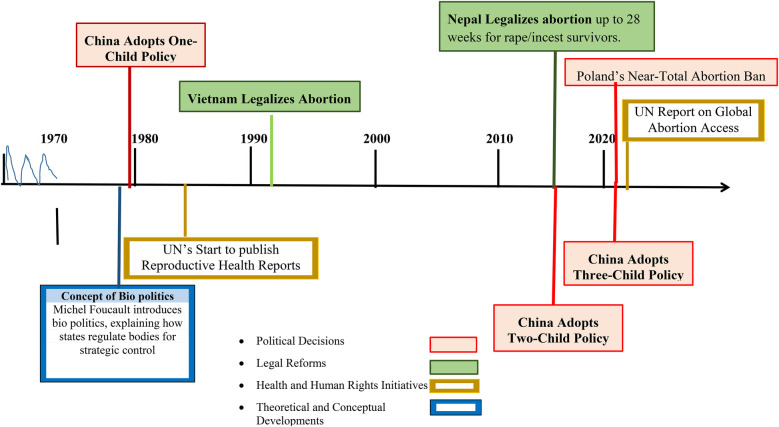 Figure 1
Peer Reviews
No public reviews on file for this paper yet. If you reviewed it on a platform where reviews are public (OpenReview, ICLR, NeurIPS, ICML), you can paste yours below so the community can read it here.
Videos
No videos yet. Explain this paper in a talk, walkthrough, or lecture? Add one.
Taxonomy
TopicsDemographic Trends and Gender Preferences