Pharmacologic Profile of A2A Adenosine Receptors: Identifying Patients with Intermittent Claudication and Associated Myocardial Ischemia
Pierre Deharo, Julien Fromonot, Soumeya Aliouane, Marion Marlinge, Bouchra Talbi, Nathalie Kipson, Tristan Werquin, Julia Dodivers, Thomas Cuisset, Marine Gaudry, Régis Guieu, Franck Paganelli

TL;DR
This study explores how adenosine A2A receptor profiles in blood cells can help identify patients with leg artery disease who also have heart artery blockages.
Contribution
The study introduces a novel pharmacologic profile of A2A adenosine receptors to detect obstructive coronary artery disease in peripheral artery disease patients.
Findings
A2AR expression and EC50 were lower in patients with positive FFR, indicating obstructive CAD.
The A2AR profile may serve as a biomarker for identifying CAD in LE-PAD patients.
Patients with LE-PAD and positive FFR showed distinct A2AR characteristics compared to those with negative FFR.
Abstract
Low-extremity peripheral artery disease (LE-PAD) is often associated with coronary artery disease (CAD). Development of biomarkers is needed to identify those among LE-PAD patients who have associated CAD. The pharmacologic profile of adenosine A2A receptors (A2AR; expression, cyclic adenosine monophosphate [cAMP] production, half maximal effective concentration [EC50]) evaluated on peripheral blood mononuclear cells is useful because these parameters are modified during myocardial ischemia. A total of 127 patients were included; 75 with CAD had a positive flow-fraction-reserve (FFR) but no intermittent claudication. Among those with LE-PAD, 27 had a positive FFR, and 25 had a negative FFR. The A2AR expression and EC50 were lower in patients with a positive FFR vs a negative FFR. Obstructive CAD might be detected by measuring the adenosine A2AR profile.
Genes, proteins, chemicals, diseases, species, mutations and cell lines named across the full text — each resolved to its canonical identifier and authoritative record.
Click any figure to enlarge with its caption.
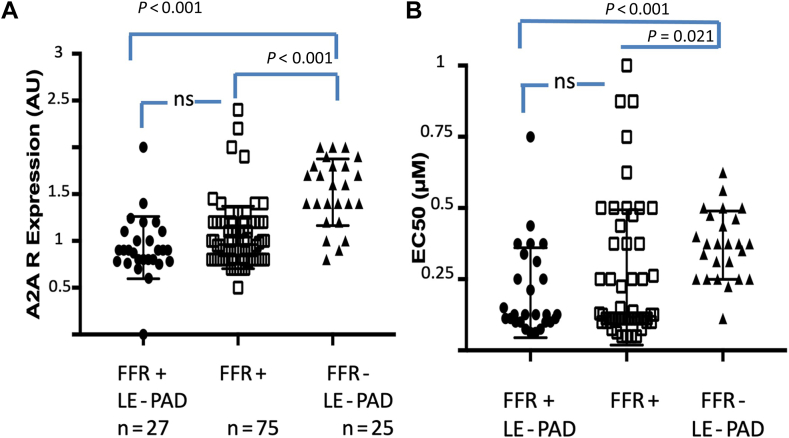 Figure 1
Peer Reviews
No public reviews on file for this paper yet. If you reviewed it on a platform where reviews are public (OpenReview, ICLR, NeurIPS, ICML), you can paste yours below so the community can read it here.
Videos
No videos yet. Explain this paper in a talk, walkthrough, or lecture? Add one.
Taxonomy
TopicsCardiac, Anesthesia and Surgical Outcomes · Pain Management and Treatment · Antiplatelet Therapy and Cardiovascular Diseases